
Teeth of Dahlver-Nar
Set of magical teeth that grant powers once set in the user's own jaw.
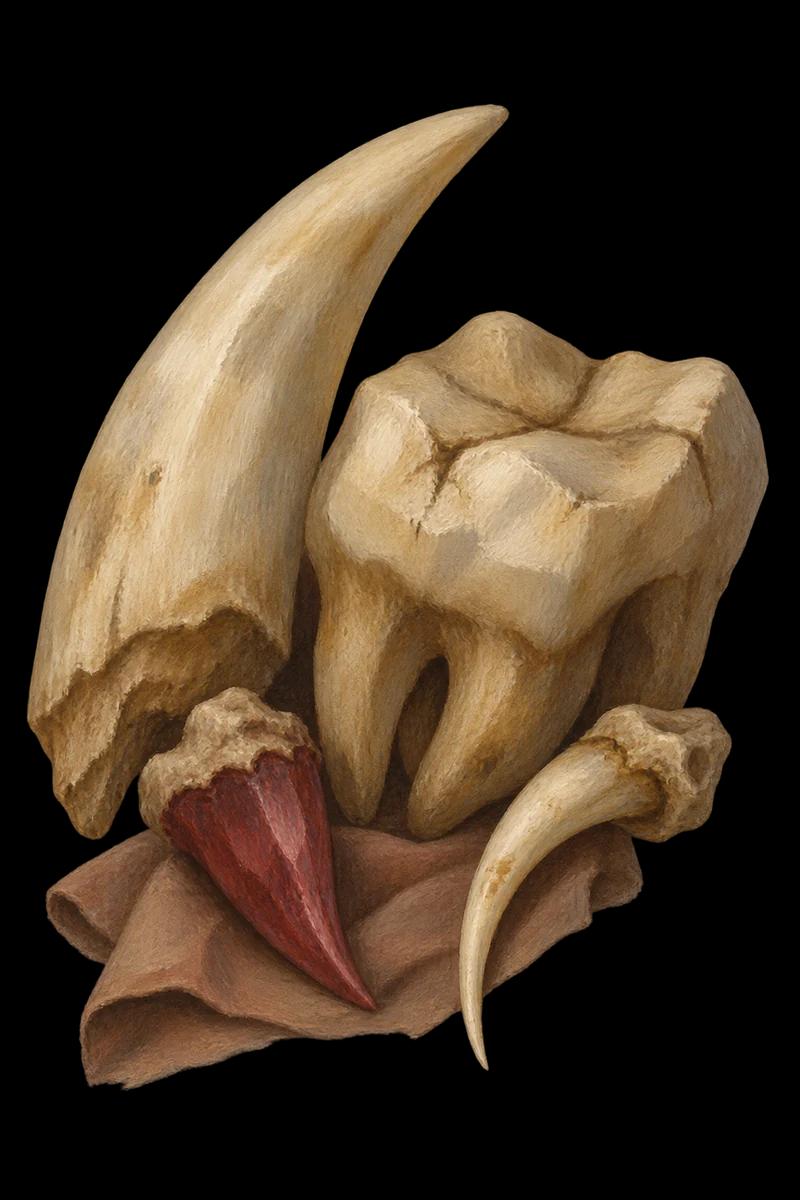
The Teeth of Dahlver-Nar are a scattered set of more than thirty teeth tied to the priest Dahlver-Nar. To use one, a person pulls out a tooth of their own and puts the magic tooth in its place. Each tooth carries the power of a strange, forgotten being, among them a ruby fang of Acererak.
At a glance
- Type
- Set of artifacts
- Number
- Usually given as 32; at least 35 are known
- Associated with
- The priest Dahlver-Nar
- Use
- Replaces one of the user's own teeth
- Current location
- Scattered
- Status
- Each tooth with its own powers and dangers
Overview
The Teeth of Dahlver-Nar are a collection of teeth of every size and shape, linked to a priest of that name. Most tales speak of thirty-two, but at least thirty-five are known. Their magic works only from inside a mouth: whoever wants a tooth's power must pull out one of their own teeth and set the artifact in the gap. Each tooth then shrinks or grows to fit the jaw – though only just. Each one is bound to a vestige, a fallen or forgotten being, and looks like it: a ruby fang for Acererak, a huge tusk, a molar the size of a dwarf's fist, a long snake fang.
Legends
The story of the teeth changes with the teller. The oldest version says they were the actual teeth of Dahlver-Nar himself. Another holds that they came from a red dragon called Incendax and that Dahlver-Nar merely found them. Later bards wove both into a third tale, linking the priest and his teeth to binders – those who make pacts with vestiges. Not every tooth is a blessing: one, sealed away in a temple of Heironeous, lets its bearer walk on water while slowly turning them into an ordinary fish.
At the table
- A single tooth makes a memorable, unsettling treasure: who in the party is willing to pull a tooth to try it?
- A collector or binder hunts the full set and will pay – or kill – for every piece.
- The vestige behind a tooth may begin to speak to its wearer, offering more power for a price.
In the timeline0
Only mentioned in passing.