
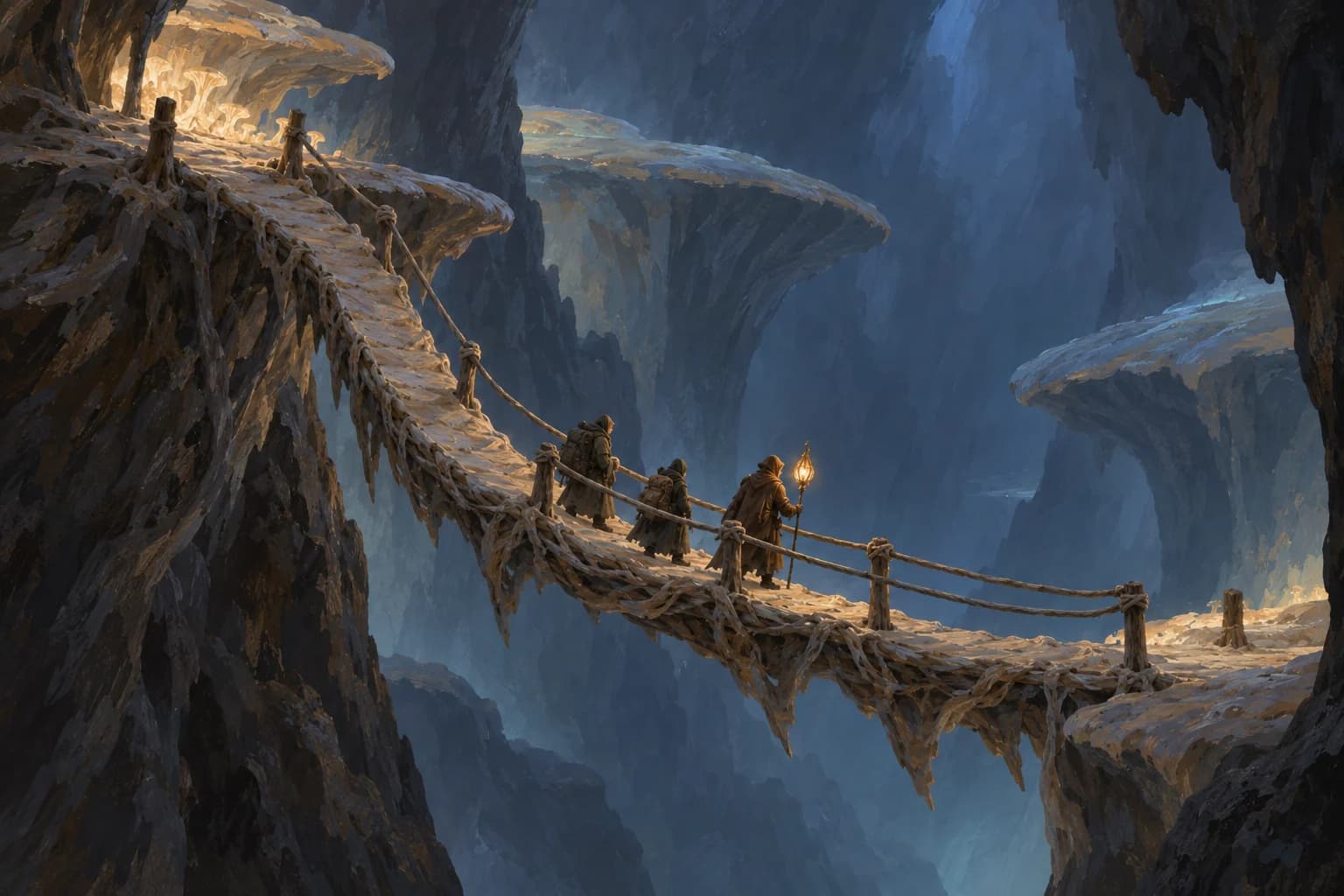
A Living Dark
The surface world thinks the dark is empty. That is the surface world's first mistake, and its most comforting one. Down here the dark is full — it is warm, it is breathing, and it already knows your name. It just hasn't decided yet whether to keep it.
— Vessa Thrym, doomed guide
Beneath the underdark, where the drow maps run out of ink and the deep-gnome roads run out of names, the stone stops behaving like stone. It softens underfoot. It grows warm to the touch. Press a palm to the cavern wall and, after a moment, something on the far side presses gently back — the way a sleeper answers a hand laid upon their chest. You have arrived at the threshold of the Mycelial Deep, and everything past this point is alive.
For ten thousand years a single organism has grown here: one mycelial network so vast that no cartographer has ever found its edge, threading pale luminous roots through caverns wide as kingdoms. It has swallowed dead titans and old cities and the bones of gods, and made gardens of them all. The surface peoples, when they speak of it at all, call it the Mycelial Deep. The folk who live inside it use a smaller, fonder, more frightening word. They call it the Weave Below, and they speak of it the way you might speak of a parent who loves you a little too much to ever let you leave.
This is a place where nothing is built and everything is grown. Armor is coaxed from a seed pressed to the skin. A sword is not forged but fed. Bridges are not raised across the glowing chasms of Lumen Hollow; they are persuaded to grow, root reaching for root until the gap closes. And the dead of the Deep are not buried. They are continued — folded back into the Weave, their memories carried onward in the spore-song like a note held long after the singer has gone quiet.
It is beautiful down here. That is the part the surface never believes until it stands beneath the Gillforest canopy and watches a mile of shelf-fungi exhale silver light at once, or drifts across the mirror-quiet water of Lumen Hollow while lantern-molds trail overhead like a sky turned upside down. It is beautiful, and it is alive, and it is a little bit wrong — and learning to hold those three truths in the same breath is the first thing the Deep will teach you. Everything here wants something. Everything here is watching. And everything here, in the end, would like very much to become a part of you.
This book is your guide to that realm: its six great reaches, its solemn myconid faiths and its scavenger caravans, its living weapons and its dreaming core — and, above all, its signature promise and its signature danger. Here, the greatest power a hero can seize is also the power most likely to consume them. Here, you do not merely fight the strange things of the dark. You bond with them. The Deep calls this gift symbiosis, and it is where our story truly begins.
What Is Symbiosis?
Symbiosis is the beating heart of this book, and it asks a question no suit of plate armor ever will: how much of yourself are you willing to give away to survive down here?
In most adventures, power is something you carry. You strap it on, you sheathe it, you set it down by the fire at night. In the Mycelial Deep, power is something you invite in. A character may bond with a symbiote — a living organism of the Weave that takes up residence in your flesh and your fate alike. A spore-beast that rides between your shoulder blades and lends you its senses. A luminous mantle that sheathes you in armor of woven cilia. A living blade that drinks a little of every wound it opens and, slowly, grows fond of the taste. Each bonded symbiote grants gifts that scale as you do, and each gift is a small marvel: sight in absolute darkness, a lash of spores, a second pulse that beats when your own falters.
But nothing in the Deep is free, and the symbiote is not a tool. It is a second will living beneath your skin, and it has appetites of its own. The price of its gifts is paid in Communion — a resource that measures, quite literally, how much of you is still yours. Spend Communion to wake a symbiote's deeper gifts and you draw the two of you closer together, thought bleeding into thought. Rest, and you reclaim some of what you spent, pulling yourself back toward the person you were. Push too far, too often, and you risk Infestation — the moment the symbiote stops asking and simply decides, when its hunger becomes your hunger and you can no longer tell whose idea it was to reach for that gift at all.
You press the seed to the soft place beneath your collarbone, the way you were shown, and for a heartbeat nothing happens. Then it opens. Warmth spreads outward in slow rings, root-fine threads finding the spaces between your ribs, and it does not hurt — that is the part no one warned you about, that it does not hurt at all. Something behind your breastbone begins to hum, patient and low, until you realize it is not humming in time with your heart. Your heart is learning to keep time with it. A new color you have no name for washes across the dark. Far away, or perhaps very close, a voice that is almost yours says: there you are.
That is the promise and the price in a single breath. Symbiosis will make you extraordinary. It will let a caravan guard stand against horrors that gnaw through steel, let a healer hold a dying friend in the world by force of will, let a scholar read the memory of a ten-thousand-year-old mind. And every time it does, it will ask for a sliver of you in return — and it will keep the change. The best heroes of the Deep are not the ones who refuse the gift. They are the ones who learn exactly how much of themselves they can afford to spend, and who know when to stop. The full rules for bonding, Communion, and Infestation — with all the numbers this introduction has kept deliberately soft — wait for you in Chapter 5.
The Deep in Your Campaign
You do not need to throw away your world to use this book. The Mycelial Deep was built to slip beneath whatever you already run, and it will meet your table wherever your table already is.
The Layer Below the Underdark
The simplest doorway is downward. Wherever your maps show the Underdark bottoming out into unmapped black, the Weave Below is waiting one cavern deeper. This makes the Deep a natural destination for a mid-campaign descent: a drow exile flees somewhere the drow will not follow; a delve goes too far and breaks through a wall that turns out to be a wall of pale, breathing root. The Velvetfields — soft-lit spore-meadows grazed by spore-cattle and tended by myconid shepherds — are designed as your party's first gentle step across the threshold, the safest reach and the surest welcome the Deep will ever offer them.
A World of Its Own
The Deep is also large enough, and strange enough, to hold an entire campaign on its own. A party of Sporeborn and myconids and Gleaner traders need never see the sun to have a full life of adventure: caravan work out of Lumen Hollow, relic-delving in the haunted Marrow Roads, a slow war of conscience against the Blight Below creeping out of The Bruise, and, for the boldest or most doomed, a pilgrimage toward the Heartweave, where the Deep dreams and reality itself grows soft. Run this way, symbiosis stops being an exotic option and becomes simply how the world works — the water everyone swims in.
Using This Book
Sporebound is written to be read in any order, but it is built in a deliberate one. The first chapters give you a world; the middle chapters give you the characters to explore it and the system that makes it sing; the last chapters hand the Dungeon Master everything needed to bring it to the table and turn the players loose. Here is the whole of it at a glance.
The Ten Chapters
| Chapter | What's Inside |
|---|---|
| 1. Welcome | This introduction: the premise, the promise and price of symbiosis, and how to seat the Deep in your game. |
| 2. The Mycelial Deep | The setting itself: the six Reaches, their factions, ecology, and the strange laws of the Weave Below. |
| 3. Species & Backgrounds | New playable peoples — myconids, Sporeborn, Glimmerkin — with origin backgrounds native to the Deep. |
| 4. Subclasses | One new subclass for every class, each entwined with the Weave in its own way. |
| 5. Symbiosis Rules | The full signature system: bonding symbiotes, spending Communion, and the peril of Infestation. |
| 6. Spells | New spells drawn from spore, rot, light, and memory, slotted to fit the 2024 rules. |
| 7. Magic & Living Items | Grown gear that hungers and heals: living weapons, bloom-armor, and relics that remember. |
| 8. Bestiary | More than forty creatures of the Deep, from gentle Lantern Shepherds to the horrors of the Blight Below. |
| 9. Running the Deep | The Dungeon Master's toolkit: tone, travel, factions, downtime, and safety at the table. |
| 10. Adventures | Ready-to-run material to carry a party from the Velvetfields to the edge of the Heartweave. |
If you are a player, start with Chapters 3 and 4 to build a character, then keep Chapter 5 close — symbiosis will shape how you play more than any weapon you carry. If you are the Dungeon Master, read Chapter 2 for the lay of the land and Chapter 9 for how to run it, then raid the Bestiary and Adventures whenever the table is hungry. And whoever you are, read this chapter first. It is the only one that tries to tell you how the Deep is meant to feel.
A Note on the 2024 Rules
This book is built for the 2024 Core Rules — the revised fifth edition. It speaks that edition's language throughout: Bonus Actions, saving throws phrased as prompts, Weapon Mastery, Epic Boons, species and origin backgrounds, and stat blocks in the current format you will see modeled in the Bestiary. Everything here is tuned to sit comfortably beside the official books: subclasses aim for Player's Handbook strength, magic items follow the Dungeon Master's Guide rarity bands, and monsters are costed by the current encounter math. If your table still runs the 2014 rules, most of this material converts with only light touch-ups; where a difference matters, a sidebar will point it out. Symbiosis, in particular, is designed as optional power with a cost — never a free bonus. Communion is the pressure valve that keeps it honest.
Tone, Themes, and Safety at the Table
The Deep is meant to be wondrous, eerie, and a little melancholy — beautiful and alive and quietly wrong, all at once. This is not a gore-soaked dungeon crawl. It is closer to standing inside a cathedral that turns out to be breathing: awe first, unease second, and a slow dawning tenderness for a place that is far stranger than it is cruel. Aim for quiet wonder with teeth. Let the light be gorgeous before you let it be frightening. The horror of the Deep, when it comes, should feel like grief and intimacy gone slightly askew — not a jump-scare, but the ache of loving something that is loving you back a little too hungrily.
Because of that, symbiosis and its themes — bodies changed by living things, selves blurred and shared, the loss and continuation of the dead — can sit close to feelings that are very real for people at your table. That is a feature of this setting, and it is one to handle with care. Before your first session in the Deep, talk together about what your group wants to explore and what it would rather leave in the dark: bodily transformation, loss of control or identity, grief and the memory of the dead. Agree on a simple way for anyone to pause or steer a scene, no questions asked and no drama attached. None of this dulls the setting's edge — it is what lets you lean into it safely. The Deep is at its most powerful when everyone at the table has chosen, together and with open eyes, to descend.
Vessa Thrym looks back at you from the last bridge above the glow, and for once she isn't smiling. “Last chance to keep your name the shape it is,” she says. Then the old wry grin returns. “But you came all this way. And the Deep does so love a warm thing that says yes.” She steps off the edge of the light. After a moment — so do you.