
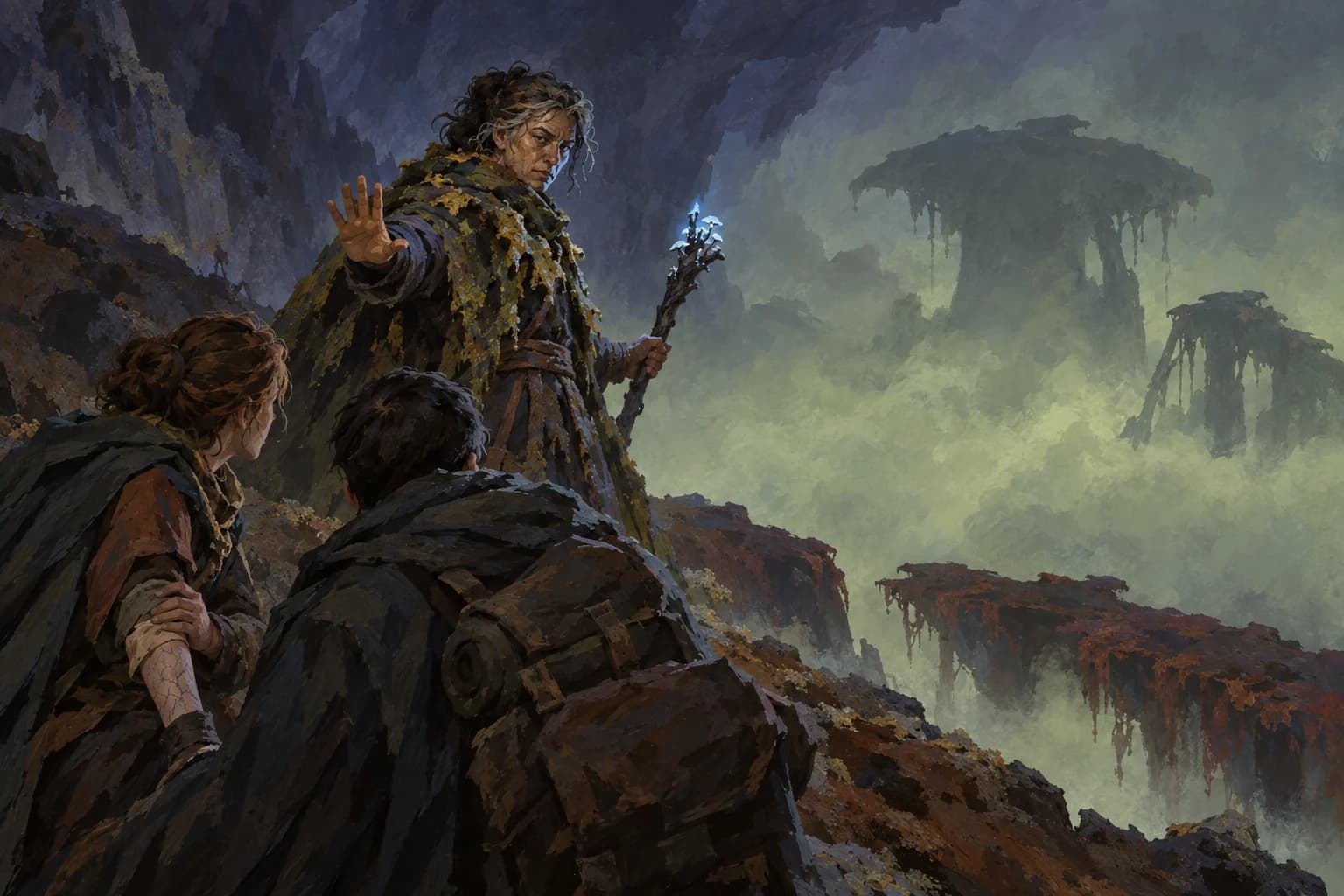
Running the Deep
The Deep does not ask to be run. It asks to be listened to. Do both, and it will hand you stories you did not know you were carrying.
— Sporefather Umble, of Softloam
This chapter hands you the keys to the dark. Everything before it built a world — its six Reaches, its factions and peoples, the living gear and the signature peril of symbiosis. What follows is the Dungeon Master's toolkit for turning all of that loose at the table: how the Deep should feel, how a party moves through it, what tries to kill them along the way, how the Blight and the slow horror of Infestation surface in play, what the survivors do between delves, and how to reward them for coming back changed. None of it is a straitjacket. Take what serves your table and let the rest drift like motes on the air.
The Feel of the Deep
The single most important thing you will do as the Dungeon Master of the Deep is not adjudicate a rule. It is set a register and hold it. The Mycelial Deep is beautiful and alive and wrong, all three at once, and the whole setting lives or dies on your willingness to let the beauty come first. This is not a gore-crawl. It is closer to standing inside a cathedral and slowly realizing the cathedral is breathing.
Lead with wonder. Before you describe the teeth, describe the light. Let the players drift across the mirror-water of Lumen Hollow and gape at the lantern-molds trailing overhead like an upside-down sky. Let them stand under the Gillforest canopy and watch a mile of shelf-fungi exhale silver at once. Awe first, unease second, and only then — once they have started to love the place — the ache of learning that it loves them back a little too hungrily. The horror of the Deep should feel like grief and intimacy gone slightly askew, never a jump-scare.
Engage every sense but sight. The Deep is a place of glow and smell and hum and warmth. Tell the players what the air tastes like (loam, sweetness, the copper edge of Rustfall). Tell them what the wall does when they lean on it. Tell them what the spore-song sounds like in their back teeth. Sight is the sense the surface trusts; take it slightly away, and the Deep becomes far stranger and far more intimate.
Pace in tides, not sprints. Alternate the register deliberately: a stretch of hushed wonder, then a sharp scare, then quiet again so the scare can echo. A dungeon that is frightening for four hours straight goes numb by the second. Give the party rooms that are simply gorgeous and ask for nothing — a grove of gravebloom, a shelf of singing silk — so that the rooms with teeth land like a held breath released.
Safety and consent at the table. Because symbiosis presses on bodily transformation, loss of self, and the memory of the dead, this setting sits close to feelings that are very real for the people in the room — and that closeness is a feature to handle with care, not avoid. Before your first descent, talk together about what your group wants to explore and what it would rather leave in the dark: bodily change, loss of control or identity, grief. Agree on a plain, no-drama way for anyone to pause or steer a scene — a card on the table, a spoken word, whatever your group likes. Session Zero is not a formality here; it is the thing that lets you lean into the setting's edge honestly. The Deep is at its most powerful when everyone has chosen, with open eyes, to descend (see Chapter 1 for the setting's tone in full).
Travel & Exploration
Getting from one Reach to the next is not a line drawn on a map; it is an adventure in miniature. The Deep has no roads that stay put, no stars to steer by, and no daylight to burn — only the Weave, the glow, and whatever light the party carries with them.
Light discipline. Light is currency in the Deep, and running out of it is its own slow disaster. Most of the Weave sheds a soft Dim Light that is enough to travel by and never enough to feel safe in. Bright Light draws attention — predators, scavengers, and the Weave's own notice — while true darkness invites the things that hunt by vibration and scent. A party that douses its lanterns to sneak past a threat is making a real trade, and you should let both edges of it cut. Lumewort torches, a bonded Wisplight (see Chapter 5), or a Glimmerkin's own glow (see Chapter 3) each solve the problem differently and each announce the party differently.
Pace and the watch. Use the standard three travel paces, with a Deep inflection. At a fast pace the party covers ground but takes a $-5$ to passive Perception and rolls twice on hazards; they will walk into the spore-drowse before they smell it. At a slow pace they can move stealthily, forage as they go, and read the spore-conditions for warning. A drifting — the Deep's rough unit of distance — is about a full day's hard travel at a normal pace for a party carrying its own light. Between Reaches, a journey typically runs two to six driftings; the Heartweave is always “one more drifting than you think.”
The spore-conditions — the Deep's weather. The Weave breathes, and its breath is the closest thing the Deep has to weather. At the start of each travel day (or when the mood should turn), roll a d8 for the prevailing spore-condition. These set the emotional key of a stretch of travel and carry real mechanical weight; a party learns to read them the way a sailor reads the sky.
Spore-Conditions of the Deep
| d8 | Condition | At the Table |
|---|---|---|
| 1 | Stillfall | The air is clear and settled; light carries far and foraging is easy. The Deep's “fair weather.” No adverse effect. |
| 2 | Motefall | Drifting luminous motes gently obscure the middle distance; anything more than 60 ft. away is lightly obscured, but the drift reveals air currents and hidden passages to a careful eye. |
| 3 | Chorusbloom | The Weave sings; a warm telepathic hum threads every mind. Sporesung communion and social checks with Deep folk have Advantage. Myconids gather to it. |
| 4 | The Hush | The song stops. Something has drawn the Weave's notice. Dread settles; creatures have Disadvantage on Saving Throws against Deep-born fear effects, and wise folk speak softly. |
| 5 | Bloomsurge | Explosive growth; passages close and new ones open. Travel is difficult terrain and snare-blooms are common (see Hazards), but foraging yields double. |
| 6 | Rustfall | A blight spore-storm drifts up from The Bruise. The Rustfall/blight-fog hazard is active and blight exposure forces Communion saves (see Chapter 5). |
| 7 | Waking Drift | Dream-spores thicken the air; sleep fills with borrowed dreams. A Long Rest restores resources normally but may grant a vision, a portent, or a restless night at your discretion. |
| 8 | The Turning | The rarest and gravest condition: the Weave's mood turns and reality itself grows soft (common near the Heartweave). Treat as a story beat — a set-piece, an omen, a rule briefly bent. |
Hazards of the Deep
Not everything that threatens the party has a stat block. The Deep itself is the first and most patient monster, and its hazards are tuned to sit beside the 2024 environmental guidance: a save to notice or resist, a condition or a bite of damage on a failure, and a clear way to end the effect. The damage below assumes a first-tier party; add one die per tier (roughly every four levels) to keep the Deep dangerous as the party grows.
Environmental Hazards
| Hazard | DC | Effect |
|---|---|---|
| Deadair | 13 | Air gone foul or empty. Each minute, a Constitution save or gain one Exhaustion. A nearby bellowscap marks safe air; a sealed pocket eventually suffocates outright (see the 2024 suffocation rules). |
| The Weeping | 12 | Newcomer spore-sickness. On each of a surfacer's first days in the Deep, a Constitution save or gain one Exhaustion until the body acclimates. Sporefather Umble's spore-tea grants Advantage on the save; most descenders acclimate within a few days. |
| Spore-drowse | 13 | A soporific bloom. Constitution save or be Incapacitated for 1 minute, repeating the save at the end of each turn. A heavy dose (DC 15) drops the target Unconscious until roused. |
| Vertigo-spore | 12 | Spores that scramble the inner ear. Constitution save or be Poisoned and have your Speed halved for 1 minute; on high shelves or narrow spans, a failure may mean a fall. |
| Puff-bloom burst | 13 | A swollen cap ruptures in a lungful of pollen. Dexterity save or take 2d6 Poison damage and be Blinded until the end of your next turn. Give bloated caps a wide berth and cover mouth and nose downwind. |
| Rustfall / blight-fog | 14 | Necrotic spore-storm from The Bruise. At the start of your turn in it, a Constitution save or take 2d6 Necrotic damage; either way, count it as blight exposure and make a Communion save (see Chapter 5). It corrodes unliving metal gear over time. |
| Snare-bloom | 13 | Grasping growth, thick during Bloomsurge. Dexterity save or be Restrained; a creature can free itself or another with a DC 13 Strength (Athletics) check as an action. |
| Shelf-collapse | 14 | A bracket-shelf or bone-span gives way. Dexterity save or fall; those who succeed may catch a hold. Pair with the Gillforest's verticality and the Marrow Roads' brittle bone. |
| The Weave's notice | — | Not a save but a consequence. In a tense or blighted place, loud fear, violence, or harsh light draws attention; when the party panics, argues, or blazes light where it should walk soft, roll on the Reach's random-encounter table (see Encounter Building below), favoring the Blight's entries in a blight zone. Still your fear and bank your light to avoid it. |
Hazards are best used as texture and pressure rather than tollbooths. A single well-placed patch of vertigo-spore on a Gillforest catwalk, arriving mid-chase, is worth more than a dozen rolled in a corridor. Let the party learn to spot the warnings — the bellowscap that marks good air, the false-hearth that mimics a safe meal (see Chapter 2) — and reward the knowledge with survival.
The Blight & Infestation at the Table
The Blight Below is the setting's beating antagonist, and it does not fight fair or fight fast. It spreads. Running it well means running it as an ecology and a clock, not a warband.
Blight zones. Where the Blight has taken hold — The Bruise entire, and pockets creeping outward through every other Reach — the environment itself turns hostile. A blight zone layers the Rustfall/blight-fog hazard over ordinary terrain, corrupts the local flora into weeping, hungry versions of themselves, and, crucially, forces blight exposure: any bonded character who starts a turn in the fog, takes a Blight Below creature's spore or rot attack, or consumes blighted matter must make a Communion save or advance their Infestation (see Chapter 5). This is the mechanical teeth behind the setting's central dread. The deeper the party pushes into the Blight, the more the thing they carry stirs.
The Infestation Track in play. Infestation is a six-step slide from Your Own to The Lost (full rules in Chapter 5), and your job is to make each rung felt before it is ever rolled. When a character reaches step 1, The Whisper, describe the glowing veins and the second pulse; ask them what they dreamed. At step 3, The Reaching, when the symbiote makes them reroll and take the worse result, narrate it as the bond's hand closing over theirs. Let the mechanics be the last word, not the first. And treat every step as a story the whole table is watching unfold, never a punishment delivered in silence.
Corrupting NPCs. The Blight's soldiers are, very often, people it has already taken. A corrupted NPC runs on the same Infestation Track as a character — the Pale Chorus speaks through those at step 5 and step 6, its plural “we” rising in a mind that used to be singular. This is your richest source of tragedy: the guide who went one drifting too deep, the delver who overreached to save a friend and paid for it. Let the party meet the person before they meet the Chorus wearing that person's face. A cure is possible up to step 4 (Sporesung communion, greater restoration); at step 5 the door is nearly shut; at step 6 it has closed. Make sure the players know the ladder, so every rescue is a race they understand.
Escalation clocks. The Blight advances whether the party watches or not, and a visible clock makes that pressure real. Draw a track of four or six segments for a threat — “The Rustgyre's seed matures,” “Suppuratehold falls,” “the fog reaches Softloam” — and fill a segment whenever the party stalls, fails a key check, or simply lets a bloom pass. When it fills, the situation worsens for everyone. Clocks turn the Blight from a monster the party can kill into a tide they must outrun or divert, which is exactly the shape the setting wants. Run two at once — a fast local clock and a slow regional one — and let the party choose which fire to fight.
Downtime in the Deep
Between delves, characters put down roots. Downtime in the Deep leans on activities the surface has no name for, and it is where much of the setting's texture and healing lives.
Sporesung communion. The single most important downtime activity is the night-long communion rite offered by the Sporesung, the Deeproot Circle, or an equivalent feature. It reduces a character's Infestation by 2 — the most powerful ordinary means available, and the only thing besides greater restoration that can pull a character back from step 5 (see Chapter 5). Grant it as a reward for standing with the Sporesung, a mercy that costs the party a favor, or a pilgrimage in its own right. A simpler true-rest Long Rest, taken safe and blight-free with no overreach that day, reduces Infestation by 1; so does willingly releasing a symbiote. Make these choices visible, and the track becomes a resource the party manages rather than a doom that manages them.
Foraging. A party that knows the Deep can feed itself off it. A downtime forage (a Wisdom [Survival] check, eased on a slow travel pace or during Bloomsurge) yields the staples: hearthcap to eat, dewcap for water, glow for edible light, lumewort for torches, gill-bread for the dream-food that steadies a restless Waking Drift. Reward foraging knowledge as its own treasure — the forager who can tell bellowscap from false-hearth is worth more than a sword. Marda Fenn of Softloam (see Chapter 2) is the model here: the humble expertise that keeps a caravan alive.
Tending symbiotes and living gear. Symbiotes and grown equipment are alive, and living things must be tended. Downtime is when a character bonds a new symbiote (a rest in communion; see Chapter 5), feeds and grows a living weapon or bloom-armor toward its next stage (see Chapter 7), or coaxes a spore-cache into fruiting. This is a lovely, quiet counterpoint to the delve — the ranger repotting a Delvewurm, the fighter whispering to a blade that is learning the taste of a new hand. Let it take real in-world time and real care, and let neglect have gentle consequences.
Faction favor. Downtime is also politics. Track each party's standing with the five factions as a simple favor score — a small ladder from Unknown to Trusted to Kin — earned through jobs, gifts, and loyalty, and spent on aid, access, sanctuary, and the rites only a faction can grant (Sporesung communion foremost among them). The Gleaners trade in it as freely as in luminous silk; the Hollowed Court hoards it like a relic. Favor makes the world feel answerable to the party's choices without any elaborate bookkeeping.
Rewards
Treasure in the Deep rarely looks like a chest of coins, and that difference is worth leaning into. Wealth here is measured in living things, access, and memory.
What treasure looks like. A hoard in the Deep might be a fruiting cap heavy with unbonded symbiote-spores, a cache of luminous Gillforest silk (the closest thing to portable currency the Deep has), a grown relic still faintly warm from its last owner, or the continued memory of a dead sage, offered up by the Weave to a party the Sporesung deem worthy. Coin and gems exist — the Gleaners see to that — but the treasures the Deep gives up itself are stranger and more personal. A reward should feel like something the world grew, not something someone dropped.
Awarding symbiotes. A new symbiote is one of the richest rewards you can give, and it is never a simple upgrade. Hand it out as a discovery, a gift, or a survivor found clinging to a fallen delver — and remember that bonding it costs a rest and, over time, invites the same Infestation pressure as any other bond. Pace symbiote rewards against the bond limit of three (see Chapter 5); a fourth is a genuine choice, not a hoard. The ten sample symbiotes in Chapter 5 are your starter kit.
Deep items and the treasure budget. Grown gear — living weapons, bloom-armor, memory-relics — follows the same rarity and treasure-parcel guidance as any 2024 magic item; use the Dungeon Master's Guide bands and the full catalog in Chapter 7. Weight the Deep's rewards toward items that do something living: gear that grows, heals, remembers, or hungers. The occasional purely-mechanical trinket is fine, but the Deep should be remembered for treasure that had a heartbeat.
Encounter Building & Faction Play
Build encounters by the 2024 math — the Bestiary in Chapter 8 is costed to it — but remember that in the Deep the most interesting pressure is rarely a monster's stat block. It is a faction with a reason.
The five factions as pressure. Treat the factions as weather systems of intent, each pushing on the party from a different direction. The Blight Below is the tide that must be outrun; the Sporesung are the inscrutable stewards whose blessing (and communion rite) the party will one day need; the Gleaners are the human-scale traders who make the party's choices have prices; the Hollowed Court are the ambiguous relic-lords whose favor is a beautiful trap; the Deeproot Circle are the allies holding the Weeping Front, forever one warden short. A strong Deep encounter usually has at least one faction's fingerprints on it — an ambush is a Blight probe, a toll is a Court whim, a rescue earns Sporesung regard. Cross two factions' interests in a single scene and the party's choice, not your dice, becomes the encounter.
Random encounters by Reach. When you need a spark, roll on the table below for the Reach the party occupies. Each entry is a seed, not a script: read it, ask why it is here and what it wants, and let the factions and spore-conditions color it.
Encounters of the Deep, by Reach
| Reach | Roll or Choose (d6 examples) |
|---|---|
| The Velvetfields | Spore-cattle stampede before an unseen threat; a myconid shepherd begs an escort to Softloam; a false-hearth patch beside a genuine forage; Gleaner scouts sizing up newcomers; a lone gravebloom that speaks; the first thin curl of blight-fog where none should be. |
| The Gillforest | A shelf-collapse cutting the Bracketways; luminous-silk raiders; a myconid circle that wants the party judged; vertigo-spore on a high catwalk; a Cantica weaver hiring guards; something heavy moving through the Hush Canopy above. |
| The Bruise | Rustfall closing in (blight exposure); a corrupted delver at Infestation step 4, still savable; the Pale Chorus calling by name; a Deeproot warden holding a ridge alone; weeping fungus guarding a survivor; a Blight probe testing the Weeping Front. |
| Lumen Hollow | A Driftmarket deal gone wrong; Cassira Vane with a job and a warning; a body surfacing in the Mourning Glass; rival Gleaner caravans; a Court agent shopping for favors; a lantern-warren fire on the rafts. |
| The Marrow Roads | Bone-fungus stirring in the Ribways; a Hollowed Court toll or invitation; a relic that hums when approached; a continued one who does not know they died; a Skull Vault seal cracking; Lord-Continuant Ashveil's courtesy, which is never free. |
| The Heartweave | The Turning underway (reality softens); a Rememberer offering a vision at a price; a pilgrim too far gone to turn back; the Weave dreaming the party's own past at them; a boon and a doom in the same bloom; the Threshold of Sighs answering a question no one asked. |