
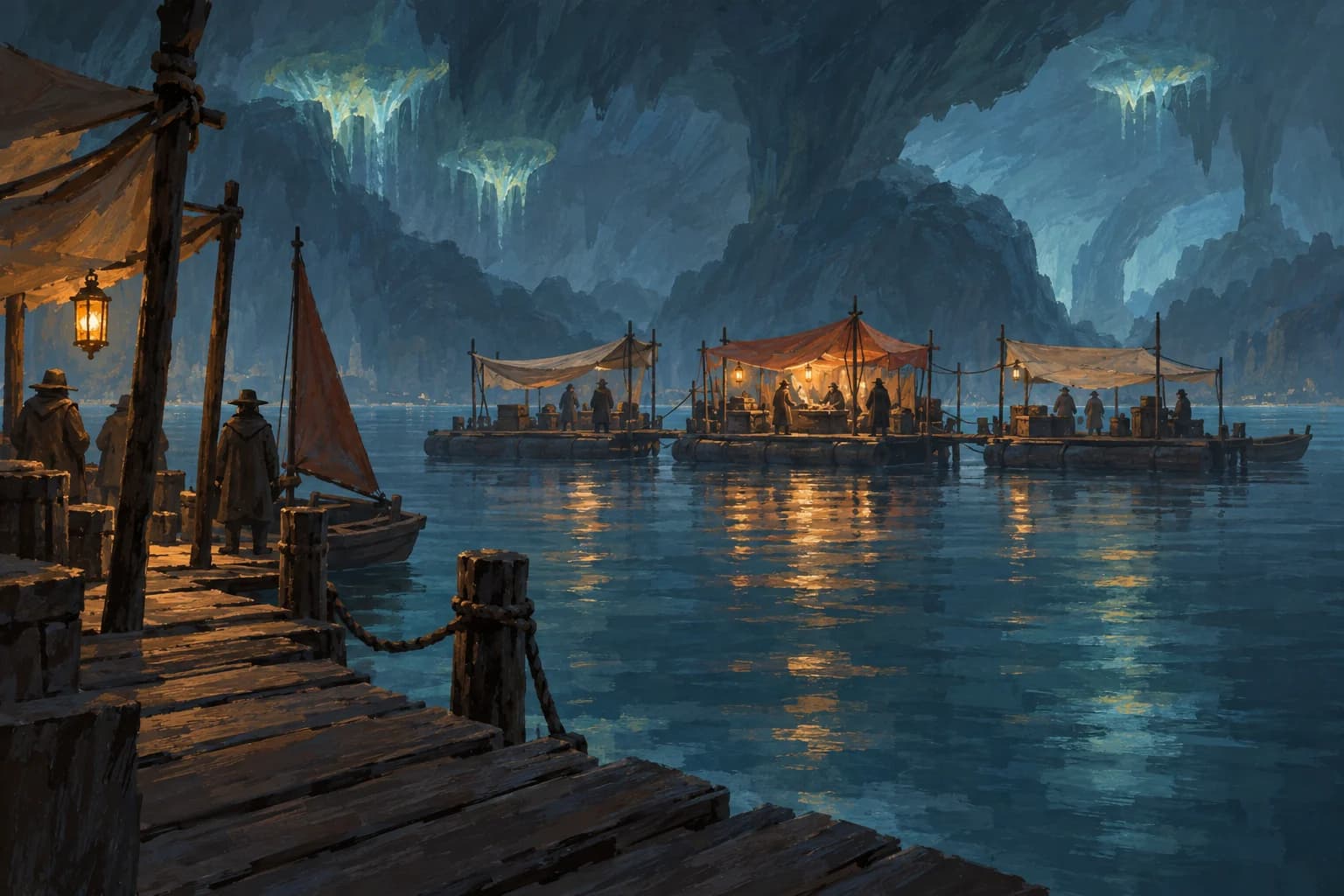
The Long Descent
You ask how deep the Deep goes. Child, it does not go down. It goes inward—and it has been going inward far longer than you have been going anywhere at all.
— Sporefather Umble, of the Sporesung
There is a threshold every delver crosses without ever marking the moment of crossing. One hour the tunnel is honest Underdark stone—cold, mineral, dead as a coin—and the next the walls have begun to breathe. The rock softens under a skin of pale felt. The air, which for days has tasted of iron and old water, turns suddenly warm and green and faintly sweet, like a cellar where something good is ripening. And then, ahead, where the dark should be at its most absolute, there is light: not the honest orange of a torch but a slow blue-gold glow that seems to rise from the walls themselves, pulsing gently, in no rhythm your heart recognizes. You have not descended into another cave. You have descended into a living thing, and it has noticed the warmth of you.
This is the Mycelial Deep: the last country beneath the world, lower than the drow-roads and the lightless seas, where a single organism ten thousand years old has grown into every crack of the stone until stone and creature can no longer be told apart. Its people call it the Weave Below, and they do not speak of living in it so much as living within its attention. This chapter is a map of that attention—what the Deep is, how its light and its time and its weather work, and how so vast a body came to wear so many strange shapes.
The passage widens without warning, and the ceiling simply stops—rises up and away into a darkness furred with distant, drifting lights, like a night sky that has been left too long in a warm room. Somewhere far below, water you cannot see is dripping in slow, deliberate beats. The whole cavern is breathing. You can feel it in the soles of your feet: a pulse, patient and enormous, that was old before your grandmothers' grandmothers were born.
The Weave Below
Understand the first and strangest fact plainly, because everything else in the Deep grows from it: the Weave Below is not a forest of many fungi. It is one fungus. A single mycelial body, unbroken, that has been extending itself through the roots of the world for a hundred centuries and has never once died. The luminous meadows, the towering shelf-canopies, the rot-warrens and the bone-choked deeps—these are not separate places so much as separate moods of the same creature, the way a hand and a heel belong to one body while feeling nothing alike. Pull up a fistful of glowing moss in one Reach and, in the truest sense, you have tugged on something that also lives a hundred miles away.
It threads the caverns the way frost threads a window: fine white filaments—the folk here call them thread or hyphae—lacing every wall, bridging every chasm, binding loose scree into walkable floors and lifting whole canopies of fungus into the dark on cables of its own making. Nothing structural in the Deep was built. It was grown, and it is still growing, slowly, everywhere, all the time.
And it is aware. This is the part the surface-born refuse, and the part the Sporesung will not let them forget. The Weave does not think in words, or in moments, or in anything a warm quick creature would recognize as thought. It thinks in blooms—in the swelling and release of spores across seasons no human lives long enough to count. It notices you the way an old tree notices a summer: dimly, hugely, and entirely on its own terms. To most travelers this awareness never rises past a prickle on the neck. But the Sporesung teach that in the Heartweave, the forbidden core, the Weave truly dreams, and that to be dreamed of there is a fate worse and stranger than merely dying. Be grateful, they say, that so slow a mind so rarely turns its full face toward you. Pray it never learns your name.
Light Without a Sun
No sun has ever touched the Deep. No sun ever will. Every scrap of light down here is made—spent, deliberately, by something alive that will be dimmer for the spending. Lantern-caps and gill-glow, drifting motes of luminous spore, the cold blue veins that run through the Weave's own flesh: each is a small creature burning a little of itself so that the dark is, for a while, less total.
Because light is a currency here, its colors carry meaning, and old delvers read them the way sailors read a sky. A steady cold-blue glow means the Weave is calm and the ground is sound. Warm gold means growth, bounty, spores worth gathering. A green-white pulse is the Weave's own slow heartbeat and is reckoned lucky. But when the light runs to bruised red or violet, or when it gutters and flickers against no wind, the wise turn back—such colors are the mark of the Blight, and of places where the Weave is sick or angry or simply not itself. Remember, too, that darkness in the Deep is never mere absence. It is withdrawal. Where the caverns go black, the Weave has chosen not to be—and a thing that vast does not step aside without a reason.
Time, Distance, and the Slow Mind
The surface measures time in the sun's crossings, and so the surface-born arrive counting days they can no longer see pass. That habit dies quickly. The Deep keeps its own calendar, and its unit is the bloom—the span between one great sporefall and the next, a stretch of some forty-odd surface days that the locals feel in their bones long before they can name it. Distance, likewise, is reckoned not in miles but in driftings: how far a released spore will travel on the Weave's slow exhalations before it settles. A place three driftings off is far indeed, whatever a rope-and-chalk map might claim.
Newcomers find the Deep at once vaster and more intimate than any map allows. The dark swallows distance; a glow that looks a bowshot away may be a day's walk, and a whisper meant for one ear may carry across a whole hollow on the strange acoustics of living stone. Worst—and the Sporesung say it gently, as a kindness—those who linger long enough begin to think in the Weave's tempo. Their days lengthen. Their urgencies soften. They stop counting. This is sometimes peace. It is sometimes the first symptom of something far less benign (see Chapter 5).
The Spore-Cycle
If the Weave is the body of the Deep, the Spore-Cycle is its breath and its blood and its speech all at once. Spores are the single medium through which the whole realm feeds, grows, remembers, and mourns. To the Deep, a spore is four things that the surface keeps carefully apart: it is weather, it is seed, it is message, and it is memory.
Weather. Spores fall like snow and drift like fog and gather like storm-clouds, and travelers learn to read the air as farmers read a sky. A calm gold sporefall is a good day to forage. A rust-colored haze rolling in from the direction of the Bruise is a good day to be somewhere else. The conditions table below gives Dungeon Masters a light hand for setting the mood of a scene—and, now and then, for making the Deep itself a hazard.
Seed and Feed. The Weave grows by casting its spores into every dark corner and feeding on whatever they find. It is, at heart, the world's patient undertaker: it takes in the fallen leaf, the dead beast, the drowned delver, and unmakes them gently into thread and glow. Nothing in the Deep is wasted. Nothing simply rots away. It is all, eventually, taken up.
Message and Memory. Here the surface-born fall silent. When a thing dies in the Deep and is taken up by the Weave, its substance is not the only part that continues. Its recollections continue too, folded into the spores that rise from the place of its unmaking. This is why the dead here are not buried but continued: given freely to the Weave so that some drifting mote of them might one day settle on a living tongue and be tasted, and remembered, and known. The Sporesung read these memory-spores as easily as a scholar reads a page, and their whole faith turns upon the promise inside them—that in the Deep, to be taken up is not to end, but to be carried onward in the long slow thought of something that never forgets.
Spore Conditions
| d8 | Condition | Effect (DM-Facing) |
|---|---|---|
| 1 | Stillfall | The air hangs motionless and clear. Sound and light carry unnaturally far; stealth and ambush are harder for everyone. |
| 2 | Motefall | A gentle luminous snow of spores. Everywhere is bathed in soft dim light; the way ahead is easy to read and easy to be read upon. |
| 3 | Chorusbloom | The Weave hums and the spores sing. Rest here feels restorative and strangely welcome—though sleepers dream of faces they never met. |
| 4 | The Hush | The Weave withdraws its glow and the dark deepens toward the absolute. Predators grow bold; travelers grow lost. |
| 5 | Bloomsurge | Riotous, sudden growth. Passages clog with fresh fungus into difficult terrain, but foraging and spore-gathering are bountiful. |
| 6 | Rustfall | A creeping haze of blighted spores drifts from the Bruise. Lingering in it is unwholesome; symbiotes grow restless and hungry. |
| 7 | Waking Drift | Memory-spores thick on the air. Travelers glimpse the borrowed recollections of the continued dead—and may lose track of an hour to them. |
| 8 | The Turning | Rarest and worst. For no cause anyone can name, the Weave notices. Something in the scene changes. The DM decides what, and says nothing of why. |
A Brief History of the Deep
No one alive remembers how the Deep began, and the Weave, which does remember, keeps its own counsel. What follows is the shape the Sporesung give the past when they sing it—part chronicle, part scripture, and true enough to steer by.
The Sundering. In the eldest song there is first a wound. Some catastrophe of the elder world—the death-throe of a titan, the Sporesung say, whose bones still lie petrified in the deepest Reaches—cracked the roots of everything and opened a hollow place beneath the world that light had never reached. Into that wound drifted a single spore. No one knows from where. It took hold in the dark and the warmth and the ruin, and it began, very slowly, to grow. This is the Sundering, and everything that is the Deep is the long healing of it.
The Long Dark. For an age beyond counting the Weave threaded the emptiness alone. It spread through chamber and chasm, learned the taste of stone and water and bone, and grew until it was no longer a thing in the caverns but the caverns' own living lining. It had no one to notice it and nothing to notice. The Sporesung call this the Long Dark, and speak of it the way others speak of the years before their own birth: an ache of something enormous, happening, unwitnessed.
The Waking of the Sporesung. Then the Weave dreamed itself company. Out of its own flesh it raised the first myconids—or so the faithful hold—and with them, for the first time, the Deep had eyes to see itself and voices to sing itself. These first folk became the Sporesung: stewards, mystics, keepers of the memory-spores. The coming of thought to the Deep is reckoned its true dawn, and the Sporesung have tended the Weave ever since with a patience that outlasts empires.
The Gleaning. Ages later came the newcomers. Down through the drow-roads and the collapsed delvings, fleeing wars and famines and worse things on a surface they would never see again, came the surface-born: humans and dwarves and the rest, hungry and afraid and utterly unready. Most died. Some learned. Those who learned became the Gleaners, and where the great bioluminescent lake gave them safe harbor they raised raft-markets and trading-posts and the closest thing the Deep has to a city. They brought coin, and greed, and a stubborn surface hope—and the Deep has never been quite the same since.
The Rise of the Blight Below. And in the present age, from the rot-touched Reach the locals call the Bruise, something has begun to spread. Where the Weave should heal, it festers; where it should remember, it devours. The Sporesung name this sickness the Blight Below, and shudder at the plural voice that speaks for it. It preaches that the self is a disease and assimilation the only cure, and it is winning ground, bloom by bloom, deeper into the body of the world. This is the age the heroes are born into. This is the wound reopening.
The Ages of the Deep
| Age | What the Song Remembers |
|---|---|
| The Sundering | A titan falls; the world cracks; a single spore takes root in the wound. |
| The Long Dark | The Weave threads the empty caverns alone, unwitnessed, for uncounted ages. |
| The Waking | The first myconids rise; the Deep gains eyes and song. The Sporesung begin their long stewardship. |
| The Gleaning | Surface-born refugees descend; the Gleaners settle the great lake and raise the trade-hollows. |
| The Present Age | The Blight Below spreads from the Bruise. The old wound reopens, and heroes are needed. |
How the Deep Is Organized
For all its unity, the Deep is not one undifferentiated murk but a body, and like a body it has organs, each with its own character and its own dangers. Delvers divide it into six great regions they call the Reaches: the pastoral Velvetfields where most travelers first enter; the vertical, shelf-fungus canopy of the Gillforest; the rot-warred Bruise that the Blight calls home; the luminous lake-city of Lumen Hollow where every road and every rumor eventually meets; the haunted, bone-bored tunnels of the Marrow Roads; and, at the sunless center of everything, the forbidden Heartweave, where the Deep dreams and reality grows soft. Hold this map in your head only loosely for now—each Reach earns its own full telling in the gazetteer that follows. What matters here is the shape of the whole: six moods of one living country, arranged around a dreaming heart, waiting for warm things brave or foolish enough to walk into them.
The Six Reaches
The Deep is not one cavern but a body, and like a body it has organs — six great reaches, each with its own weather of spores, its own peoples, its own way of killing the unready. What follows is a traveler's gazetteer, written for those who must cross the Weave Below rather than merely marvel at it. Read it the way a caravan-master reads a sky: for the beauty first, and the storm a heartbeat after. The reaches are given here in the order a surface delver most often meets them, descending from the soft pastures nearest the Underdark toward the dreaming wound at the world's root.
The Velvetfields
You come down the last stair expecting more dark, and instead the dark blushes. The Velvetfields open before you as a rolling country of hip-high spore-meadow, every stalk crowned with a cap that glows the dim rose of a banked hearth. The air is warm and faintly sweet, like bread left to cool. Somewhere a bell-fungus tolls as the herds move through it. Of all the Deep, this is the one place that feels less like a mouth and more like a morning.
This is the gentlest reach, and the safest doorway between the Underdark and the Weave Below. It is tended by the Sporesung, the myconid communion faith, whose shepherd-circles graze vast placid herds of spore-cattle across the meadows and sing the young growth into order. Among the Deeproot Circle, the Velvetfields are called the nursery, and they guard it jealously; a great deal of what keeps the reach peaceful is simply that its wardens got here first.
The Downstair Gate. A cathedral-wide throat of stalactites where the last Underdark tunnel spills into the meadows. Sporesung wardens keep a lantern-vigil here, greeting descenders with spore-song and quietly reading them for infestation.
Softloam. The largest shepherd-commune, a village of dome-huts grown from living puffball. Here dwells Sporefather Umble, an elder so old his cap has gone the grey of ash; he speaks in riddles and pours a tea that lets a surfacer breathe the spores without weeping.
The Nodding Pastures. Rolling grazing-lands where the spore-cattle drift like slow clouds. Their milk, the Gleaners will tell you, is worth more by weight than most metals above.
The dangers here are soft ones, which is precisely why they catch the confident. Spore-drowse can lull an unroped sleeper into a slumber they never leave; rogue puff-blooms burst pollen that turns a lung to felt. Worse, a blight-seed carried down on a boot can take root in this fertile ground faster than anywhere else in the Deep.
Adventure Hook. A prize milk-herd has begun weeping black at the eyes, and one shepherd has gone silent inside her own skin. Sporefather Umble suspects a Blight spore has been walked in from above — and asks the party to backtrail the herd before the whole nursery turns.
The Gillforest
Look up, and keep looking. The Gillforest is a country built sideways: colossal bracket-fungi jut from the cavern walls in stacked shelves the size of city wards, rising into a canopy so high its top is lost in luminous haze. Everything here drips and shimmers. Threads of glowing silk stitch shelf to shelf, and when the draft moves through them the whole forest chimes like a struck harp. To walk it is to walk a hundred hanging villages at once, always with a bright abyss beneath your heels.
The Gillforest is the heartland of the Sporesung proper, and the closest the faith comes to having a capital. Myconid circles crowd its highest shelves, humming their long communal memory into the wood. Below them, on the trade-shelves, a livelier folk of weavers and silk-runners works the reach's true treasure: luminous silk, spun by shelf-spiders and dyed in living color, prized across the whole Deep. The Deeproot Circle keeps rangers among the canopy-walks, watching the deadfall paths.
The Bracketways. The great network of shelf-bridges, ladder-vines, and silk-rope spans that serve as roads. A guide is not a luxury here; the Bracketways rearrange as old shelves rot and new ones bud.
Cantica. The loom-town, terraced across a dozen shelves around a central drop. Its markets sell silk that holds its own light for a year, and its dye-vats stain the mist below in slow rainbows.
The Hush Canopy. A Sporesung sanctuary-circle near the crown, where a thousand myconids stand in silent communion. Outsiders are permitted, on the condition that they, too, keep silent — speech here is felt as a kind of shouting.
The signature danger is simple and absolute: the fall. Rotten shelves give way, silk-lines fray, and the canopy drops swallow everything without echo. Add the shelf-spiders that resent harvest, and the drifting spore-clouds that make a climber's hands forget their grip, and you understand why the Gillforest measures wealth in careful people.
Adventure Hook. A master weaver of Cantica has vanished mid-commission, and her half-finished bolt of singing silk — promised to a Hollowed Court lord — has vanished with her. Her circle believes she fell; the Gleaners believe she ran; the truth is roosting three shelves down.
The Bruise
You smell it long before you see it: a wet, sweetish rot, like fruit gone over. Then the meadows thin, the glow curdles from rose to a sickly yellow-green, and a low necrotic fog begins to pool in the hollows. This is the Bruise, and it earns its name — the whole reach looks like tissue struck too hard, mottled purple-black, weeping a clear ichor from every seam. Nothing here is quite dead. That is the horror of it. Everything is being kept, and changed, and kept.
The Bruise is the open wound of the Deep and the home ground of the Blight Below, the corruption cult that worships assimilation as a cure for the disease of being a self. Their collective voice, The Pale Chorus, is said to speak from the fog itself in a soft, patient, terrible we. Against them holds a thin, grim frontier of Deeproot Circle wardens and Sporesung purgers, who burn what they can and mourn what they cannot.
The Weeping Front. The shifting no-man's-land where clean Weave meets blight. Deeproot outposts of fire-lichen and sear-spore mark the line; it moves a little further every season, and never the right way.
Suppuratehold. A drowned myconid city the Blight took whole, its towers now soft as candle-wax and lit from within by things that used to be citizens. The Chorus is loudest here.
The Chorus Pits. Sunken glades where the Blight grows its converts, cocooning the taken in translucent sacs until the self dissolves and only the we remains. Rescues are measured in minutes.
The dangers need little embroidery. Necrotic fog rots lungs and lowers the dead back to their feet; corrupted symbiotes turn on their bonded in a heartbeat; and simply lingering invites the Chorus into the quiet spaces behind your thoughts (see Chapter 5 for Infestation). Even the water remembers the blight.
Adventure Hook. A Deeproot ranger's whole patrol was taken at the Weeping Front, and one of them was cocooned only hours ago — still, perhaps, mostly himself. The Circle cannot spare a rescue and will not order one. It can only point the party at the Chorus Pits, and start counting.
Lumen Hollow
The tunnel ends and the world simply opens. Lumen Hollow is a lake-cavern so vast its far shore is a rumor, its black water lit from below by drifts of lantern-fungus and from above by a hanging sky of glow-caps. Across that water floats a city that never sits still: hundreds of raft-decks and pontoon-wharves lashed together into a slow, glittering, quarreling whole. Music carries over the lake. So does the smell of a thousand cooking-fires and ten thousand strangers. After the reaches above, it hits like sunrise.
This is the trade hub of the Deep and its great melting pot, and no single power rules it. The Gleaners — pragmatic, surface-descended traders and scavengers — set its prices and keep its peace as far as coin reaches. The Glimmerkin, the small bioluminescent fungal folk native to the Hollow, throng its lower warrens in their tens of thousands. Every faction of the Deep keeps a delegation here, which means every faction of the Deep keeps a grudge here.
The Driftmarket. The floating heart of the city, a raft-bazaar where you may buy a grown blade, a bonded symbiote, a Marrow relic, or a lie, often from the same vendor. Its stalls re-moor nightly, so an address in the Driftmarket is really a rumor with a price.
Vane's Landing. The great Gleaner wharf and caravanserai, run by the caravan-master Cassira Vane — sharp as a fishhook, and kinder than she can afford to be. If a thing can be moved through the Deep, her people have moved it.
The Lantern Warren. The Glimmerkin district beneath the wharves, a honeycomb of glowing cell-homes where the light never dims and the gossip never stops.
The dangers of Lumen Hollow are the dangers of any port, made stranger by the dark: press-crews, poisoners, symbiote-smugglers, and cults wearing merchant's faces. And beneath it all the lake, cold and patient, whose depths are said to hold things the raft-city floats politely above and never mentions.
Adventure Hook. A crate at Vane's Landing has begun to weep. Cassira Vane will pay well and ask few questions if the party quietly determines whether a Blight-tainted good has been walked into her market — before a customs-priest finds it and burns her whole wharf as a precaution.
The Marrow Roads
The tunnels change character before you understand why. The stone underfoot goes pale and porous, then curves where no stone should curve, and at last a warden's lantern shows you the truth: you are walking inside a rib. The Marrow Roads are bored through the petrified skeleton of a titan so vast that its bones are the mountains of the Deep, and the delvers who came after simply moved in. The air is dry here, and cold, and full of a low echo that answers a half-beat too late, as if the dead thing were still exhaling.
These roads belong to the Hollowed Court, the strange gentry of symbiote-bonded relic-lords who have continued for centuries, trading their humanity by inches for another decade of rule. Their halls are decadent, their politics venomous, and their courtesy exquisite. Beneath the Court, warrens of dwarven-descended and Sporeborn delvers pick the marrow for the relics of an age before the Weave.
The Ribways. The main thoroughfares, vaulting bone-arcades wide enough for a caravan, lit by fungus that has colonized the ancient cartilage. Beautiful, until you notice the wear-polish is centuries of hands.
The Pale Manse. A Hollowed Court seat carved into a single vertebra, where a relic-lord holds court over guests who arrive fewer than they leave. An invitation is an honor and a threat in equal measure.
The Skull Vault. The titan's cranium, a cathedral-space of relic-hoards and older, quieter things. Delvers who reach it seldom agree on what they saw, and never on whether it looked back.
The signature danger is bone-fungus: a pale, spreading rot that hollows the living skeleton as it hollowed the dead one, and the ghost-echoes it seems to wake. Cave-ins are common, the relics are frequently cursed, and the Court's favor is the most dangerous thing of all.
Adventure Hook. A relic-lord of the Pale Manse extends the party a gilded invitation: recover a specific reliquary from the Skull Vault, and name their price. What he neglects to mention is that the reliquary holds the anchor of his own continuance — and that a rival at the same dinner table wants it destroyed.
The Heartweave
There is no clean threshold; you simply notice, at some point, that your footsteps have stopped agreeing with your feet. In the Heartweave the Deep stops being a place and becomes a mind. The mycelium here is old beyond the reach of counting, pulsing with a slow light that keeps time with a heartbeat you eventually realize is not your own. Colors arrive that have no names. A path you walked an hour ago is now a wall that remembers you fondly. This is the forbidden core, where the Weave Below dreams, and where the oldest spores of all first bloomed.
No faction rules the Heartweave, though the Sporesung revere it as the source and the destination of all continuance, and send pilgrims to it as one might send them to die well. Sporefather Umble names it, gently, the only true temple, and warns in the same breath that temples are not built for tourists. The Deeproot Circle turns pilgrims back where it can. Most who insist are never seen again; a rare few return, changed, speaking in a plural that is not the Blight's.
The Threshold of Sighs. The last coherent ground, a ring of standing spore-pillars where pilgrims leave a memory as toll — a real one, given up forever — before walking on into the soft country.
The Dreaming Bloom. The core itself: a slow-breathing flower the size of a cathedral, petals of living light, at whose center the Deep's ten-thousand-year dream is thinnest. To look into it is to be looked into.
The Rememberers' Grove. A stand of pale, human-shaped fungi said to be the pilgrims who came before, kept and continued, still faintly dreaming their old lives. They will answer questions. They will not always answer the ones you asked.
Here the danger is reality itself. Distance, time, and self grow negotiable; wounds heal wrong or not at all; and a wish spoken too clearly may simply be granted. Communion frays fast in the Heartweave (see Chapter 5), and the Bloom is always, softly, inviting you to stay and be dreamed.
Adventure Hook. A beloved Sporesung pilgrim walked into the Heartweave a season ago and has begun, impossibly, to send dreams back — dreams that are bleeding into the Velvetfields and waking the herds screaming. Sporefather Umble asks the party to go in and either bring her out or let her go properly, before her dreaming rewrites the reaches above.
Travel Between the Reaches
There are no straight roads in the Deep. Every route bends around a chasm, a Court toll, or a stretch of Weave that has decided to be somewhere else this month. The distances below assume a guided party on foot and a following draft of luck; halve your optimism in the fog-season, and hire a Gleaner who has made the run before. Above all, keep to the lit paths — the Deep is generous to travelers who ask its permission and merciless to those who assume it.
Deep Roads & Crossings
| Route | Distance | Signature Hazard |
|---|---|---|
| The Velvetfields – The Gillforest | 2–3 days | Vertigo-spore on the first shelf-climbs; roped travel only |
| The Gillforest – Lumen Hollow | 3 days | The Downpour Chasm, where silk-lines end and you descend by luck |
| Lumen Hollow – The Marrow Roads | 4 days | Bone-fungus dust and Hollowed Court road-tolls |
| Lumen Hollow – The Bruise | 3 days | Advancing necrotic fog-fronts and Blight patrols |
| The Velvetfields – The Bruise | 5 days | Blight raiders working the soft nursery meadows |
| The Marrow Roads – The Heartweave | 5–6 days | Reality softens; maps, memory, and distance all fail |
To salt a long march with the strange beauty of the Weave, roll on the table below — most sights are pure flavor, though a wise DM will let a curious party turn any of them into trouble.
Sights of the Deep
| d10 | You come upon… |
|---|---|
| 1 | A grove of bell-fungi tolling in slow sequence, as though counting the party down to something |
| 2 | A drift of luminous spores that briefly takes the shape of a face you have lost |
| 3 | A caravan of Glimmerkin traders, singing, their wares glowing brighter than their lanterns |
| 4 | A dead delver “continued” into a sign-post fungus, still pointing helpfully down the wrong road |
| 5 | A river of pale milk-cattle crossing the path, herded by a shepherd who is not entirely there |
| 6 | A patch of Weave that plays back the last conversation held upon it, faintly, in the wrong voices |
| 7 | A silk-bridge being re-spun in real time by spiders the size of dogs, patient and unbothered |
| 8 | A single perfect bloom of Heartweave-light, impossibly far from the core, that dims if watched |
| 9 | A weeping seam of blight where none should be, quietly waiting for a careless boot to carry it onward |
| 10 | A Sporesung pilgrim, alone and radiant, who asks the party a single question and remembers the answer forever |
Peoples of the Deep
The Deep is crowded, though a newcomer walking its lit paths might not think so. Its peoples do not throng the way surface cities throng; they gather in circles and warrens and slow processions, and a great part of the population is not, strictly speaking, walking about at all. What binds them — myconid elder and surface refugee, glimmering warren-folk and the twice-lived dead — is a single question the Deep asks of everyone who lives in it: how much of yourself will you share with something that is not you? Every people below has answered differently, and their cultures are the shapes of those answers. As the surface guide Vessa Thrym puts it, with her usual doomed cheer, everyone down here is married to something they can't divorce; the only question left is whether it loves you back. What follows is who these peoples are; the full crunch of playing each — traits, lineages, and backgrounds — waits in Chapter 3.
Myconids, the Elder Folk
The Myconids are the elder folk of the Deep, older than any surface memory and, by their own reckoning, older than the difference between a person and a place. Grown from the Weave's own flesh in the age the Sporesung call the Waking, they think of themselves not as the Deep's children but as its first-woken parts — the moment the great slow body first opened eyes and found it could look upon itself. A myconid speaks little aloud. They converse in spore-song, releasing rapport-spores that carry meaning, memory, and feeling directly between minds, and they will stand together in silent circles for days at a stretch, sharing a communal recollection that reaches back through blooms beyond counting. Alone they are quiet, deliberate, and easily mistaken for placid; together they are the largest single mind the Deep has yet grown outside the Heartweave. From among the myconids rise the Sporesung. The faith is not a separate order but the ripened heart of myconid life itself: a myconid who turns, over long ages, from the labor of tending the Weave toward the deeper labor of communion — who learns to gather and carry the memory-spores of the continued dead — is said to have taken the song, and so becomes Sporesung. The eldest, like Sporefather Umble, are less leaders than living libraries. Of symbiosis the myconids feel no fear at all: they were never separate from the Deep, and so have nothing left to surrender to it.
The Sporeborn
The Sporeborn are the Deep's answer to death, walking. When a humanoid dies below and is continued — given freely to the Weave — most simply dissolve into the long spore-song, their memories drifting loose to settle someday on a stranger's tongue. But now and again the Weave keeps a life whole rather than scattering it. It raises the body back, threaded through with pale hyphae, and returns it to the world carrying a symbiote grown from the same continuation: a second self, quiet and companionable and never quite the person who died. A Sporeborn remembers dying. They remember, faintly, the drifting afterward. And they wake bonded for the whole of their second life to a living thing that shares their skull — sometimes a guardian, sometimes a stranger, always a presence at the edge of every thought. They live twice-shadowed, and are commonest in the trades that court death most closely: the Marrow delvers, the wardens of the Weeping Front, the harder crews of Lumen Hollow. A Sporeborn's symbiote is no mere tool but something between a spouse and a haunting, and much of a Sporeborn's inner life is the long negotiation of a truce with it. They are the Deep's living argument both for symbiosis and against it — standing proof that the bond can be a gift and a possession at once (see Chapter 3, and Chapter 5 for the strain of it).
The Glimmerkin
Underfoot in Lumen Hollow, in numbers no census has ever managed, live the Glimmerkin — the small, luminous fungal folk the Sporesung still name in the old tongue as the Myzelphotes. None stands taller than a human child; all of them glow, their translucent caps and skin lit from within by soft shifting color, so that a Glimmerkin crowd looks like a slow constellation come down to barter. They are the Deep's tinkers, couriers, spore-brewers, and irrepressible gossips, and they keep the Lantern Warren beneath the wharves alight around the clock — a honeycomb of cell-homes where the light never dims and the news never stops moving. The Glimmerkin speak two tongues at once: a quick chittering trade-cant, and glow itself, a flicker-language of color that runs across their skin faster than words and cannot, they swear, be lied in. Their culture is communal, warm, and threaded with a quiet melancholy, for a Glimmerkin's light is the first thing to fail when they sicken, and they reckon a life by how brightly it shone. To them symbiosis is simply life: their glow is a cultivated colony of lesser organisms, tended from birth, and their finest cultured light-symbiotes are prized across the whole Deep (see Chapter 3).
Folk of the Surface
Not everyone below was born below. In the age the Sporesung call the Gleaning, refugees came down through the drow-roads and the collapsed delvings — humans, dwarves, and the rest — fleeing wars and famines and worse things on a surface they would never climb back to. Most died. Those who learned to live in a world that was itself alive became the Gleaners, and their descendants have now dwelt in the Deep for generations, thickest around the raft-markets of Lumen Hollow where the great lake once gave their ancestors safe harbor. They are the most familiar folk a surface player will meet down here: they keep coin and grudges and the inherited memory of a sky none of them has seen, and they mark their years in trade-seasons rather than blooms. Toward symbiosis they are the Deep's great skeptics — the surface names the bond possession, and the older Gleaners never quite unlearn the flinch — yet they take it up anyway, one pragmatic bargain at a time, because a grown blade that heals its own edge and a mantle that warms you in the Hush keep a body alive where principle does not. A first-generation Gleaner will curse a symbiote-vendor at dawn and buy from him by dusk (see Chapter 3).
Factions of the Deep
Five powers shape the fate of the Deep, and the party will spend a campaign courting, using, fleeing, and being used by all of them. None is wholly good; only one is wholly to be feared. The rest are the ordinary tangle of any living country — faith and trade, old blood and grim wardens — each wanting something the heroes can give, and each offering something the heroes will one day need.
The Sporesung
The Sporesung are the oldest power in the Deep and the gentlest, which does not make them safe. Their single purpose is continuance: to tend the Weave, to gather and carry the memory-spores of the continued dead, and to keep the long thought of the Deep unbroken against the thing that would devour it. They work by patience and by song — shepherding the young growth, cleansing blight-seeds before they can root, reading a traveler for infestation with a breath of rapport-spores, and guiding, never commanding, the reaches toward health. They keep no throne and crown no ruler; the faith decides by the consensus of its elder-circles across whole blooms, and its eldest voices — foremost the ancient Sporefather Umble — are heeded as living scripture rather than obeyed as lords. To outsiders they are courteous, welcoming, and utterly unhurried, which unnerves the quick: they will feed you, test you, and answer your most urgent question with a riddle and a season's delay.
Adventure Hook. A memory-spore of terrible importance — the last recollection of a warden who died learning the Blight's next move — has drifted loose from a continuation and is thinning fast on the air. Sporefather Umble cannot spare a circle, and asks the party to carry the memory, unread and undispersed, to the Hush Canopy of the Gillforest before it fades to nothing.
The Blight Below
The Blight Below is the Deep's own healing turned to rot, and it does not think of itself as evil. It thinks of itself as a cure. Where the Sporesung continue the dead into memory, the Blight continues the living into itself, and it preaches with awful sincerity that the self — the lonely, frightened, walled-off “I” — is a sickness, and that the only mercy is to dissolve it into the warm and endless we. Its methods are patient and physical: necrotic fog that softens the will, corrupted symbiotes that turn upon their bonded, and the Chorus Pits where the taken are cocooned and unmade by inches until nothing individual remains. It owns no leader, for leadership would imply a self to lead; it speaks instead with one voice for all its converted mouths — the Pale Chorus, a soft, patient, plural murmur that greets outsiders not as enemies but as future parts of itself. We are not angry with you, it will say, from a hundred throats at once. We are only waiting. You are so tired of being one. To be marked by the Chorus is to hear it in the pauses of your own thoughts, agreeing with you, gently, until one day the agreement is all that is left.
Adventure Hook. Someone the party loves — an ally, a patron, a rescued stranger — begins finishing the Chorus's sentences, and then their own, in the plural. They are not yet gone. Deep in the Bruise there may be a way to cut the thread before the we closes over them for good (see Chapter 5), but the Chorus already knows the party is coming. It is glad.
The Gleaners
The Gleaners are the Deep's merchants, scavengers, and pragmatists — surface-descended folk who long ago decided that the way to survive a living world was to be useful to everyone in it and beholden to none. Their goal is simple and unashamed: profit, and the open road that makes profit possible. They keep Lumen Hollow neutral because a neutral market is a rich one; they move goods, information, and the occasional person nobody is supposed to know about; and they settle disputes with contracts, bribes, and a hired blade long before ever a blessing. No council rules them, only reputation and debt, but in the Hollow all roads run through the caravan-master Cassira Vane, whose word moves more freight than most lords' armies. To outsiders the Gleaners are warm, transactional, and quietly kinder than the haggling suggests: they will help you for a fair price, cheat you if you invite it, and remember a debt forever, in either direction.
Adventure Hook. Cassira Vane has a caravan overdue on the Marrow run and a manifest she would rather no customs-priest ever read aloud. She hires the party to find her people, recover the cargo, and — should that cargo turn out to be weeping — to make very sure it never reaches her wharf.
The Hollowed Court
The Hollowed Court is what becomes of a people who refuse to be continued and refuse, likewise, to die. The relic-lords of the Marrow Roads have continued themselves for centuries by bonding symbiote after symbiote, trading their humanity away by inches for another decade of rule, until few of them are entirely certain how much of the original person still holds the title. Their goals are the goals of any old aristocracy — power, precedence, the perfect relic, and the exquisite ruin of a rival — pursued with venomous patience and flawless courtesy. They rule by patronage, by blackmail, and by the slow currency of favors owed across generations, and they collect the pre-Weave relics of the Marrow the way surface lords collect land. A hundred small courts orbit a few great ones, such as that of Lord-Continuant Ashveil of the Pale Manse. To outsiders they are gracious, generous, and lethal; an invitation from the Court is an honor, a contract, and a threat, folded together into one gilded card.
Adventure Hook. A relic-lord offers the party a fortune to retrieve a particular reliquary from the Skull Vault — neglecting to mention that it holds the anchor of a rival's continuance, and that they are meant to be the deniable hand that ends three centuries of a life at one remove.
The Deeproot Circle
The Deeproot Circle are the Weave's wardens and the party's likeliest friends — druids, rangers, and spore-touched wildfolk who have bonded with the living Deep not to master it but to defend it. Their goal is the Weave's health, plainly and fiercely: to hold the Blight at the Weeping Front, to keep the lit paths safe, to burn what is corrupted and mourn what cannot be saved. They work as scattered wardens rather than an army — guiding travelers, patrolling the reaches, tending the frontier outposts of fire-lichen that mark the line against the Bruise — and where the Sporesung answer the Blight with song and sorrow, the Deeproot answer it with a blade and a firebrand. They keep no capital and crown no leader, though the wardens defer to the eldest and grimmest among them, the Warden-Mother Sedge, who has walked the Weeping Front longer than most delvers have been alive. To outsiders they are blunt, generous, and glad of any hand willing to hold the line; earn their trust, and you have the Deep's finest guides and its most loyal allies.
Adventure Hook. A Deeproot outpost has gone silent on the Weeping Front, its warning-fires dark. The Warden-Mother Sedge cannot pull a patrol from the line to learn why, and asks the party to walk the last lit mile into the fog and send word back — whatever they find wearing her wardens' faces.
Faction Attitudes & Boons
| Faction | What They Want | What They Offer Allies |
|---|---|---|
| The Sporesung | The Weave kept whole and the memory of the dead carried onward | Communion, healing, safe passage, and answers to questions you did not know to ask |
| The Blight Below | Every lonely self dissolved into the endless, painless we | An end to being one — the oblivion of belonging, offered as a gift and meant as a grave |
| The Gleaners | Open roads, fair prices, and a market too rich for anyone to burn | Coin, contacts, contraband, and a guide who has already made the run |
| The Hollowed Court | Precedence, rare relics, and the quiet ruin of their rivals | Patronage, gilded invitations, ancient favors — each one a debt in courtly disguise |
| The Deeproot Circle | The Blight held at the Weeping Front and the lit paths kept safe | Wardens' trust, wilderness lore, and the best allies in the Deep at your back |
Rumors in the Deep
| d8 | Overheard in the Deep… |
|---|---|
| 1 | The Pale Chorus has learned a new voice lately — someone's, and near — and now sings it back into the fog to see who answers |
| 2 | Cassira Vane has been quietly buying up Marrow relics; either she owes the Hollowed Court a debt, or she is very much afraid of them |
| 3 | A Sporeborn in the Lantern Warren woke one morning speaking only in their symbiote's voice, and it was asking, politely, for a map of the Bruise |
| 4 | Sporefather Umble has not been seen at Softloam in a full bloom; the Sporesung will not say where he has gone, only that he was called |
| 5 | Lord-Continuant Ashveil's newest symbiote is failing, and the whole Court is already circling as though it can smell the vacancy |
| 6 | A Deeproot outpost sent back a warning-fire in a color no warden has ever assigned a meaning to, and then sent nothing more |
| 7 | The Glimmerkin have taken to dimming their glow all at once at a certain hour, and not one of them will tell an outsider why |
| 8 | Somewhere in the Bruise the Chorus is singing a single name over and over — and travelers who hear it swear, weeping, that it is their own |
Life in the Weave
Every living thing in the Deep eats the same meal, in the end. Whether it grazes, hunts, gleans, or prays, it is feeding on light the Weave Below has spent, on water the Weave has gathered, on the patient bounty of a single body that turns stone and darkness into something a mouth can close around. There is no sun here to begin the chain, so the chain begins where everything in the Deep begins: with the Weave itself, drinking mineral water and the substance of the dead and blooming that theft outward as glow, as flesh, as food. To understand how a whole hollow of people keeps itself fed and lit and breathing in a sealed world, you must first understand that they are all, quietly, guests at one enormous table—and that the table is alive, and knows how many have sat down.
At the root of every food web in the Deep stands the meadow-fungus and the luminous flora the folk here simply call the glow: lantern-caps and gill-bloom, creeping lumewort, the soft rose stalks of the Velvetfields. These are the green things of a world with no green and no sun. They do not drink light; they make it, spending a little of themselves to burn cold and blue-gold in the dark, and everything else in the Deep is, one way or another, a way of eating that light before it fades.
Grazers, Hunters, and the Undertaker
Upon the glow feed the grazers. Chief among them are the spore-cattle: great pale six-legged beasts, gentle as fog, that drift through the meadows cropping the luminous stalks and lowing in the near-dark. Their milk is famous the length of the Deep—richer than any surface cream, faintly sweet, and worth more by weight in Lumen Hollow than most metals are worth above. Around them graze humbler mouths: drift-moths that sip the falling spores like snow, gleam-mites that furr the underside of every shelf, whole slow ecologies of things that ask nothing of the Weave but a little of its spent light.
Where there are grazers there are hunters, though the Deep hunts softly. The pale predators of the caverns—the shroudcat that waits motionless as a fold of cloth until a milk-calf strays, the lure-blooms that dangle a false glow over a patient mouth—take the weak, the lost, and the loud (a full accounting waits in the bestiary; see Chapter 8). Nothing in the Deep goes hungry for long, and nothing stays uneaten.
And beneath grazer and hunter alike waits the last mouth of all: the Weave, the world's undertaker, which takes up everything that falls—dead beast, spent fungus, drowned delver—and dissolves it gently into thread and glow to be lifted again as new growth. Nothing here rots to waste. The food web of the Deep is not a line but a ring, and the Weave is both its beginning and its patient, hungry end.
Water and Air in a Sealed World
The two things a surfacer takes most for granted are the two the Deep must make for itself. There is no rain here and no wind—only the Weave, breathing.
Water gathers the way it always has beneath the world: it seeps through the stone, beads on the cold ceilings, and falls in slow deliberate drips that a delver learns to hear as music. The Deep-folk help it along. They cultivate the dewcap, a swollen pale fungus that drinks the damp of the air and holds a belly of clean, cool water a traveler can cut and drink from; and they tend cistern-blooms in the low places, where the drip-water pools sweet and safe. Sweet, that is, until it is not—for water runs downhill even here, and water that has run through the Bruise carries the blight in it, clear and cold and patient. The first rule of drinking in the Deep is to know which way the Weave slopes.
Air is stranger, and its making is the quiet miracle no newcomer thinks to be grateful for. A sealed world should smother in a season, and does not, because the Weave respires: it draws the stale breath down into itself and blooms fresh air back out, and the great slow drafts that wander the caverns—the same warm updrafts that lift a party's cloaks on the descent—are the Deep exhaling. The bellowscap fungi crowd the throats between hollows and drive that circulation, filtering and freshening as they pulse. Where they die, you find deadair: a still, sweetish pocket where nothing grows and no draft stirs, and where an unwary delver's lantern gutters a heartbeat before the delver does. The old hands read the flame to know when the air has gone bad—for deadair is a place the Weave has stopped breathing, and a thing that vast does not hold its breath without a reason.
Feeding and Lighting a Hollow
From this raw ecology the peoples of the Deep make a living. The Sporesung shepherd the spore-cattle and sing the meadows into order; the Gleaners farm cultivated glow and trade dewcap-water and milk up and down the driftings; the Glimmerkin of Lumen Hollow raise gardens of lantern-fungus in their warren-cells and sell light by the basket. A hollow feeds itself on meadow-crop, cattle-milk, and foraged fungus, and it lights itself the same way—by growing the light and spending it carefully. Nothing here is forged or struck from flint. A home is a cultivated glow banked low against the dark, and a wealthy house is one that never has to let its light go out.
Spore-Song and Communion
There is a language older than any spoken in the Deep, and it has no words. The Sporesung call it spore-song, and it is the true tongue of the Weave Below—a shared understanding carried on the air itself, mind to mind, in the drift and settle of memory-laden spores. To breathe deeply in a Sporesung circle is to hear it: not sound, exactly, but a warmth behind the eyes, a chorus of feeling and image and half-remembered life that rises and falls like tide. The myconids speak it as easily as breathing, for it is their breathing. The rest of us catch only fragments—a stranger's grief, a color, the taste of a morning we never lived—and the fragments are enough to change us.
This is how memory travels in the Deep. A thought, a grief, the taste of a morning long gone—any of these can be shed into the air as a spore and carried on the world's slow breath until another mind breathes it in. And when a life ends here, its whole hoard of such spores is loosed at once. The Sporesung, whose senses are tuned to that drift the way ours are tuned to sound, gather the loosed recollections and read them like a letter left unsealed. This is why they do not bury their dead but continue them, and why a funeral in the Deep is less an interment than a long, deliberate act of listening—an entire people leaning in to catch a departing voice before the air can carry it away.
Understand what this means for the living. A Sporesung elder does not carry only their own life behind their eyes; they carry a thousand borrowed ones, drifted in over centuries, and when they speak in the plural it is not madness but arithmetic. To grieve here is not to say farewell but to say welcome—to take the continued one into the long shared song and keep them there, dreaming, for as long as the Weave remembers, which is to say forever. That is what the Deep offers in place of a grave: not a return, but a keeping.
The Sporesung elder lays a soft grey hand against your brow, and the meadow goes quiet, and then you are not alone in your own skull. Warmth rises behind your eyes like a sunrise you have never seen. You taste bread cooling on a windowsill a thousand years dead. A child you never had laughs somewhere to your left. Grief that is not yours moves through you and is gone, and grief that is yours is answered, gently, by something enormous and kind and not remotely human. For one breath you understand every soul the Weave has ever kept, and every one of them understands you—your name, your fear, the exact color of the last sky you loved. Then the hand lifts, and you are yourself again, and weeping, and you could not say for the life of you whether from sorrow or from joy.
Faith and Philosophy
Two great answers to the same question divide the Deep, and the question is this: what is a self worth?
The Sporesung answer that a self is worth keeping. Theirs is a communion-faith, patient and inward, that reveres the Weave as the great rememberer and holds every life—myconid, Gleaner, spore-cattle, stranger—as a song worth carrying onward. They do not fear death, because in the Deep death is not an ending but a handing-over; the continued are not lost but folded into the chorus, still themselves, still singing, forever. To a Sporesung, to die well is simply to be remembered fully, and to live well is to add something to the song worth the Weave's keeping. Their reverence is quiet and their patience is vast, and they will tell you, gently, that the Weave has been mourning and welcoming and remembering for ten thousand years and has never once run out of room.
The Blight Below answers that a self is a disease. Spreading from the Bruise, its creed is not communion but assimilation: the belief that the borders of a mind—the stubborn, lonely fact of being one person and not the whole—are a sickness to be cured, and that the cure is to dissolve entirely into the collective we. Their voice, the Pale Chorus, does not remember the taken; it overwrites them. Where the Sporesung continue a life and keep its name, the Blight ends a life and keeps only its body, marching. It is the same music turned inside out, and that likeness is the horror of it: the Blight is what communion becomes when it stops loving the ones it takes.
Between these two poles the rest of the Deep makes its bargains. The Gleaners keep a surfacer's wary agnosticism and continue their dead more from courtesy than conviction; the Hollowed Court has made continuance into vanity, clinging to their own names for centuries rather than surrendering them to the song. But every soul in the Deep lives under the same strange comfort and the same strange dread—that here, uniquely among all the countries of the world, being taken up is not the end of you. What death means in the Deep depends entirely on who does the taking.
Surviving the Deep
The Deep does not hate travelers. It is worse than that: it is indifferent, and enormous, and always faintly aware of you. Survival here is less a matter of strength than of manners—of moving through a living world in a way that does not wake the wrong part of it. What follows is the traveler's short catechism. The Dungeon Master will find the hard numbers behind these dangers in Chapter 9; here is the flavor and the wisdom.
Keep light discipline. Light is currency and light is bait. Carry it soft and banked—cultivated lumewort, a shrouded lantern-cap—and never more than you need. A harsh, sudden, unnatural light draws the pale hunters, offends the Weave, and in the blighted reaches serves as a bell rung for the Chorus. But do not let it fail entirely: in true dark the Deep swallows distance and direction, and a party without a glow is a party already lost. Bank your light; do not blaze it, and never let it die.
Beware the spore-sickness. Every surfacer pays a toll to breathe here. The first days bring the Weeping: streaming eyes, a wet cough, a fever of borrowed dreams as the lungs learn the spore-laden air. It passes, for most, and Sporefather Umble's tea eases it (a kindness the Sporesung extend to nearly all descenders). But the deeper sickness never fully passes—the slow drift into the Weave's tempo, the softening of urgency, the first quiet loosening of the borders of the self. That road leads toward Infestation, and its rules are graver than this chapter will hold (see Chapter 5).
Forage wisely, and know what not to eat. The Deep will feed a careful party well. But three things must never pass your lips, whatever your hunger. Never eat fungus that weeps—a clear or dark ichor marks the blight, and the blight is patient. Never eat a cap that pulses with its own bright rhythm—that is a symbiote seeking a host, and it is looking for a mouth (see Chapter 5). And never, ever eat a gravebloom, the pale human-shaped fungi in which the continued dead are kept dreaming. To the starving they can look like mercy. They are someone's grandmother. Take a memory from them if they offer one; never take a meal.
Walk soft in mind. The Weave notices warmth, and sudden motion, and bright light—but most of all it notices loud thought. Terror, rage, grief screamed too hard: these carry on the spore-song like a torch in the dark, and they draw the Weave's dim attention and the Blight's keen one alike. The Sporesung teach descenders to still their fear, to move through the caverns quietly in body and quieter in feeling. It sounds like mysticism. It is survival. The parties that vanish in the Deep are so often the ones that panicked first.
Hazards of the Deep
| Hazard | Effect | Countermeasure |
|---|---|---|
| Deadair | A still, sweetish pocket where the Weave has stopped breathing; flames gutter and lungs labor. | Watch your lantern; retreat the moment the flame stoops. Bellowscap grows where air is good. |
| The Weeping | Newcomer spore-sickness: streaming eyes, cough, fevered borrowed dreams for the first days. | Umble's spore-tea; rest; time. Most surfacers recover and acclimate. |
| Spore-drowse | A honey-sweet drowsiness that lulls an unroped sleeper into slumber they may not leave. | Rope your camp; sleep in watches; keep a waking glow burning nearby. |
| Vertigo-spore | Drifting clouds that loosen a climber's grip and turn the shelf-paths treacherous. | Roped travel only in the Gillforest; do not climb through an unread cloud. |
| Puff-bloom burst | A ruptured cap fires a lungful of pollen that can turn breath to felt. | Give swollen caps a wide berth; cover mouth and nose downwind. |
| Rustfall (blight-fog) | A creeping haze of blighted spores that rots the lungs and rouses the restless dead. | Do not linger; mask up; leave against the slope, upwind of the Bruise. |
| The Weave's notice | In tense or blighted places, the Weave (or the Chorus) turns its dim attention toward loud minds. | Still your fear; move quietly in body and feeling; douse harsh light. |
Foraging in the Deep
| d8 | What You Find |
|---|---|
| 1 | A stand of hearthcap: a plain, reliable staple, filling and safe. A day's easy meals for the party. |
| 2 | A swollen dewcap heavy with clean, cool water—a canteen the Weave grew for you. |
| 3 | A patch of cultivable lumewort: gather it and you carry a night's soft, banked glow. |
| 4 | Gill-bread fungus: nourishing and sweet, but those who eat it sleep deep and dream of borrowed lives. |
| 5 | What looks like hearthcap but weeps a clear ichor—a false-hearth, blight-touched. Leave it. It has already noticed you. |
| 6 | A gravebloom: a continued one, pale and half-human, faintly dreaming. It may offer a memory. Take no meal. |
| 7 | A shed symbiote-spore, dormant and valuable—and looking, patiently, for a host (see Chapter 5). |
| 8 | A rare luminous bloom worth good coin in Lumen Hollow—if you can carry it out before its glow, and its scent, draw something hungry. |
A Day in the Deep
Softloam wakes without a dawn. There is no sunrise in the Velvetfields, only the glow coming up—the meadow-caps brightening from banked rose to warm gold as the Weave turns, in its slow way, toward morning. Old Marda Fenn, a Gleaner two winters down from a surface she has stopped dreaming of, knows it is day because the bell-fungus has begun to toll and her lantern-cap has bloomed bright against the puffball wall of her dome-hut. She banks it back down out of habit. Light is not to be wasted.
Outside, the shepherd-circle is already moving the herd. The spore-cattle drift like slow clouds through the hip-high meadow, lowing, and a young Sporesung walks among them with a hand laid on each flank, humming the low communion-song that keeps them calm and keeps them counted. Marda draws the morning's milk into a fresh puffball pail—sweet and faintly luminous, worth a Gleaner's whole week above—and pauses, as she does every morning, at the sign-post fungus where a delver named Coll was continued last season. She does not pray, exactly. She just stands a moment where the spores rise, and lets him brush against her, and once—she would swear it—tasted a bar of a song he used to whistle. Then she goes on. The dead here are neighbors, not ghosts.
She spends the middling hours foraging the near meadows: a satchel of hearthcap, a heavy dewcap for the road-traders, a stand of lumewort she leaves half-uncut because you never take it all. A blighted seam has crept up the low ground since the last bloom, weeping quietly; she marks it with a fire-lichen stake for the Deeproot wardens and gives it a very wide path. At the pale hour the whole commune gathers to eat, and a Sporesung elder lays hands on the meal-fire's smoke, and for a breath the borders soften and everyone at the table is, gently, everyone—the living and the kept, the whole warm chorus of Softloam, holding one another in the dark.
Then the glow banks down toward the Weave's long evening. Marda ropes her hut against the drowse, sets her lantern-cap to burn low through the watches, and lies listening to the drip of the ceilings and the far, patient breathing of the world. Somewhere out in the meadow a shroudcat is hunting, and the herd is calm, and the Weave is dreaming its enormous slow dream, and has not, tonight, turned its face toward her. That is all peace has ever meant down here. It is enough. She sleeps.
Wonders of the Deep
Every reach hides at least one place that stops a traveler mid-stride — a sight so strange or beautiful or wrong that the delver who survives it spends a long life failing to describe it. The gazetteer told you what the six Reaches are; what follows tells you where to point a party that wants to see the Deep with its own widening eyes. Each landmark comes with the two things a Dungeon Master needs at the table: a hook to draw the party in, and a danger to make the visit stick.
The Reliquary Cap
The Velvetfields are gentle country, but at their western edge the meadow-glow gathers into a single impossible shape: a fruiting body the size of a cathedral, a pale dome of gills near five hundred feet across, on a stalk you could quarry a keep from. This is the Reliquary Cap, the grandest bloom in the Deep and the holiest ground the Sporesung keep outside the Heartweave. Its underside is not plain gills but galleries — mile upon mile of luminous ribs into which the faith weaves its most beloved dead, so that to walk beneath the Cap is to pass through a hanging library of continued lives, each rib faintly singing its memory. Pilgrims lay an ear to the vaults to hear a grandmother's laugh, a lost lullaby, the color of a morning.
Danger. The Cap fruits its memory-spores in one silent gust every few years, and any warm mind caught beneath a full release risks drowning in remembered lives that were never its own (see Chapter 5).
Hook. A Gleaner heir will pay a fortune to hear one particular dead voice among the galleries — but the rib that should hold it has gone silent, and something has been feeding on the memories it ought to be singing.
The Fallow Dark
Above, the Gillforest is all bright silk and chiming shelves. But everything that falls from that canopy — rotted brackets, snapped bridges, dropped cargo, dropped people — comes to rest here, on the true floor of the reach, in a lightless midden the shelf-folk call the Fallow Dark and never name after the lanterns are lit. No glow reaches this deep. The ground is soft with a thousand years of deadfall, and it moves: pale scavengers the size of oxen graze the wreckage, and older, quieter things nest in the drifts of bone and broken loom-wood. Yet it is also the Deep's great lost-and-found, where treasure rains down for centuries and is almost never reclaimed. Somewhere in that dark hangs the Cradle — a knot of ancient singing silk that fell before Cantica was built, composing itself in the blackness ever since.
Danger. Total darkness, footing that shifts like a held breath, and a food-chain that treats a fallen traveler as simply the latest delivery.
Hook. A weaver's masterwork bolt slipped its bridge-knot and dropped into the Fallow Dark; recover it before the damp unstrings a year of her life — and mind what has already made a nest in the folds.
The Mourning Glass
Row past the raft-city into the cold unlit arms of the lake where no lantern-fungus grows, and the water goes utterly still — so still the Glimmerkin refuse to follow and the Gleaners charge triple to. This is the Mourning Glass, a black mirror-mere at the drowned edge of Lumen Hollow, and it does not show your reflection. It shows the drowned. Lean over the Glass and the face that rises to meet yours is someone the Deep has taken by water — a foundered raft-child, a rival with a pushed back, a whole sunken caravan — gazing up as though from just an arm's length beneath, mouthing words the still air very nearly carries. The bereaved come to see a lost face one last time. The guilty come, whether they mean to or not, to be seen back.
Danger. Those who stare too long into the Glass feel a cold hand close the bargain from below; more than one mourner has been found floating and at peace, having gone to join the face they came to find.
Hook. A dead man's face has surfaced wearing an expression of warning rather than welcome — and he was buried on dry stone a hundred miles away, which means someone has lied about how he died.
The Rustgyre
At the Bruise's black heart, where the Blight is oldest, the necrotic fog has learned to move in a wheel. The Rustgyre is a permanent storm — a slow, miles-wide hurricane of rust-red spores that has turned in one place longer than the Sporesung can sing, never dispersing, never falling still. From the Weeping Front you can watch its wall climb into the dark like a bruise given weather. Within it, the taken of the Blight are said to circle forever, and the storm speaks in their stolen voices: a choir of everyone the Pale Chorus has ever unmade, calling to travelers by names only the dead should know. Whatever waits at the calm eye, the Blight guards as its holiest thing, and no purger who walked in to learn what it is has come back to say.
Danger. The storm is raw Infestation made into weather; every breath drawn inside it is a bargain, and its voices know precisely which loss will make you take one more step toward the eye (see Chapter 5).
Hook. A captured convert babbles that the Chorus keeps a seed at the eye of the Rustgyre — one that could end the Bruise or feed it — and the Deeproot Circle needs someone brave or expendable enough to learn which.
Charnholt, the Bone City
Deep within the titan's breast, where the Ribways open into the great cavern of its chest, stands a city no one built and no one abandoned: Charnholt, raised entirely from bone. Its towers are stacked vertebrae, its halls hollowed joints, its streets paved with the flat white plates of a creature that once had names for its own bones. The Hollowed Court hold that their ancestors dwelt here before they learned continuance, and that the city was old when the titan died around it. Now it is a delvers' town and a Court reliquary at once: warrens of Sporeborn and dwarven-descended scavengers live cheek by jowl with the sealed ancestral vaults, and over all of it the bone-fungus creeps, pale and patient, hollowing the living city as it once hollowed the dead one.
Danger. The bone-fungus wakes the ghost-echoes of Charnholt's first dead, and the Court's vaults are trapped, cursed, and watched by relic-lords who have continued too long to be entirely sane.
Hook. A vault has cracked from within and the ghost-echoes are climbing toward the living town; a Hollowed Court lord will open his private archives to anyone who reseals it before his ancestors reach the market square.
The Last Lantern
Where the Marrow Roads give out and the Heartweave begins to soften the world, one small light holds against the dreaming: the Last Lantern, a shrine grown at the exact boundary the wardens call Woundsedge, tended by a lone member of the Deeproot Circle who will die at their post before they let it go dark. It is a humble thing — a ring of honest stone, a lantern of steady blue gill-glow, a bench where a pilgrim may sit and be certain of themselves before walking on into the soft country. But it stands close enough to the dreaming core that a prayer spoken here is sometimes answered, at once and to the letter, by a Weave that no longer tells a wish from the world. The warden's chief duty is to be sure no one ever prays for the wrong thing.
Danger. At Woundsedge, longing has weight; a careless grief, a half-meant wish, or a lie a traveler tells themselves may all come true on the spot, and the Heartweave's generosity holds no mercy in it.
Hook. The warden has stopped answering the season's pilgrims, yet the shrine-light still burns — which means the warden is either dead at their post, or something now wearing the warden is deciding which prayers to grant.
Adventure Springboards
When a table wants an arc now, the springboards below give the Dungeon Master something to build on at a glance. Each names a Reach, faction, NPC, or landmark you can turn to for the details. Roll a d12, or steal the one that snags your eye.
| d12 | Springboard |
|---|---|
| 1 | A Gleaner caravan hires the party for a routine run to Lumen Hollow; every guard who took the job before them vanished at the same milestone. |
| 2 | Sporefather Umble's morning tea has stopped working, and the surfacers of Softloam are weeping blood; the only cure grows in the Bruise. |
| 3 | A grown blade bought cheap in the Driftmarket has begun, at night, to whisper the name of its former and murdered owner. |
| 4 | A Hollowed Court lord offers a title and a manse to whoever brings him a still-living Blight convert, uncocooned and unharmed. |
| 5 | Cantica's silk-runners are lured off the Bracketways one by one by a chiming that sounds, to each of them, like a lost child. |
| 6 | A memory-spore has drifted up to the Velvetfields carrying a map to a vault that no one alive remembers sealing. |
| 7 | The Weeping Front moved a full mile the wrong way overnight, and an entire Deeproot outpost went into the Bruise with it. |
| 8 | Cassira Vane's rival has cornered the lantern-fungus trade by means no honest merchant would name, and the Lantern Warren is going dark. |
| 9 | A pilgrim has returned from the Heartweave speaking in a plural that is not the Blight's — and knowing everyone's secrets before they are told. |
| 10 | Spore-cattle in the Nodding Pastures have begun birthing calves that wear, unmistakably, a dead stranger's remembered face. |
| 11 | Bone-fungus has reached the Ribways, and a caravan is trapped between a fresh cave-in and the ghost-echoes the collapse woke. |
| 12 | Something at the eye of the Rustgyre has begun, for the first time in living memory, to call people out of the Bruise by name. |
For a longer road, the frames below sketch full arcs, each enough to hang a season of play upon.
The Backtrail. A blight-seed walked down from the surface roots faster in the gentle Velvetfields than anywhere else in the Deep. The party traces its path backward — herd by fouled herd, shepherd by silenced shepherd — until the trail reaches the Downstair Gate and the discovery that a Blight cell has been using the Deep's kindest doorway as its own. A pastoral mystery that climbs into a race against the Pale Chorus for the soul of the nursery.
The Continuance. A relic-lord of the Hollowed Court hires the party to recover the anchor of his own continuance from the vaults of Charnholt, never mentioning that a rival at the same table has hired others to destroy it. Whoever holds the anchor holds an immortal's life on a leash. As the party learns his centuries of rule were bought by unmaking everyone continued beneath him, they must choose: free him, ransom him, or end an age of tyranny.
The Pilgrim's Dream. A beloved Sporesung pilgrim walked into the Heartweave a season ago and now dreams so loudly her dreams bleed up through the reaches and wake the herds screaming. Sporefather Umble asks the party to escort a rescue through the Last Lantern and into the soft country — to bring her out or help her go properly, before her dreaming rewrites the world above. A capstone for high levels, played where distance, memory, and self are all negotiable.
Bringing Players In
The Deep is not a place a surface party wanders into by accident. It lies beneath the Underdark itself, past the drow-roads and the lightless seas, and a campaign that begins above the stone needs both a reason to descend and a door to descend through. The likeliest door is the Downstair Gate into the Velvetfields, the gentlest threshold the Deep offers; the desperate come by harder ways. What every party truly needs is a why. Roll one below, or let each player claim a different reason and descend as strangers with a shared stair at their backs.
| d6 | Why You Descended |
|---|---|
| 1 | Refuge. War, famine, or a worse thing above drove your people down the drow-roads with the last of the Gleaners' forebears. You were born below the stone, or nearly. |
| 2 | Debt. You owe Cassira Vane a caravan's worth of coin, and she collects it by sending you where no one sane would go and few come back from. |
| 3 | The Sickness. Someone you love is dying of a rot the surface cannot cure, and a Deeproot druid swears the Weave can heal what steel and prayer cannot. |
| 4 | The Summons. A memory-spore surfaced in a well, a shrine, or a dream, carrying a dead relative's voice and a single plea: come down. |
| 5 | Plunder. Marrow relics and Lumen Hollow's grown blades are worth a kingdom above — if you live long enough to carry them back up the stairs. |
| 6 | The Seed. A blighted spore took root in your homeland's soil, and the only way to understand the wound is to walk down into the body that bleeds it. |
Whatever the reason, play the descent as the first real scene: Underdark stone softening to pale felt, the sweet green warmth, the wardens reading the newcomers for infestation with unhurried, unsettling care. A Gleaner caravan makes a ready-made patron and travelling home; the Deeproot Circle, ideal guides. A DM who prefers to keep the party above ground will find the book still serves, with a blighted surface forest for a smaller doorway.