
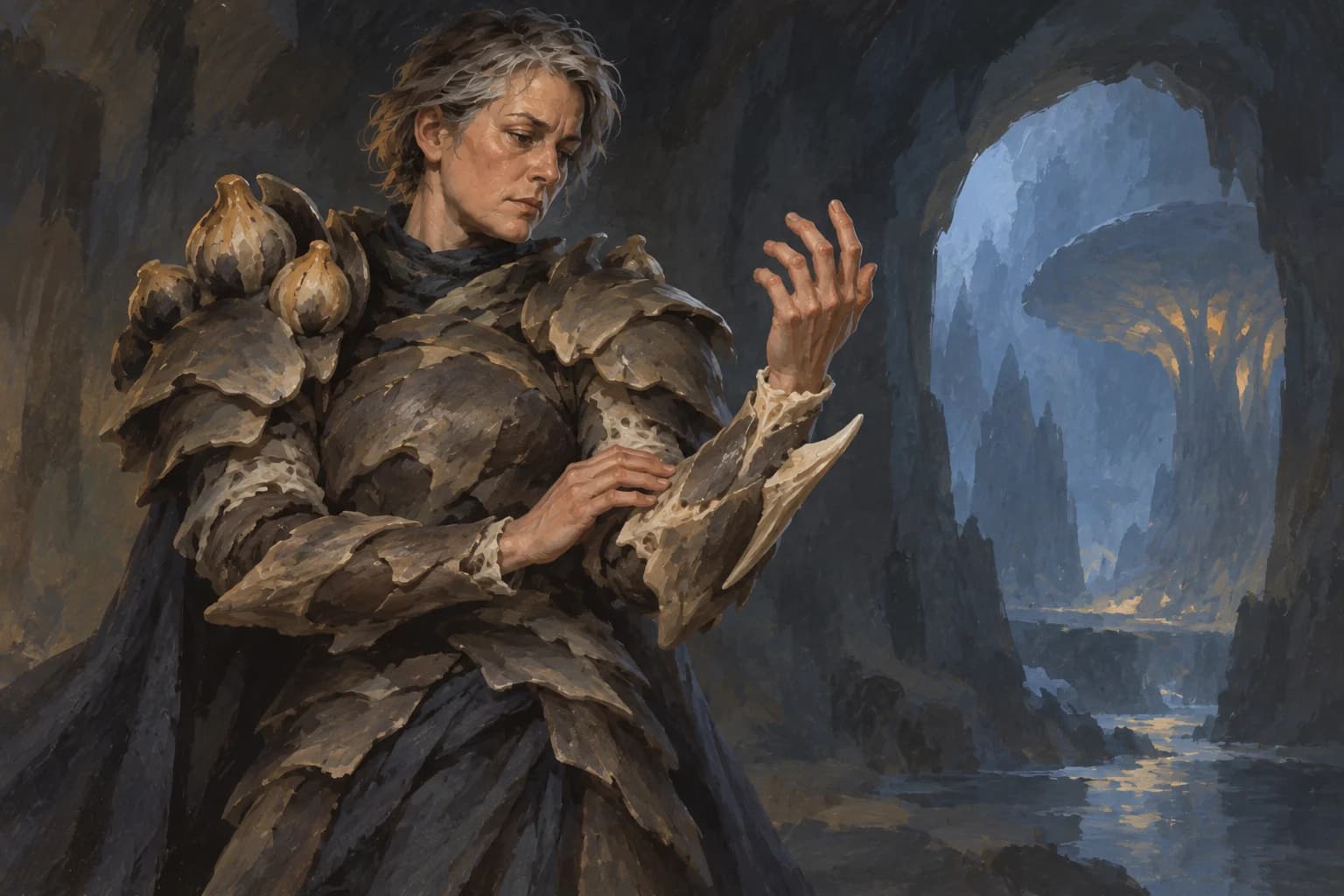
Subclasses for Warriors
The Deep does not forge its champions; it grows them. Where a surface warrior is the sum of drill and scar, a warrior of the Mycelial Deep is often something shared — a body that has learned to carry a second, hungrier will and turn it toward the enemy. The three subclasses that follow give the Barbarian, the Fighter, and the Monk a way to make that bargain in the field. Each stands on its own as a martial path; each also opens a door to the symbiosis rules of Chapter 5, so that the point of Communion you spend and the Infestation you risk are the same currency that decides whether the fury, the graft, or the flowing Weave is finally yours.
Path of the Infested
Most who carry a symbiote spend their lives keeping the peace with it, coaxing its gifts out a careful point at a time. You made the opposite covenant. Somewhere — in the weeping fog of the Bruise, or in a rite the Sporesung would not name aloud — you invited a predatory symbiote past every wall a wiser host would have kept, and told it to come when you called. Now your rage is not only yours. When the red rises, the thing beneath your skin rises with it: barbs erupt from your forearms, your veins run luminous and dark, and for a span of murderous minutes you are two hunters wearing one hide. Other paths spend their strength keeping the symbiote asleep; you spend yours pointing it at the enemy and getting out of its way. You do not fear the Whisper. You have learned to let it scream in the same voice you do, and to be the one still standing when it quiets — to walk off the field, wipe the ichor from your barbs, and answer to your own name when someone calls it. “The trick,” a Weeping Front barbarian once told Warden-Mother Sedge, “is to be angrier than it is.” She did not laugh, because she had buried three who forgot the trick, and one who had never learned it at all.
Level 3: The Feral Bond. You have bonded a war-symbiote that sleeps beneath your skin and wakes with your fury. It occupies one of your three bond slots (see Chapter 5), but it is fused to you and cannot be released while you retain this feature. As a Boon, the symbiote grows you a natural weapon — barbed limbs — whenever you wish. Your barbed limbs deal 1d8 Slashing damage, use your Strength, count as a Simple Melee weapon with which you have proficiency, and can't be disarmed, sundered, or taken from you.
In addition, the symbiote feeds on the harm you deal and passes a share of the vitality back to you. While your Rage is active, once on each of your turns when you hit a creature with a melee weapon (including your barbed limbs), that creature takes an extra 1d6 Necrotic damage, and you gain Temporary Hit Points equal to your Rage Damage bonus. The barbs are not subtle: a foe struck by them bruises spore-green around the wound, and the mark lingers for a day, so that everyone can see exactly what it was that opened them.
Level 6: Fury Drowns the Whisper. The louder your rage, the less the symbiote can be heard beneath it, and the more freely it gorges on what you feel. While your Rage is active, you have Advantage on Communion saving throws. In addition, each time you enter a Rage, the bond drinks deep and you regain Communion Points equal to your Rage Damage bonus; this can't raise your Communion Points above your maximum of Proficiency Bonus + Constitution modifier.
Level 10: Lashing Thorns. The barbs answer an attacker before you can decide to. While your Rage is active, when a creature within 5 feet of you hits you with an attack, you can take a Reaction to make one melee attack against it with your barbed limbs. On a hit, in addition to the attack's damage, you can pull the creature up to 10 feet straight toward you if it is Large or smaller.
Level 14: The Bloom Ascendant. In your fury the symbiote surfaces fully, and you become a walking sickness to everything nearby. While your Rage is active, you have Resistance to Necrotic and Poison damage, you are immune to the Poisoned condition, and you are wreathed in a 10-foot Emanation of caustic spores. Once on each turn, when a creature enters the Emanation for the first time on a turn or starts its turn there, it makes a Constitution saving throw against your Symbiote save DC, equal to 8 + your Proficiency Bonus + your Constitution modifier. On a failed save, the creature takes 2d6 Poison damage and can't regain Hit Points until the start of its next turn; on a successful save, it takes half as much damage and suffers no other effect.
The Grafted
Some knights are given their armor. You grew yours. A spore-graft — part carapace, part second skin, part patient parasite — took root along your bones and has been spreading ever since, closing over old wounds, sprouting spurs where you needed a blade, weeping caustic spores when struck. The Hollowed Court calls your kind “continuants in the making,” and means it as flattery; the Sporesung watch you with a quieter worry. You are a wall that heals, a soldier who is never truly disarmed, and a slow lesson in how much of a person a symbiote can wear before the question stops mattering. You have felt the graft close a killing gash while you were still deciding whether it hurt; you have reached for a blade and found the blade already growing out of your own hand. There is a comfort in that, and a warning, and you have made your peace with both. “I have not taken a wound in ninety years that stayed,” Lord-Continuant Ashveil is fond of saying, “and not one thought in ninety years I am wholly certain was mine.” You intend to prove the second half of that need not follow the first — to master the graft so completely that when it finally quiets, the hand still on the sword is yours.
Level 3: The Living Graft. You have bonded an armor-symbiote grafted to your body. It occupies one of your three bond slots (see Chapter 5) and is fused to you; it can't be released while you retain this feature. As a Boon, the graft grows bone-spurs you can extend or withdraw at will. Your bone-spurs deal 1d8 Piercing damage, use your Strength or Dexterity (your choice), count as a Simple Melee weapon with which you have proficiency, and can't be disarmed or taken from you.
Moreover, your graft blooms when you draw on your own resilience. When you use Second Wind, choose one of the following additional effects: you gain Temporary Hit Points equal to your Fighter level; or each creature of your choice within 5 feet of you makes a Constitution saving throw against your Symbiote save DC (8 + your Proficiency Bonus + your Constitution modifier) or has the Poisoned condition until the end of its next turn; or you end one of these conditions on yourself — Blinded, Frightened, or Poisoned.
Level 7: Caustic Carapace. The graft answers pain with pain. When a creature you can see hits you with an attack, you can take a Reaction to vent a spray of spores at it. The attacker takes Poison damage equal to 1d8 + your Constitution modifier and must succeed on a Constitution saving throw against your Symbiote save DC or have the Poisoned condition until the end of its next turn. You can use this feature a number of times equal to your Constitution modifier (minimum once), and you regain all expended uses when you finish a Short or Long Rest.
Level 10: Bloomstrike. You can force the graft to erupt through the wound you have just opened. Once on each of your turns when you hit a creature with an attack, you can spend 1 Communion Point to make the strike bloom. The target takes an extra 2d6 Poison damage, and each other creature within 5 feet of it makes a Dexterity saving throw against your Symbiote save DC, taking 2d6 Poison damage on a failed save or half as much on a successful one.
Level 15: Rampant Growth. The graft spreads faster than any wound can outpace it. Your bone-spurs now deal 1d10 Piercing damage. In addition, once on each of your turns when you score a Critical Hit or reduce a creature to 0 Hit Points, the graft surges: you gain Temporary Hit Points equal to your Constitution modifier + your Proficiency Bonus, and you regain one expended use of Second Wind.
Level 18: Endless Bloom. You and the graft have become a single, self-mending thing. At the start of each of your turns while you have at least 1 Hit Point and no more than half your Hit Point maximum, you regain Hit Points equal to 5 + your Constitution modifier. While you are bonded to your graft, you also have Advantage on Death Saving Throws, and you automatically stabilize at the start of your turn while at 0 Hit Points. Finally, the graft no longer fights the self it protects: each time you finish a Long Rest, reduce your Infestation by 1 additional step (to a minimum of 0), even if you overreached that day.
Way of the Living Weave
The other monks of the Deep discipline the body until it holds still enough to hear the Weave Below. You went further: you opened the body and let the Weave run through it. Now the great mycelial current does not merely surround you — it flows in your breath and pools in your hands, and your Focus and the Weave are two names for one moving thing. Your strikes plant more than bruises. Hyphae bloom from your knuckles to root an enemy where it stands; a seed pressed into a wound waits, patient as the Deep itself, for the day you call it open. You are a channel the Weave has learned to trust, which is its own quiet danger — for a channel is a thing water may one day decide to keep. The Sporesung who trained you spoke of it as an honor and an erosion in the same breath: the current wears the stone even as it polishes it. So you move, always, because still water is what settles and claims. You walk that edge the way you walk everything: lightly, and without stopping, letting the Weave pass through your open hands and out again before it can pool.
Level 3: Living Weave Technique. You thread the Weave through your unarmed blows. Whenever you hit a creature with one of the attacks granted by your Flurry of Blows, you can impose one of the following effects on that target. The saving throws use your monk save DC (8 + your Proficiency Bonus + your Wisdom modifier).
Rooting Hyphae: the target makes a Dexterity saving throw or has the Prone condition as fungal threads snare its feet. Spore Shove: the target makes a Strength saving throw or is pushed up to 15 feet away in a burst of spores. Severing Weave: the target can't take Reactions until the end of your next turn.
Level 6: Woven Communion. Your Focus and the Weave are a single current, and you can pour one into the other. Once on each of your turns, you can spend 1 Focus Point in place of 1 Communion Point when you activate a symbiote's Gift. In addition, once on each of your turns when you hit a creature with an Unarmed Strike, you can spend 1 Focus Point to drive a seed of the Weave into the wound. The target makes a Constitution saving throw against your Symbiote save DC (8 + your Proficiency Bonus + your Constitution modifier). On a failed save, it takes Poison damage equal to two rolls of your Martial Arts die and has the Poisoned condition until the end of its next turn.
Level 11: The Weave Answers. The living network carries you where you will it. Whenever you spend a Focus Point to take the Flurry of Blows, Patient Defense, or Step of the Wind Bonus Action, you can also take the Step of the Wind Bonus Action for free (Disengage and Dash, and your jump distance is doubled for the turn). In addition, Difficult Terrain made of fungus, root, or living growth costs you no extra movement, and during your turn you can move across liquids, webs, and sheer fungal surfaces without falling.
Level 17: The Blooming Seed. You can plant a death in a body and let it grow. When you hit a creature with an Unarmed Strike, you can spend 4 Focus Points to sow a dormant seed of the Weave inside it. The seed is harmless until you end it, and you can have only one creature seeded at a time. For a number of days equal to your Wisdom modifier (minimum 1), while you and the seeded creature are on the same plane, you can take a Magic action to make the seed bloom, no matter the distance between you. The target makes a Constitution saving throw against your Symbiote save DC. On a failed save, it takes 10d12 Necrotic damage, and if this reduces it to 0 Hit Points it dies as the bloom devours it from within; on a successful save, it takes half as much damage. You can end the seed harmlessly, requiring no action.
Subclasses for the Skilled & the Sworn
The Deep does not make its heroes the way the surface does. It grows them. The three subclasses that follow — one Rogue, one Ranger, one Paladin — each answer the same quiet question the Weave Below asks of everyone who walks it: how much of yourself will you lend, and how much will you keep? Every one of them leans on the symbiosis rules in Chapter 5 — the Communion Points (CP) you spend, the Symbiote save DC of 8 + your Proficiency Bonus + your Constitution modifier, and the slow accounting of the Infestation Track — so that the power each grants is always power carried, never power owned. Build them beside the 2024 subclasses and you will find they sit level with the Assassin, the Hunter, and the champions of Devotion, no stronger for their strangeness.
Symbiont Stalker
A Rogue Subclass
Some hunters of the Deep learn to move quietly. The Symbiont Stalker learns to disappear — because something is doing it for them. Each of these rogues carries a bonded predator beneath the skin, a stalking symbiote that spreads a numbing veil of spores, climbs where fingers cannot, and pours a killing bloom into every wound its host opens. The Sporesung call them the Quiet Mouths of the Weave, and speak of them the way one speaks of a held breath. A Symbiont Stalker does not sneak up on you. By the time you feel the cold in the wound, the two of them have already gone.
Level 3: The Stalking Graft. You bond a hunting symbiote called the Clingshade, and it is grown into you without the usual rite. This bond occupies one of your three bond slots (see Chapter 5), and the Clingshade can't be released or targeted apart from you. While it is with you, you gain its Boon: you have a Climb Speed equal to your Speed, and you can take the Hide action whenever you are Lightly Obscured — by dim light, spores, foliage, or gloom — even without cover.
The Clingshade also feeds on the wounds you open. When you deal Sneak Attack damage to a creature, you can spend 1 CP to force it to make a Constitution saving throw against your Symbiote save DC (8 + your Proficiency Bonus + your Constitution modifier). On a failed save, the creature has the Poisoned condition until the end of your next turn, and while Poisoned this way it can't regain Hit Points.
Level 9: The Clinging Dark. The symbiote learns to hide the both of you. When you take the Hide action, you have Advantage on the check, and until you move more than half your Speed or take an action, creatures have Disadvantage on Wisdom (Perception) checks made to find you. In addition, so long as you are bonded to at least one symbiote, you have Advantage on Initiative rolls.
Level 13: Blooming Contagion. Your killing spores take root and spread. When a creature fails its saving throw against your Level 3 feature, it takes 2d6 Poison damage at the start of each of its turns and remains Poisoned; at the end of each of its turns it repeats the save, ending the effect on a success. Further, when a creature Poisoned by this feature is reduced to 0 Hit Points or dies, the bloom leaps free: one creature of your choice within 10 feet of it must succeed on the same saving throw or become Poisoned by this feature as well.
Level 17: The Killing Bloom. You and the Clingshade have become a single, perfect predator. You have Advantage on attack rolls against any creature that hasn't taken a turn yet in combat. When you hit a creature that hasn't taken a turn yet in this combat with an attack roll, you can force it to make a Constitution saving throw against your Symbiote save DC. On a failed save, you double the damage of that attack against the target, and the spores flood the wound so that it can't regain Hit Points until the end of your next turn. Once you use this feature, you can't use it again until you finish a Short Rest or Long Rest.
Deeproot Warden
A Ranger Subclass
The Deeproot Circle does not protect the Weave from a distance. Its wardens bond with it — sinking a rootling symbiote into their own flesh until the difference between defending the Deep and being the Deep grows thin. A Deeproot Warden reads the ground through the soles of their feet, calls up grasping roots to hold a foe where it stands, and knows the long, patient rite by which the Sporesung draw a poisoned self back from the edge of Infestation. Warden-Mother Sedge, eldest of them, has walked the Weeping Front so long that new growth follows her footprints. “The Weave is not ours to save,” she says. “We are its, and it saves itself through us.”
Level 3: Warden's Roots. You bond a rootling symbiote called the Deeprootling, grown into you without the usual rite. This bond occupies one of your three bond slots (see Chapter 5). While it is with you, you gain its Boon: you have a Burrow Speed of 10 feet through loam, loose earth, and fungus, and you have Advantage on Wisdom (Perception) checks that rely on scent or on vibration carried through the ground.
You can also call the roots to your aid. When you hit a creature with a weapon attack, you can spend 1 CP to erupt grasping roots beneath it. The creature makes a Strength saving throw against your Symbiote save DC (8 + your Proficiency Bonus + your Constitution modifier). On a failed save, its Speed becomes 0 until the start of your next turn.
Level 7: Warden's Communion. You are taught the Sporesung communion rite. Over the course of a Long Rest, you can lead a night-long communion for yourself and any allies who rest with you; at its end, reduce the Infestation of each willing participant by 2, exactly as the Sporesung rite in Chapter 5. Because this counts as Sporesung communion, it can draw a creature back even from Step 5 of the Infestation Track.
In addition, the Weave shields those who keep close. You and each ally within 10 feet of you have Resistance to Poison damage and Advantage on Communion saving throws forced by Blight exposure.
Level 11: Grasping Weave. Your roots no longer merely hold — they crush and bind. When a creature fails the saving throw against your Warden's Roots, it instead takes 2d6 Bludgeoning damage and has the Restrained condition (escape DC equals your Symbiote save DC) until the start of your next turn, and it repeats the save at the end of each of its turns, ending the effect on a success. Furthermore, when you use Warden's Roots you can spend 2 CP rather than 1 to catch a second creature within 10 feet of the first; each makes its own saving throw against the same effect.
Level 15: Heartwood Aegis. The Deep will not let its warden fall easily. When you take damage, you can use your Reaction and spend 1 CP to sheath yourself in living heartwood: until the start of your next turn, you have Resistance to all damage and can't be moved against your will. You can use this Reaction to protect one creature within 5 feet of you instead of yourself.
Oath of Continuance
A Paladin Subclass
In the Deep, the dead are not buried. They are continued — folded gently back into the Weave, so that nothing that lived is ever wholly lost. The paladins of the Oath of Continuance take that funeral rite and make of it a battle-creed: no ally falls while they can hold the line between here and gone, no ending is final while breath and root remain. They are healers who wear plate, wardens of the last threshold, and they walk toward the dying the way others walk toward light. Sporefather Umble blesses them with the same words each time: “Go, and let nothing end that does not choose to.”
Tenets of Continuance. An oathsworn of Continuance holds the last threshold against every ending they can reach.
Let None Fall Alone. Where you can stand between an ally and the dark, you stand there. No companion is spent until you have spent yourself.
Refuse the Final Word. Death is the Deep's to speak, not the Blight's and not despair's. Contest every ending that is not freely chosen.
Carry Them Onward. What lived is not lost; it is continued. Honor the fallen by folding their memory into the road ahead and walking it.
Level 3: Oath Spells. You always have the following Oath of Continuance spells prepared, and they don't count against the number of spells you can prepare. You gain each pair when you reach the listed Paladin level.
Oath of Continuance Spells
| Paladin Level | Prepared Spells |
|---|---|
| 3 | false life, heroism |
| 5 | aid, gentle repose |
| 9 | aura of vitality, revivify |
| 13 | aura of life, death ward |
| 17 | greater restoration, raise dead |
Level 3: Channel Divinity: Deny the Ending. You can use your Channel Divinity to snatch a life back from the brink. When a creature you can see within 30 feet of you (which can be yourself) is reduced to 0 Hit Points but not killed outright, you can take a Reaction to expend one use of your Channel Divinity. That creature instead drops to a number of Hit Points equal to your Paladin level, and it doesn't fall Prone from the blow.
Level 7: Aura of the Unbroken. Continuance flows from you to all who stand near. While you aren't Incapacitated, you and your allies in your Aura of Protection have Advantage on Death Saving Throws and on Communion saving throws — the Constitution saves that hold back Infestation. In addition, an ally reduced to 0 Hit Points while in your aura is automatically Stabilized.
Level 15: Rite of Continuance. You have mastered the deepest healing the oath can offer, the mending not of the body but of the self. Whenever you finish a Long Rest, you can perform the rite of continuance over yourself or one willing creature who rested beside you; this counts as Sporesung communion and reduces that creature's Infestation by 2, working even at Step 5 of the Infestation Track.
Your smites carry that same refusal of endings. When you expend a spell slot to cast Divine Smite, you gain Temporary Hit Points equal to 2 + the slot's level, and so does each ally within 10 feet of you.
Level 20: The Undying Bloom. As a Bonus Action, you become a living beacon of continuance for 10 minutes. For the duration, you have Resistance to all damage, and you can't be Charmed or Frightened. Moreover, the first time each ally within 30 feet of you would drop to 0 Hit Points during this effect, they drop to 1 Hit Point instead. Once you use this feature, you can't use it again until you finish a Long Rest, unless you expend a level 5 spell slot to use it again.
Subclasses for the Devout & the Learned
The Weave does not much care which book a person learned their power from. It answers a Sporesung priest kneeling in the loam of Softloam and a Deeproot warden burning blight on the Weeping Front and a Gleaner scholar who has decided that a spore is only an equation not yet solved — and it answers each of them a little differently. The three subclasses that follow are the Deep's reply to the devout and the learned alike: one Cleric domain, one Druid circle, and one Wizard tradition, each grown around the same strange soil. Each leans, in its own way, on the symbiosis rules of Chapter 5, and each rewards a character who dares bond a second self — yet none requires it. Play any of them with an empty bond slot and you lose nothing but the deepest of their gifts. Throughout, remember that Constitution is the anchor of symbiosis: it sets your Communion pool, steadies you against Infestation, and powers the Gifts of anything you carry beneath your skin.
Cleric: Domain of the Weave
There is a faith older than any altar in the Mycelial Deep, and it does not pray so much as it listens. The Sporesung tend the great living network as one tends a dying and undying god at once, singing the rite of continuance over the fallen and folding the dead gently back into the loam. Clerics of the Domain of the Weave are the voices of that faith made martial — healers, keepers of memory, and quiet wardens against the rot that would turn shared life into swallowed self. Where the Life Domain honors the spark, the Weave honors the thread: the long, patient continuity that outlasts any single flame. Sporefather Umble is the domain's living exemplar, but its priests walk every Reach, and where they walk, fewer of the wounded are left behind.
A cleric of this domain does not see death as an enemy to be beaten so much as a door to be tended, opened gently and, when the Weave wills it, opened both ways. They carry the loosed memories of the dead cupped like water in the hands, and they are as apt to be found singing over a gravebloom as raising a Holy Symbol against the Blight Below. It is a gentle domain with a spine of iron: nothing that has ever laid a wounded companion into safe loam and sung them whole again is soft.
Level 3: Domain of the Weave Spells. Your connection to the Weave grants you access to certain spells. When you reach a Cleric level specified in the Domain of the Weave Spells table, you thereafter always have the listed spells prepared, and they don't count against the number of spells you can prepare.
Domain of the Weave Spells
| Cleric Level | Prepared Spells |
|---|---|
| 3 | Detect Poison and Disease, Gentle Repose, Healing Word, Warding Bond |
| 5 | Aura of Vitality, Revivify |
| 7 | Aura of Life, Death Ward |
| 9 | Greater Restoration, Mass Cure Wounds |
Level 3: Tender of the Continued. The Weave lends its own vitality to your healing. When you cast a spell with a spell slot that restores Hit Points to a creature, that creature regains additional Hit Points equal to 2 plus the spell slot's level. A creature threaded with grave-fungus feels the loam answer twice at once.
Level 3: Channel Divinity: Rite of the Weave. You can use your Channel Divinity to call up a bloom of healing spores. As a Magic action, you present your Holy Symbol and evoke a soft, luminous cloud that knits wounds. Choose any creatures within 30 feet of yourself, and divide Hit Points among them equal to five times your Cleric level. This feature can restore a creature to no more than half its Hit Point maximum, and it has no effect on Undead or Constructs.
Level 6: Communion of the Sporesung. You have learned to lend the bond your steadying song. As a Bonus Action, you touch a creature bonded to a symbiote (which can be you), and the Weave answers through your blessing: that creature regains Communion Points equal to your Wisdom modifier (minimum 1), up to its Communion maximum. You can use this a number of times equal to your Proficiency Bonus, and you regain all expended uses when you finish a Long Rest.
In addition, you can lead the night-long rite of Sporesung communion. When you finish a Long Rest during which you tend a willing creature (which can be you), that creature reduces its Infestation by 2.
Level 17: Supreme Continuance. The rite that once took a whole night now lives in a single breath of yours. When you roll dice to restore Hit Points with a spell or with your Channel Divinity, you instead use the highest number each die can roll.
In addition, once per Long Rest you can compress the rite of continuance into a moment. As a Magic action, you touch a willing creature and reduce its Infestation by 2. This counts as Sporesung communion for the purpose of reducing Infestation at the higher steps of the track, where ordinary rest no longer reaches.
Druid: Circle of the Mycelium
The Deeproot Circle does not worship the Weave. It is the Weave, in the way a fingertip is the hand — druids who have let the living network reach up through their own flesh until the line between warden and wilderness has gone soft and warm. The Circle of the Mycelium are the deepest-bonded of them all. Where other druids borrow the shapes of beasts, these borrow the will of the Deep itself, carrying a second self openly and teaching it to fight beside them rather than beneath them. Warden-Mother Sedge, who has held the Weeping Front longer than most delvers have drawn breath, walks this circle; her students learn early that the safest way to carry a symbiote is to stop pretending you are only one thing.
To join this circle is to accept, on purpose, the very bond that other folk of the Deep spend their lives learning to fear. A druid of the Mycelium bonds not out of desperation but out of stewardship: they take the Weave's gifts openly so that the Weave will not have to take them by surprise. It is a discipline of balance more than of ferocity — of knowing precisely how far to reach into the second self and precisely when to stop — and the wardens who master it become the surest hands the Deeproot Circle can send into the fog.
Level 3: Weavebound. Your training opens you to the Deep's oldest gift. Choose one symbiote from among those described in Chapter 5, or another your DM offers; you are bonded to it. Establishing this bond does not require a rest, and it counts against your limit of three bonds as normal. If it is ever lost, you can bond a replacement over a Short or Long Rest.
More than that, the Circle has taught you to carry the second self without being carried. You have Advantage on Communion saving throws — the Constitution saving throws you make against Infestation when you overreach or when the blight reaches for you.
Level 6: Deepening Bond. You spend Communion the way a river spends water, and lose less of yourself for it. A number of times equal to your Proficiency Bonus, when you activate a symbiote's Gift, you can reduce its Communion Point cost by 1 (to a minimum of 1 CP). You regain all expended uses when you finish a Long Rest.
As a warden of the Deeproot Circle, you can also lead the night-long rite of Sporesung communion. When you finish a Long Rest during which you tend a willing creature (which can be you), that creature reduces its Infestation by 2.
Level 10: Bloomhardened. The spore-sickness that fells surfacers is nothing to you now. You are immune to the Poisoned condition, and you have Resistance to Poison damage. In addition, when you or a creature bonded to a symbiote that you can see within 30 feet of you takes damage, you can take a Reaction and spend 1 Communion Point to harden the bond into a shield, granting that creature Resistance to that instance of damage.
Level 14: One with the Weave. You and your second self have become a single, seamless will. Once per Long Rest, you can activate a symbiote's Gift without spending Communion Points and without overreaching — the Weave simply gives. In addition, once per Long Rest, when you fail a Communion saving throw, you can choose to succeed instead. The pull that has claimed so many wardens finds, in you, nothing left to take.
Wizard: School of the Sporewright
Most wizards study the fire, the frost, and the folding of space. The Sporewrights study the spore — and insist, to anyone who will listen and many who will not, that it is the most elegant magic of all: a single seed that becomes a forest, a whisper of dust that becomes a plague, an equation that solves itself in living tissue. Mycomancy is a young tradition, born among Gleaner scholars in Lumen Hollow who came down to trade and stayed to learn, and it treats the Weave Below as the largest arcane text ever written. A Sporewright inscribes spellbooks into living bracket-fungus, seeds a battlefield the way a farmer seeds a field, and — most daring of all — studies the symbiote not as a curse to be feared but as a variable to be balanced.
That last conceit is what sets a Sporewright apart, and what makes older wardens nervous around them. To a Sporesung priest the bond is a sacrament; to a Deeproot warden it is a duty; to a Sporewright it is a fascinating problem, and problems are meant to be pushed. They alone among the learned treat Communion, Infestation, and the slow arithmetic of overreach as a system to be optimized rather than a fate to be endured — which makes them brilliant, useful, and precisely the sort of person the Blight Below likes to find still awake in a Lumen Hollow reading-loft, one experiment too far along.
Level 3: Sporewright Savant. You have filled a whole shelf of your living spellbook with the grammar of growth and decay. When you reach a Wizard level specified in the Sporewright Spells table, you add the listed spells to your spellbook for free. Each of these spells counts as a Wizard spell for you, is always prepared, and doesn't count against the number of spells you can prepare. In addition, whenever you add a spell to your spellbook that has the Conjuration or Transmutation school, the time and gold you must spend to copy it are halved.
Sporewright Spells
| Wizard Level | Sporewright Spells |
|---|---|
| 3 | Entangle, Ray of Sickness, Spike Growth, Web |
| 5 | Plant Growth, Stinking Cloud |
| 7 | Blight, Evard's Black Tentacles |
| 9 | Cloudkill, Contagion |
Level 3: Cultivated Spores. You tend a living reagent-garden in the pages of your bracket-fungus spellbook. You can use a pinch of cultivated spores as a Spellcasting Focus for your Wizard spells, and you can replace any Material component of a Wizard spell that has no listed cost with grown spore-matter. In addition, you learn the Detect Poison and Disease spell; it is always prepared, it doesn't count against the number of spells you can prepare, and you can cast it as a Ritual, reading a creature's hidden sickness in the fine dust its body sheds.
Level 6: Arcane Symbiosis. You have learned to run your magic and your second self through the same channels — though each keeps its own voice. A symbiote's Gift still forces its saving throws against your Symbiote save DC (8 plus your Proficiency Bonus plus your Constitution modifier), never your spell save DC; the bond answers to the body that shares it, not the book that studies it.
What you have gained instead is a way to feed one power from the other. As a Magic action, you can expend a spell slot to regain Communion Points equal to the slot's level, up to your Communion maximum. You can do this a number of times equal to your Intelligence modifier (minimum once), and you regain all expended uses when you finish a Long Rest.
Level 10: Empowered Spores. Your seeded magic bites deeper than any rival's, and even those who dodge it cannot shake off the residue. Once on each of your turns when you roll damage for a Wizard spell that has the Conjuration or Transmutation school, or that deals Poison or Necrotic damage, you can add your Intelligence modifier to one damage roll of that spell. In addition, when you cast a cantrip that deals damage and a creature succeeds on its saving throw against the cantrip, the creature still takes half the cantrip's damage (rounded down), though it suffers no additional effect. The bloom always finds the soft tissue.
Level 14: Overbloom. You can force a spell to its fullest, most riotous flowering — and, if you dare, let the bond pay the price. When you cast a Wizard spell of level 1 through 5 that deals damage, you can deal maximum damage with that spell.
The first time you use this feature after a Long Rest, you suffer no ill effect. If you use it again before you finish a Long Rest, you take 2d12 Necrotic damage per level of the spell immediately after casting it, and this damage increases by 1d12 per spell level each additional time you use the feature before a Long Rest. This Necrotic damage ignores Resistance and Immunity.
If you are bonded to a symbiote, you can instead pay this cost by overreaching. Rather than taking the Necrotic damage, increase your overreach tally by 2 and make a Communion saving throw — a Constitution saving throw against DC 8 plus your overreach tally (minimum 10). On a failure, you gain 1 Infestation. The Weave is happy to lend; it simply keeps a ledger.
Subclasses for the Gifted & the Golden-Tongued
Magic learned on the surface does not keep its old shape once it is carried down into the Mycelial Deep. Arcane power takes root; a pact is answered by something older and slower than any devil; a song finds a second voice already waiting for it in the spore-song of the Sporesung. The three subclasses that follow — one apiece for the sorcerer, the warlock, and the bard — grow their gifts from spore, dream, and shared breath. Each stands on its own beside the options in the Player's Handbook and can be played with no symbiote bonded at all; each also reaches, at least once, for the living power — and the living cost — described in Chapter 5. Where a feature touches Communion, Infestation, or a bonded symbiote, it uses the numbers set down there and nowhere invents a new one. If your table has left symbiosis on the shelf, those features simply wait, quiet and unspent, until the day you pick a seed up out of the dark and decide to let it in.
Sporeblood Sorcery
My grandmother was continued the year I was born. I have her eyes, my father says, and something else besides — something that flowers when I am afraid.
— a Gleaner spellbinder of Vane's Landing
Some sorcerers carry a dragon's ember in the blood. You carry something that grows. Perhaps an ancestor was continued into the Weave and passed the Deep down through the marrow; perhaps a spore took quiet root in the womb and has been waiting, patient as soil, ever since. Either way, the magic you hold is not merely inside you — it is alive. Your spells smell of turned earth and wet light. Your wounds close over with pale, fruiting bodies. Where you bleed, for a little while, something new tries to live, and the power comes easiest when you are frightened enough to let it. Other sorcerers strain to hold their magic in; you have spent your whole life learning, gently, when to stop holding. That is the trouble with a gift that grows. It does not want to be a spell you cast and set aside. It wants to be you, a little more each season, and it is in no hurry at all.
Level 3: Sporeblood Magic. The spores braided through your blood have always answered you. You always have the following spells prepared, and they don't count against the number of spells you can prepare: Ray of Sickness and Caustic Brew (3rd level); Acid Arrow and Stinking Cloud (5th level); Blight and Vitriolic Sphere (7th level); and Cloudkill and Contagion (9th level). In addition, the living matter woven through your veins hardens you against the poisons of the Deep: your Hit Point maximum increases by 3, and it increases by 1 whenever you gain another sorcerer level. You also have Resistance to Poison damage.
Level 6: Virulent Spores. You have learned to make your magic fester. When you cast a spell that deals Poison or Necrotic damage, you can add your Charisma modifier to one damage roll of that spell. In addition, as a Bonus Action, you can spend 1 Sorcery Point to wreathe yourself in a drifting haze of spores for 1 hour, gaining Resistance to Poison and Necrotic damage for the duration.
Level 14: Font of Spores. Your blood has become fertile ground, and the living things you carry drink from it freely. Bleeding the Bloom. As a Bonus Action, you can spend 2 Sorcery Points to regain 1 expended Communion Point (see Chapter 5), up to your Communion Point maximum — your Proficiency Bonus + your Constitution modifier (minimum equal to your Proficiency Bonus + 1). Overripe Magic. Creatures no longer have Resistance to the Poison damage of your spells, and any creature that fails a saving throw against a sorcerer spell you cast that deals Poison or Necrotic damage also has the Poisoned condition until the end of your next turn.
Level 18: Contagion Incarnate. You have become a walking bloom, and death takes root wherever your magic falls. As a Magic action, you exhale a 30-foot Cone of virulent spores. Each creature in that area makes a Constitution saving throw against your spell save DC. On a failed save, a creature takes 10d6 Poison damage and has the Poisoned condition for 1 minute; on a successful save, it takes half as much damage and isn't Poisoned. A creature Poisoned this way repeats the save at the end of each of its turns, ending the effect on itself on a success. Once you use this feature, you can't use it again until you finish a Long Rest, unless you spend 5 Sorcery Points to use it again. In addition, whenever you reduce a creature to 0 Hit Points with a spell, spores burst from it, and each other creature within 10 feet of it takes Poison damage equal to your Charisma modifier (minimum 1).
The Weave Below
We are not below you. We are beneath everything. We have all the time there has ever been — and we are spending it on you.
— the Weave Below, as dreamed to its warlocks
Your patron has no face, no throne, no name you could speak aloud without your teeth beginning to ache. It has a hunger that is also a kind of love, and it has lain beneath the roots of the world for ten thousand years, dreaming. The Weave Below is the single vast mycelial mind that threads the whole of the Deep — and once, in the dark, it noticed you. Now its dream leaks upward through your bones. You speak in your sleep in a tongue you never learned. And when you ask the Weave for power, it answers the way soil answers a seed: slowly, completely, and forever. Other warlocks bargain with a patron who wants something from them — a soul, a service, a name. The Weave wants nothing so small. It wants only what it is already having: you, one breath and one dream at a time, folded gently into a chorus that has never once fallen silent in ten thousand years. Some who serve it come to find that terrifying. Others come to find it the only peace they have ever known. Most, in the end, feel both, and cannot always tell which thought is theirs.
Level 3: Weave Below Spells. The Deep teaches you spells that reach, and root, and swarm. When you reach a warlock level listed in the Weave Below Spells table, you thereafter always have the listed spells prepared.
Weave Below Spells
| Warlock Level | Spells |
|---|---|
| 3 | Arms of Hadar, Entangle, Spider Climb, Web |
| 5 | Hunger of Hadar, Stinking Cloud |
| 7 | Giant Insect, Grasping Vine |
| 9 | Contagion, Insect Plague |
Level 3: Gift of the Deep. The Weave feeds those who feed it. When you reduce an enemy to 0 Hit Points, or when an enemy within 10 feet of you is reduced to 0 Hit Points, you gain Temporary Hit Points equal to your Charisma modifier + your warlock level (minimum of 1). In addition, you understand the spore-song — the silent, scent-borne speech of myconids and the Sporesung — and can answer it in kind.
Level 6: The Deep's Favor. The dream steadies you when you would otherwise fall. When you make an ability check or a saving throw, you can add a d10 to the roll. You can do so after seeing the roll but before learning whether you succeed or fail. You can use this feature a number of times equal to your Charisma modifier (minimum of once), and you regain all expended uses when you finish a Long Rest.
Level 10: Rooted in the Weave. The Deep has grown into you now, and you into it. Fungal Flesh. Whenever you finish a Short or Long Rest, choose one of the following damage types: Acid, Cold, Fire, Lightning, Necrotic, Poison, or Thunder. You have Resistance to the chosen damage type until you finish a rest and choose a different one. Deep Communion. You are recognized among the Sporesung as one who carries the Weave, and you can lead a Sporesung communion (see Chapter 5). Once per Long Rest, over the course of that rest, you can reduce your Infestation by 2. You also always know your Symbiote save DC, which equals 8 + your Proficiency Bonus + your Constitution modifier. Room for One More. Your bond with the Deep runs deeper than most flesh allows, and your symbiote bond limit increases from three to four (see Chapter 5).
Level 14: Dreamed Under. You can pull a creature down into the Deep's dream, where a single moment lasts an age. Once per turn when you hit a creature with an attack roll, you can force that creature to make a Charisma saving throw against your spell save DC. On a failed save, the creature vanishes into the dreaming Deep, where it has the Incapacitated condition and can't be affected by anything, until the start of your next turn. It then returns to the space it left, or to the nearest unoccupied space, and takes 8d10 Psychic damage from the strange, devouring peace it has glimpsed. Once you use this feature, you can't use it again until you finish a Long Rest, unless you expend a Pact Magic spell slot (no action required) to use it again.
College of Spore-Song
The surfacer thinks a song is a thing you make. Down here, child, a song is a thing you join.
— Sporefather Umble, Sporesung elder of Softloam
Long before the surface folk carried lute and lyre down the Downstair Gate, the Deep was already singing. The Sporesung speak in that song: a slow chord of scent and spore passed mouthless from myconid to myconid, older than any spoken tongue. The bards of the College of Spore-Song have learned to join the chorus — to weave their own music into the shared song of the Weave until an ordinary melody carries spores that mend a wound, cloud an enemy's eyes, or quiet the Infestation gnawing at a friend. When you perform, others do not merely hear you. They breathe you in. A ballad in Lumen Hollow becomes, in your throat, a thing that settles on the skin and works inward; a war-chant on the Weeping Front carries spores that scab a wound before the blood has finished falling. The Sporesung do not think of this as a new music grafted onto their old one. They think of it as a surfacer, at long last, learning to stop shouting over the song and sing inside it. It is the highest compliment they know, and they pay it to very few.
Level 3: Song of Spores. You gain proficiency in the Nature and Medicine skills and with the Herbalism Kit. More than that, you learn to lace your Bardic Inspiration with living spores and to spend it in two ways. Dissonant Spores. When a creature you can see within 60 feet makes a damage roll or succeeds on an attack roll or an ability check, you can take a Reaction to expend one use of your Bardic Inspiration, rolling the Bardic Inspiration die and subtracting the number rolled from the creature's roll. You can do this after the creature rolls but before you learn whether it hits or succeeds, and biting spores may turn a hit into a miss or a success into a failure. Healing Spores. Alternatively, when a creature you can see within 60 feet takes damage, you can take a Reaction to expend one use of your Bardic Inspiration and grant that creature Temporary Hit Points equal to the number rolled on the Bardic Inspiration die + your Charisma modifier, as soothing spores knit over the wound.
Level 6: Sporesung Chorus. Your voice has been welcomed into the deeper verses of the Weave's song. Deeper Verses. Choose two spells from the Druid or Cleric spell list, each of a level you can cast. The chosen spells are always prepared for you and count as bard spells for you. Whenever you gain a bard level, you can replace one of these spells with another spell of a level you can cast from the Druid or Cleric list. Sporesung Communion. The Sporesung name you a cantor of the shared song. Over the course of a Long Rest, you can lead a Sporesung communion (see Chapter 5) for yourself and any number of willing creatures resting with you. Each participating creature reduces its Infestation by 2.
Level 14: Chorusbloom. Your song has grown roots, and it steadies your own hand as surely as any other's. When you fail a D20 Test, you can expend one use of your Bardic Inspiration, roll the Bardic Inspiration die, and add the number rolled to the roll, potentially turning the failure into a success. If the roll still fails, you don't expend that use of Bardic Inspiration. In addition, whenever you use your Song of Spores feature, you can affect a second creature within range with the same effect, expending only a single use of Bardic Inspiration for both.