
The Torch
The water in the lower gallery comes up to the knee and is colder than it has any right to be. Nine miners stand in it, one behind the other, because the man at the front has stopped. The gallery forks there. Left runs dry and level. Right drops away under the water, and somewhere down it a prop is groaning like a ship's mast.
He doesn't move. Nobody behind him can pass in a passage this narrow, and the water is still rising.
The woman third in line hands her pick to the boy beside her and wades forward. She doesn't argue with the man at the front. She takes the torch out of his hand as if he had offered it, and she puts her free hand flat against the nearest timber and waits. The wood is wet, and it is holding. She tries the next one. That one shivers, so she says "Not that one, keep to the left wall," loudly enough for the last miner to hear, and goes left.
After that she talks the whole way. Ten paces, a loose stone. Low beam, duck. Five paces, step up. She never looks back, but every time someone stumbles she stops until the sound of splashing settles again.
At the shaft she gives the torch back to the man who froze. He climbs first.
A torch is a working tool. It doesn't belong to anyone in particular, and it passes down the line from hand to hand. You are the one who makes sure it never hits the water. You walk at the front with it, you call back what you find, and you hand it on when the way is clear.
Playing a Fighter
You are the most reliable weapon in the party. You make more attacks than anyone, two at level 5, three at level 11 and four at level 20, and Action Surge gives you the one turn that decides a fight. Your Second Wind is more than healing. Tactical Mind spends it on failed checks, and the Forlorn Hope, the Arbalist and several feats in this chapter spend it too, so count your uses and ask for a Short Rest before the last door. Weapon Mastery is your toolbox: carry two or three weapons with different masteries, such as Topple, Push, Sap or Vex, and choose per enemy instead of always swinging the biggest one.
Put your best score in Strength or Dexterity, then Constitution. A Bodyguard wants Wisdom third, for Insight and Perception. An Arbalist is a Dexterity fighter with a Heavy Crossbow and a rope in the pack. A Forlorn Hope wants Constitution as high as Strength, because everyone will be swinging at you. The Soldier suits every fighter, and so do this book's Miner, Torchrunner and Watchfire Keeper. Your Fighting Style is a feat that you can swap whenever you gain a Fighter level, and this chapter adds eight of them: Shoulder to Shoulder or Living Bulwark for a Bodyguard, Suppressive Shooting for an Arbalist, Clinch Fighting or Nimble Footing for a Forlorn Hope. Battle Orders and Steadying Breath suit any path, and Deep Reserves suits anyone who runs through Second Wind before the second fight.
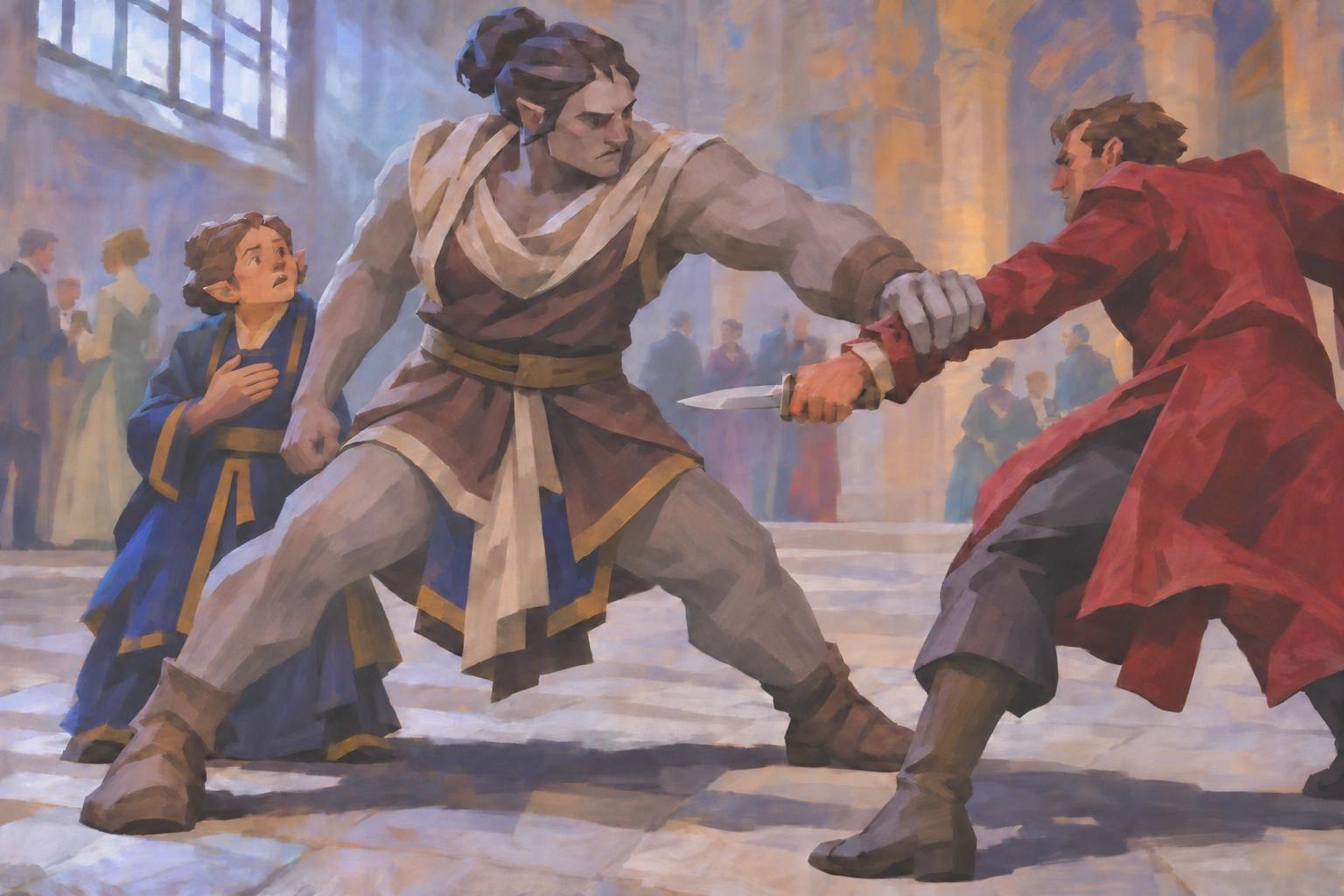
Out of combat, Tactical Mind makes you a dependable backup for any check. Take Athletics, Perception, Insight or Survival, whichever the party lacks, and volunteer for the climb, the watch and the long walk at the front. A Bodyguard is at its best at a crowded reception, reading the room for the knife. An Arbalist lays the rope across the gorge and holds the far end of the bridge. A Forlorn Hope opens the door first, so nobody else has to.
You make everyone around you safer, because enemies have to deal with you first. A wizard or a cleric gets the most out of you, since you keep the space around them clear. A rogue or a ranger gets the cleanest shots at whatever you are holding, and a bard or a paladin who keeps you standing turns a good fighter into a wall. Choose your path by temperament: the Bodyguard if you like keeping one particular person alive, the Arbalist if you like waiting for the perfect moment, and the Forlorn Hope if you love impossible odds and don't mind the bruises.
Fighter Subclasses
There are three ways to walk at the front with the torch. Choose by temperament, not by weapon: one fighter guards a single friend, one waits for the clean shot, and one charges into the worst of it.
Fighter Subclasses at a Glance
| Subclass | Carried | Choose It If You Like |
|---|---|---|
| Bodyguard | held high | keeping one particular person alive, in a fight and at a reception |
| Arbalist | hooded | picking your spot, holding the shot and firing at the perfect moment |
| Forlorn Hope | stoked | impossible odds, a crowd of enemies and the bruises that come with them |
Bodyguard
Stand Between Them and Harm
Every important person who travels has someone walking half a step behind them, watching hands instead of faces. Bodyguards are fighters who took that job and made it a craft. They choose one person to keep alive, and from then on every room is a question of exits, every crowd a question of who is moving the wrong way. When the knife comes, the Bodyguard is already in its path, and the blade has to get through them first. What pulls at them is the one time they might be a step too far away. They never sit with their back to a door.
Shines on: the knife that finds you instead of your friend.
Leaves in the dark: the glory, which goes to whoever you saved.
Level 3: Chosen Ward
When you finish a Short or Long Rest, you can choose one willing creature you can see to be your ward. You can also choose a ward as a Bonus Action. The ward must be Large or smaller and can't be you. You can have only one ward at a time; choosing a new ward ends the old choice.
Swap Places. When a creature you can see attacks your ward while you're within 5 feet of the ward, you can take a Reaction to swap places with your ward before the attack roll is made. You can't do so if either of you has the Incapacitated condition. This movement doesn't provoke Opportunity Attacks. The attack then targets you instead, using your Armor Class, and any effect of a hit applies to you.
Level 3: Threat Reading
You gain proficiency in the Insight skill. If you already have this proficiency, you instead gain proficiency in one of the following skills of your choice: Perception or Persuasion.
In addition, you can take the Search action as a Bonus Action. For example, you can sweep a crowded hall for a hidden crossbow and still attack on the same turn. When you succeed on a Wisdom (Insight) check to read a creature, you also learn whether that creature currently intends to harm you or your ward. The Game Master (GM) answers yes or no and reveals nothing else, such as when, how or why.
Level 7: Escort
After you swap places with your ward using Chosen Ward, your ward can move up to half its Speed without provoking Opportunity Attacks (no action required). The ward chooses where it moves and doesn't have to stay near you.
In addition, while your ward is within 5 feet of you, it has Advantage on Constitution saving throws that it makes to maintain Concentration.
Level 10: Divided Watch
You can have two wards at a time; a new ward replaces one of them. Chosen Ward and Escort work for each.
When you roll Initiative and don't have the Incapacitated condition, you can move up to your Speed toward one of your wards without provoking Opportunity Attacks (no action required). Once on each of your turns when you hit a creature within 5 feet of one of your wards, it takes an extra 1d8 damage of the weapon's type.
Level 15: Interpose
When you take the Reaction of Chosen Ward, you no longer need to be within 5 feet of your ward. As part of that Reaction, you first move up to half your Speed to a space within 5 feet of the ward without provoking Opportunity Attacks, and then you swap places with it. If you can't reach such a space, you don't move.
Level 18: In Your Stead
When your ward fails a saving throw against an effect created by a creature you can see, you can take a Reaction to make the ward succeed instead. You then make that saving throw yourself and suffer its consequences on a failure.
Once you use this feature, you can't use it again until you finish a Long Rest unless you expend a use of your Second Wind (no action required) to restore your use of it.
Arbalist
Wait for the One Clean Shot
A crossbow is a patient weapon. It is slow to load, heavy to carry and merciless when it finally speaks. Arbalists are fighters who learned to love that patience. They pick a spot, set their feet and wait, and while they wait the battlefield comes to them. When the door opens or the charge begins, the bolt is already on its way. Out of combat they are the party's line-layers, shooting rope across gorges and up walls. What pulls at them is the shot they didn't take because the moment wasn't right. They know the range of every window in town.
Shines on: the bolt that arrives exactly as the door opens.
Leaves in the dark: every chase that won't stand still.
Level 3: Dug In
As a Bonus Action, you can dig in with a Hand Crossbow, Light Crossbow or Heavy Crossbow you're holding. You stay dug in until you move, whether willingly or not, until you have the Incapacitated condition or until you stop holding that crossbow.
While you're dug in, you ignore that crossbow's Loading property, and attacking at long range doesn't impose Disadvantage on your attack rolls with it. For example, a level 5 Arbalist who is dug in can shoot a Heavy Crossbow twice with the Attack action, at a target up to 400 feet away, without Disadvantage. If you dig in again after you move, you need another Bonus Action.
Level 3: Rope Bolt
As a Utilize action, you can shoot a bolt trailing a Rope you carry from a crossbow you're holding. The bolt strikes a point you can see within 50 feet of yourself and within the crossbow's normal range, on wood, stone, earth or a similar surface, and lodges there, anchoring that end of the Rope. If a fixed point is within your reach, you can tie off the other end as part of the same action.
The anchor holds until you take a Utilize action to work it free, or until a creature succeeds on the Strength (Athletics) check needed to burst the Rope, which tears the bolt loose instead.
Level 7: Patient Shot
When you take the Ready action to attack with a crossbow and the trigger occurs, you can make all the attacks your Attack action allows as part of that Reaction, instead of only one. You have Advantage on the first of these attack rolls against the creature whose action or movement set off the trigger. If the trigger never occurs before the start of your next turn, nothing happens.
Level 10: True Aim
While you're dug in, when you miss with an attack roll using a crossbow, you can expend a use of your Second Wind to roll 1d10 and add the number rolled to the attack roll, potentially turning the miss into a hit. If the attack still misses, this use of Second Wind isn't expended.
Level 15: Pinning Shot
Once on each of your turns when you hit a Large or smaller creature with an attack roll using a crossbow while you're dug in, you can try to pin it. The creature must succeed on a Strength saving throw (DC 8 plus the ability modifier used to make the attack roll and your Proficiency Bonus) or its Speed is 0 until the start of your next turn.
Level 18: The Waited Shot
When you make the attacks of Patient Shot, the first of them that hits is a Critical Hit. Later hits from the same Reaction are normal hits, and if none of the attacks hits, nothing happens. This feature applies only to the attacks of Patient Shot, not to attacks you make with Action Surge or on your own turn.
Forlorn Hope
Go First Where the Odds Are Worst
Every army has a name for the soldiers who go into the breach first. Most of them don't come back, and the ones who do aren't quite right afterward. Fighters of the Forlorn Hope went first and liked it. They drop their guard on purpose, wade into the middle of a crowd and get better with every enemy at their elbow. At the table, the fight goes quiet when they charge, because everyone can see how many blades now point at one person. What pulls at them is the next breach, and the suspicion that one day there will be one enemy too many. They laugh a lot, mostly at the wrong moments.
Shines on: enemies on every side, and you grinning.
Leaves in the dark: the careful approach, and the healer's nerves.
Level 3: Headlong
When you use your Second Wind, you can also throw yourself into a headlong rush. You still regain Hit Points as normal.
The rush lasts for 1 minute; it ends early if you have the Incapacitated condition, and you can end it at any time (no action required). While your headlong rush lasts, attack rolls against you have Advantage. Using Second Wind again during the rush starts a new minute.
For example, a level 3 fighter can use Second Wind as a Bonus Action, regain 1d10 + 3 Hit Points and charge into a pack of goblins in a headlong rush on the same turn.
Level 3: All Comers
While your headlong rush lasts and two or more hostile creatures are within 5 feet of you, once on each of your turns when you hit one of those creatures with a melee attack, it takes an extra 1d6 damage of the attack's type. From Fighter level 6, the extra damage increases by 1d6 if three or more hostile creatures are within 5 feet of you.
The extra damage increases by 1d6 when you reach Fighter levels 10 (2d6, or 3d6 with three or more hostile creatures) and 15 (3d6, or 4d6). For example, a level 10 fighter surrounded by three goblins deals an extra 3d6 damage on the first hit of each turn.
Level 7: Wade In
When you start a headlong rush, you can move up to your Speed without provoking Opportunity Attacks. This movement replaces the movement of Tactical Shift for that use of Second Wind.
In addition, while your headlong rush lasts, you can move through the space of a hostile creature. That space is Difficult Terrain for you, and you can't end your move there.
Level 10: Against the Odds
While your headlong rush lasts and two or more hostile creatures are within 5 feet of you, when you reduce a creature to 0 Hit Points with a melee attack on your turn, you can move up to half your Speed without provoking Opportunity Attacks and then make one melee weapon attack (no action required). You can use this feature only once per turn.
Level 15: Undaunted
While your headlong rush lasts, you have Immunity to the Frightened condition.
In addition, when you start a headlong rush, you gain Heroic Inspiration if you don't have it. Once you gain Heroic Inspiration from this feature, you can't do so again until you finish a Short or Long Rest.
Level 18: Ring of Steel
While your headlong rush lasts, when you take the Attack action on your turn, you can replace one of the attacks with a sweep of a melee weapon you're holding. Each hostile creature within 5 feet of you must succeed on a Dexterity saving throw (DC 8 plus the ability modifier used for your attack rolls with that weapon and your Proficiency Bonus) or take damage equal to one roll of the weapon's damage dice plus that modifier, of the weapon's type. You can sweep only once per turn.
Fighter Options
Everything in this section is optional, and the Game Master (GM) decides which of these options are available in a campaign. The Fighter has no new option family of its own. Instead, the section offers variant features that replace a Fighter feature with a different one of the same level, four feats and an Epic Boon for characters who have the Second Wind feature, eight Fighting Style feats that a Fighter, a Paladin or a Ranger can take, and four magic items made for people who fight for a living.
Many entries in this chapter spend uses of Second Wind, so a fighter who takes several of them has to budget. Keep in mind that you regain one expended use when you finish a Short Rest and all of them when you finish a Long Rest. The table below lists every way this chapter's subclasses and options use the feature, next to the Fighter's own.
Ways to Spend Second Wind
| Source | Level | What a Use Buys |
|---|---|---|
| Second Wind | 1 | regain 1d10 plus your Fighter level in Hit Points |
| Tactical Mind | 2 | add 1d10 to your own failed ability check |
| Shouted Advice | 2 | add 1d10 to an ally's failed ability check |
| Headlong (Forlorn Hope) | 3 | start a headlong rush as you heal |
| Battle Orders | 4 | an ally moves and attacks with Advantage |
| Old Campaigner | 4 | lose one Exhaustion level on a Short Rest |
| True Aim (Arbalist) | 10 | add 1d10 to a missed crossbow attack |
| In Your Stead (Bodyguard) | 18 | take a failed save in your ward's place again |
Fighter Variant Features
Each variant feature replaces the named Fighter feature at the same level; you gain the variant instead of that feature. Ask your GM before you take one. You can take more than one variant feature, as long as each replaces a different feature.
Level 2: Shouted Advice
Fighter Variant Feature (replaces Tactical Mind)
You have a habit of yelling the right tip at the right moment. When an ally you can see within 30 feet of you fails an ability check, and that ally can hear you, you can take a Reaction and expend a use of your Second Wind to shout advice. Rather than regaining Hit Points, you roll 1d10, and the ally adds the number rolled to the check, potentially turning it into a success. If the check still fails, this use of Second Wind isn't expended. For example, you can call out the handhold to a friend slipping on a wall. You don't gain the bonus to your own ability checks that Tactical Mind grants.
Level 5: Gritted Teeth
Fighter Variant Feature (replaces Tactical Shift)
Catching your breath also means shaking off whatever has its hooks in you. When you use your Second Wind, you can also immediately repeat one saving throw against an effect on you that a saving throw can end, such as a spell that lets you repeat the save at the end of each of your turns. On a success, the effect ends on you as it normally would. You don't gain the movement that Tactical Shift grants. For example, if a spell has given you the Frightened condition and lets you repeat the save at the end of each of your turns, you can try again as soon as you use Second Wind.
Level 13: Measure the Foe
Fighter Variant Feature (replaces Studied Attacks)
Every swing that misses you teaches you something about the one who made it. When a creature misses you with an attack roll, you have Advantage on your next attack roll against that creature before the end of your next turn. For example, if a knight swings at you and misses on its turn, your first attack against the knight on your own turn has Advantage. You don't gain the Advantage that Studied Attacks grants after you miss with an attack roll of your own. The Advantage applies to one attack roll only, and you can have it against several creatures at once if several of them miss you.
Fighter Feats
The following feats are open to any character who has the Second Wind feature, including a character who has only a few levels in the Fighter class. The four General feats require level 4 or higher. The Epic Boon is a choice for the Epic Boon feature you gain at level 19. The Fighting Style feats follow in their own section.
Battle Orders
General Feat (Prerequisite: Level 4+, Second Wind Feature)
You gain the following benefits.
Ability Score Increase. Increase your Intelligence or Charisma score by 1, to a maximum of 20.
Give an Order. As a Bonus Action, you can expend a use of your Second Wind, regaining no Hit Points, to give an order to one ally you can see within 30 feet of you who can hear you. The ally can take a Reaction to move up to half its Speed without provoking Opportunity Attacks. Whether or not it moves, the ally has Advantage on the next attack roll it makes before the end of its next turn. For example, you can send the rogue around the ogre to strike from behind it.
Deep Reserves
General Feat (Prerequisite: Level 4+, Second Wind Feature)
You gain the following benefits.
Ability Score Increase. Increase your Strength or Constitution score by 1, to a maximum of 20.
Deep Breath. When you use your Second Wind to regain Hit Points, you regain additional Hit Points equal to your Constitution modifier (minimum of 1).
Last Reserve. When you roll Initiative and have no uses of your Second Wind left, you regain one expended use. Once you regain a use this way, you can't do so again until you finish a Long Rest. For example, if you spent both uses in the morning's fights, you start the evening ambush with one use in hand.
Old Campaigner
General Feat (Prerequisite: Level 4+, Second Wind Feature)
You gain the following benefits.
Ability Score Increase. Increase your Constitution or Wisdom score by 1, to a maximum of 20.
Road-Worn. You gain proficiency in one of the following skills of your choice: Athletics or Survival.
Shake It Off. When you finish a Short Rest, you can expend a use of your Second Wind to reduce your Exhaustion level by 1. You regain expended uses of Second Wind as normal. Once you use this benefit, you can't use it again until you finish a Long Rest. For example, after a long march in bad weather, you can walk off one level of Exhaustion over a Short Rest.
Steadying Breath
General Feat (Prerequisite: Level 4+, Second Wind Feature)
You gain the following benefits.
Ability Score Increase. Increase your Strength or Dexterity score by 1, to a maximum of 20.
Measured Strike. When you use your Second Wind, you have Advantage on the next attack roll you make before the end of your next turn. In addition, your Speed increases by 10 feet until the end of the current turn. If you don't attack before the end of your next turn, the Advantage is lost. For example, you can take a Bonus Action to use Second Wind, step around the guard and attack it with Advantage on the same turn.
Boon of the Long Fight
Epic Boon Feat (Prerequisite: Level 19+, Second Wind Feature)
You gain the following benefits.
Ability Score Increase. Increase one ability score of your choice by 1, to a maximum of 30.
Surge and Breathe. When you use Action Surge, you regain one expended use of your Second Wind. If you have no expended uses, you gain no benefit. The use comes back before you take the extra action, so you can spend it on the same turn, for example on Second Wind as a Bonus Action. A character without the Action Surge feature gains only the Ability Score Increase from this feat.
Fighting Style Feats
These Fighting Style feats are open to any character who has the Fighting Style feature, so a Fighter, a Paladin and a Ranger can all take them. You choose one whenever that feature lets you choose a Fighting Style feat, and a Fighter can swap it for another whenever the Fighter gains a level. None of them needs a subclass from this book, and none of them adds to the damage of every attack.
Fighting Style Feats
| Feat | Best With | What It Does |
|---|---|---|
| Clinch Fighting | Shield and a free grapple | grappled foes struggle to escape |
| Improvised Fighting | chairs, bottles and ladders | improvised weapons deal 1d8 |
| Living Bulwark | Shield | adjacent allies have Half Cover against ranged attacks |
| Nimble Footing | any weapon | step 5 feet when a melee attack misses you |
| Polearm Fighting | Reach weapons | push a distant foe 5 feet away |
| Saddle Fighting | a mount | stay in the saddle; extra 1d8 against smaller foes |
| Shoulder to Shoulder | an ally at your side | +1 to Armor Class |
| Suppressive Shooting | Ranged weapons | a target you hit can't make Opportunity Attacks |
Clinch Fighting
Fighting Style Feat (Prerequisite: Fighting Style Feature)
While you have a creature Grappled, it has Disadvantage on ability checks it makes to escape the grapple. You can use the Grapple option of your Unarmed Strike with a hand that is holding a Shield, and the Shield still grants its bonus to Armor Class.
Improvised Fighting
Fighting Style Feat (Prerequisite: Fighting Style Feature)
You have proficiency with improvised weapons. When you hit with one, it deals 1d8 damage of a type appropriate to the object instead of 1d4. When you throw one, it keeps its normal range of 20 feet and long range of 60 feet.
Living Bulwark
Fighting Style Feat (Prerequisite: Fighting Style Feature)
While you're holding a Shield, each ally within 5 feet of you has Half Cover against ranged attack rolls. This benefit doesn't stack with other Half Cover, and it doesn't protect you.
Nimble Footing
Fighting Style Feat (Prerequisite: Fighting Style Feature)
When a creature misses you with a melee attack roll, you can move up to 5 feet without provoking Opportunity Attacks (no action required). You can move this way only once per turn. For example, when a club whistles past, you step around its wielder.
Polearm Fighting
Fighting Style Feat (Prerequisite: Fighting Style Feature)
Once on each of your turns when you hit a creature that is 10 or more feet away from you with a melee attack using a weapon that has the Reach property, you can push the creature up to 5 feet straight away from you.
Saddle Fighting
Fighting Style Feat (Prerequisite: Fighting Style Feature)
While you're mounted, you have Advantage on saving throws you make to avoid falling off your mount. In addition, once on each of your turns when you hit a creature smaller than your mount with a melee weapon, it takes an extra 1d8 damage of the weapon's type.
Shoulder to Shoulder
Fighting Style Feat (Prerequisite: Fighting Style Feature)
While an ally who doesn't have the Incapacitated condition is within 5 feet of you, you have a +1 bonus to Armor Class. The bonus applies whatever armor you wear, and it ends as soon as no such ally is within 5 feet of you.
Suppressive Shooting
Fighting Style Feat (Prerequisite: Fighting Style Feature)
When you hit a creature with an attack roll using a Ranged weapon, that creature can't make Opportunity Attacks until the start of your next turn. Your allies can use the moment to break away from it, or you can step away yourself.
Fighter Magic Items
The first three items answer to a fighter's training and require attunement by a Fighter. The last one is a lamp that any character can set at the edge of a camp, with no attunement required. Each item stands on its own; none of them needs another item to work.
Mastery Whetstone
Wondrous Item, Uncommon (Requires Attunement by a Fighter)
This grey stone is worn into a shallow curve by years of use. When you finish a Short or Long Rest, you can hone one weapon you're proficient with on it. Only one weapon can be honed at a time; honing a new one ends the effect on the old one.
Honed Edge. When you hone it, choose one of the following mastery properties: Cleave, Graze, Nick, Push, Sap, Slow, Topple or Vex. Until you finish your next Long Rest, when you attack with the honed weapon and can use its mastery property, you can use the chosen property instead. A property works only if the weapon meets its requirements, such as the Light property for Nick or a melee attack for Cleave. For example, before a day spent fighting ogres, you can hone your Longsword so that it topples instead of sapping.
Armor of the Long Watch
Armor (Any Medium or Heavy), Rare (Requires Attunement by a Fighter)
The straps of this armor are soft with wear, and its plates sit as easily as an old coat. You have a +1 bonus to Armor Class while wearing this armor. It counts as armor of its normal type for every other rule, such as the Stealth Disadvantage of most Heavy armor.
Old Coat. You can don or doff this armor as a Utilize action, whatever its type.
Easy Breath. When you use your Second Wind while wearing this armor, you regain additional Hit Points equal to your Constitution modifier (minimum of 1). This bonus applies alongside any other bonus to the Hit Points you regain. A wearer without the Second Wind feature gains only the bonus to Armor Class and Old Coat.
Blade of Twofold Effort
Weapon (Any Melee Weapon), Very Rare (Requires Attunement by a Fighter)
The fuller of this weapon runs in two grooves that meet near the point, and it hums faintly when the wielder pushes past the point of exhaustion. You gain a +2 bonus to attack rolls and damage rolls made with this magic weapon.
One Blow More. When you use Action Surge to take the Attack action, you can make one additional attack with this weapon as part of that action. For example, a level 11 fighter who surges makes three attacks with the first Attack action and four with the second. A wielder without the Action Surge feature gains only the weapon's bonus.
The weapon keeps the damage, properties and mastery property of its normal type. Its two grooves are the only outward sign of its magic, and it rings a little longer than an ordinary weapon when struck.
Picket Lamp
Wondrous Item, Uncommon
This lamp burns Oil like an ordinary Lamp, shedding Bright Light in a 15-foot radius and Dim Light for an additional 30 feet; a flask of Oil keeps it lit for 6 hours.
Set the Picket. As a Magic action, you can set the lamp down and name up to six creatures. For 8 hours, or until the lamp is picked up, it guards a 30-foot Emanation originating from itself, and it burns without using Oil. When a Tiny or larger creature that you didn't name enters the Emanation, the lamp either chimes loudly enough to be heard within 60 feet or alerts you mentally if you are within 1 mile of it; you choose which when you set the lamp. Once used, this property can't be used again until the next dawn.
Fighter Personal Tables
Roll on these tables or choose an entry that fits your character. None of them has a rules effect. Every entry is a hook your GM can use in the first session, so tell the GM which ones you picked, and leave room for the answer to surprise you. If no entry fits, use one as a model for your own.
How It Was Lit
| d6 | Beginning |
|---|---|
| 1 | You were the recruit holding the gate rope when the wolves came, and you didn't let go. |
| 2 | A traveling sellsword taught you three moves in exchange for mending her boots. |
| 3 | You won a village wrestling match against a grown smith and never stopped training after that. |
| 4 | Your family kept a bridge; someone had to stand in the road when travelers refused to pay. |
| 5 | You carried your wounded captain out of a ditch and found you were good at the part before that. |
| 6 | A bored guard trained you as a joke, and the joke ended when you knocked him flat. |
What Feeds the Flame
| d6 | Drive |
|---|---|
| 1 | You owe your old teacher a debt you can only repay by becoming better than they were. |
| 2 | You want a line of friends you'd trust with your back, and you're still recruiting. |
| 3 | Somewhere there's a duelist who beat you once, and you plan to be ready next time. |
| 4 | Every coin you earn goes home to a farm that would fail without it. |
| 5 | You believe a good fighter ends fights early, and you want to prove it again and again. |
| 6 | You keep a list of everyone you couldn't protect, and you don't want it to get longer. |
Soot
| d6 | Mark |
|---|---|
| 1 | You check every room's exits before you sit down, even at weddings. |
| 2 | Your sword arm is visibly thicker than the other, and tailors complain about it. |
| 3 | You wake before dawn out of habit and sharpen something, anything at all. |
| 4 | Old comrades greet you by a nickname you refuse to explain to anyone. |
| 5 | A missing fingertip makes you hold a cup in a way strangers always notice. |
| 6 | You can't walk past a sparring match without critiquing the footwork, quietly at first. |
Beyond the Edge
| d6 | Out There |
|---|---|
| 1 | The soldiers you deserted still know your face, and one of them is hunting you. |
| 2 | A former student has gone bad and fights for the wrong people with your techniques. |
| 3 | The duelist who scarred you is touring the fairs, issuing open challenges in your name. |
| 4 | Your old sergeant is missing, last seen heading into the hills you swore never to enter again. |
| 5 | A rival claims credit for the battle you won and is getting rich on the story. |
| 6 | A broken sword waits somewhere for you to reforge it and finish what its owner started. |