
The Campfire
Sleet comes sideways over the pass, and the caravan stops where the road bends around the mountain. Nine travelers stand in the lee of the wagons and argue about going back, and the wind takes every second word out of their mouths. The drover says the mules won't take another mile. A merchant says the valley is only three hours down. A boy with a cough says nothing, because nobody asked him.
The ranger doesn't join the argument. She walks a little way up the slope, kicks at the snow, and finds the one boulder on the whole pass that breaks the wind. She scrapes a pit behind it with the heel of her boot. She splits a wet pine branch with her knife until she reaches the dry heart, shaves it into curls, and cups them in her hands while the sleet hisses on her hood. It takes a long time, and twice the curls go out. At first nobody watches.
Then a thin flame catches, and the argument gets quieter. The drover brings a sack of feed to sit on. The merchant finds a kettle. The boy with the cough ends up closest, because she puts him there, and the mules shuffle in behind the travelers without being told. Somebody laughs for the first time since noon.
A campfire is no beacon. Nobody in the valley will see it, and it shows nothing but a ring of faces and the next armful of wood. But for one night it turns a stretch of wild road into a place where people can sleep. In the morning, someone who knows the way kicks snow over the coals and leads everyone down. That someone is you.
Playing a Ranger
A Ranger is the party's guide and its second striker. Between fights, you find the way, read the ground and spot the ambush before it springs. In a fight, Hunter's Mark and Extra Attack keep your damage steady, at the back line or beside the Fighter. Favored Enemy gives you free castings of Hunter's Mark, but each still needs Concentration, so every other Concentration spell you prepare, such as Entangle, Spike Growth or Pass without Trace, competes with the mark.
Dexterity drives your attacks and your Armor Class, and Wisdom drives your spells and the uses of every subclass in this chapter. Start with 16 Dexterity and 14 or more Wisdom, and raise Wisdom once your subclass counts its uses by it. The Fighting Style feats in the Fighter chapter suit you: Suppressive Shooting keeps enemies off your friends, Nimble Footing keeps you out of reach, and Polearm Fighting suits a Ranger with a spear or a pike. Among the feats in this chapter, Spare Mark suits a Waymaker, Quick Mark a Trapper who marks the enemy before it reaches the traps, and Keen Pursuit and Fresh Trail a Bloodhound.
Exploration is half your class. Deft Explorer, Roving and your spell list make the long road safe, so ask your Game Master (GM) how much travel the campaign holds before you choose a subclass. The SRD's Soldier suits a Ranger who scouted for an army. Among this book's backgrounds, the Charcoal Burner fits a Ranger who grew up deep in the woods, the Herder one who walked the high pastures with a flock, and the Camp Cook one who fed a caravan from one pot and knows that a warm meal wins more arguments than a good map. Choose the Waymaker if you like getting everyone across, the Trapper if you like preparing the ground and waiting, and the Bloodhound if you want one quarry and nothing else.
A Ranger makes the whole party faster and harder to surprise. Walk first on the road and last out of a fight. A Rogue shares your scouting, so split the trail and the watch between you; a Fighter or a Paladin holds the line while you shoot; a Cleric or a Druid covers the healing your spell slots can't spare. If another caster in the party relies on Concentration, agree before the fight who holds the battlefield and who holds the mark. When the party is lost, everyone looks at you. Have an answer ready, even if it's only which way the water runs, and say it before anyone has time to start arguing.
Ranger Subclasses
There are three ways to keep a campfire on a wild road. Choose the one that matches your temper, not your weapon: all three work with a bow or a blade, and all three count their uses by your Wisdom.
Ranger Subclasses at a Glance
| Subclass | Carried | Choose It If You Like |
|---|---|---|
| Waymaker | held high | getting the whole party across rough ground and into the fight on time |
| Trapper | hooded | preparing the ground, waiting, and punishing the enemy that walks into it |
| Bloodhound | stoked | naming one quarry and running it down, whatever it costs you against the rest |
Waymaker
Open the Road for Everyone Behind
On a bad road, a party moves at the pace of its slowest walker. Rangers who call themselves Waymakers have decided that this is their problem, not the slow walker's. They walk ahead, find the firm ground and the handhold, then turn around and wave everyone across before the enemy can close in. At the table, a Waymaker rarely lands the deciding blow; the Waymaker is the reason the Fighter arrived in time to land it. What pulls at them is the road itself, and the nagging sense that somewhere behind them there is always one more traveler who won't make it alone.
Shines on: the slowest friend arriving first, out of breath and grinning.
Leaves in the dark: the quarry, which you let somebody else catch.
Level 3: Waymaker Spells
When you reach a Ranger level specified in the Waymaker Spells table, you thereafter always have the listed spell prepared.
Waymaker Spells
| Ranger Level | Spells |
|---|---|
| 3 | Longstrider |
| 5 | Pass without Trace |
| 9 | Water Walk |
| 13 | Freedom of Movement |
| 17 | Tree Stride |
Level 3: Clear the Way
As a Bonus Action, you can choose a number of creatures equal to your Wisdom modifier (minimum of one) within 30 feet of yourself that can see or hear you; you can include yourself. Until the start of your next turn, each chosen creature ignores Difficult Terrain, and its Speed increases by 10 feet.
You can use this feature a number of times equal to your Wisdom modifier (minimum of once), and you regain all expended uses when you finish a Long Rest. Starting at Ranger level 5, you can also use it by expending one use of your Favored Enemy feature instead of a use of this feature; you don't cast Hunter's Mark when you do so.
For example, with a Wisdom modifier of +3, you can send the Fighter, the Wizard and yourself 40 feet across a rubble-strewn hall in a single round.
Level 3: Trail Sense
While you are traveling and don't have the Incapacitated condition, you and up to eight companions traveling with you can't become lost except by magical means, and nonmagical Difficult Terrain doesn't slow your group's travel pace. In addition, you have Advantage on Wisdom (Survival) checks you make to find a safe path, a ford or a place to camp.
This feature works alongside Deft Explorer and Roving, and it doesn't stop magic that leads travelers astray. For example, your group crosses a mile of bog in the time it takes to walk a mile of road, and fog can't turn you around, but an illusion of a false trail still can.
Level 7: Catch and Carry
When an ally you can see within 30 feet of you would fall, would have the Prone condition, or would be pushed or pulled against its will, you can take a Reaction to steady it. Choose one effect that matches the trigger: the ally takes no damage from a fall of 30 feet or less and lands on its feet, the ally doesn't have the Prone condition, or the ally is moved 10 feet less (minimum of 0 feet).
Level 11: Swift Company
When you use Clear the Way, each chosen creature other than you can immediately take a Reaction to move up to half its Speed without provoking Opportunity Attacks. This movement benefits from Clear the Way. For example, the Rogue pinned in a corner can slip out of reach before the enemy's turn, and the Cleric can step into range of a friend who needs healing.
Level 15: Open Road
You and allies within 30 feet of you have Advantage on saving throws and ability checks made to avoid or end the Grappled or Restrained condition, and your Speed and theirs can't be reduced by nonmagical effects. This doesn't prevent the Speed 0 of the Grappled or Restrained condition. This benefit doesn't function while you have the Incapacitated condition.
Trapper
Choose the Ground Before the Fight
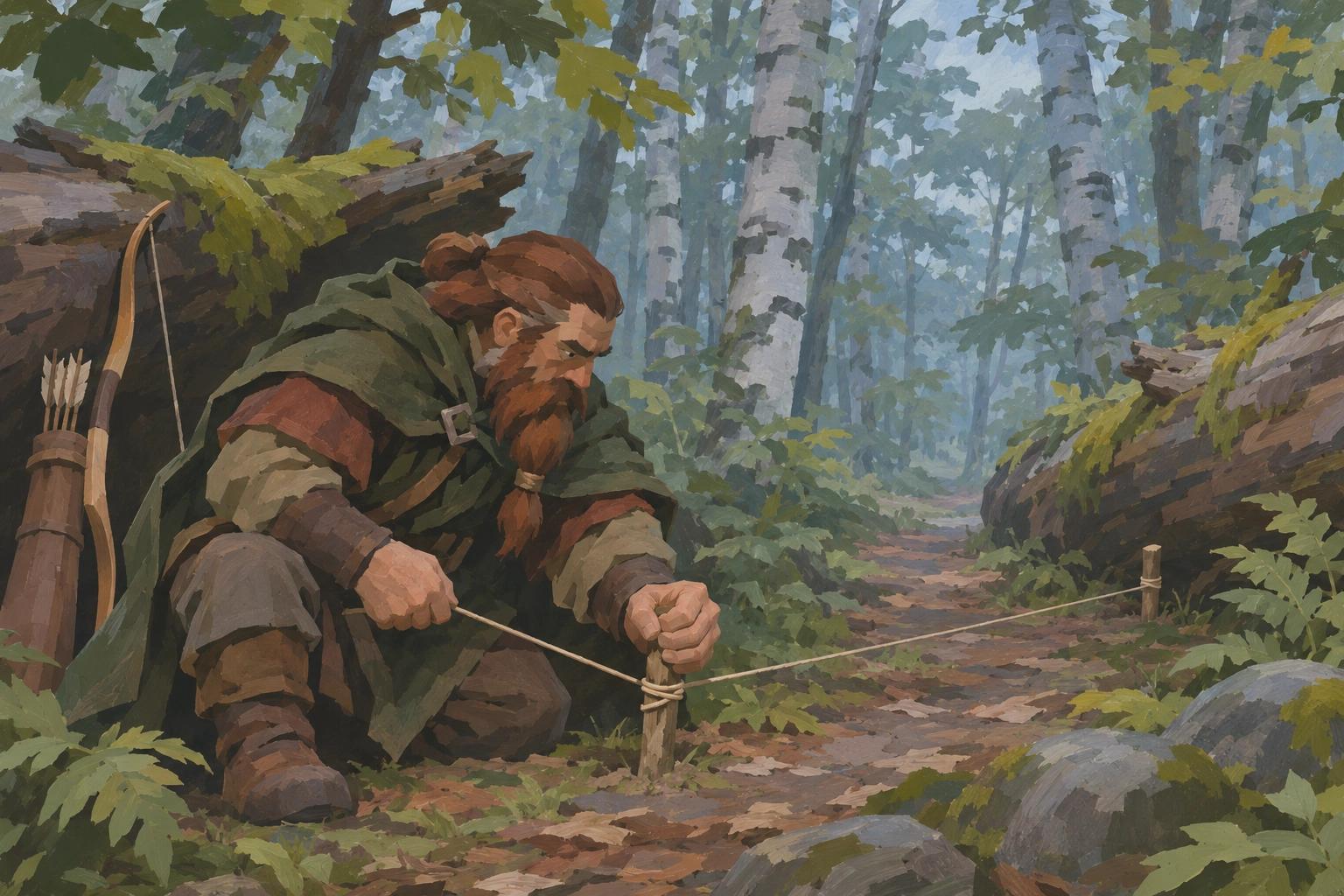
Most hunters chase. Trappers let the quarry come to them. A Trapper reads a battlefield the way a farmer reads a field, and knows where anything in a hurry will put its foot. They rig jaws of cord and stake across the approach, then step back and wait with a bow across their knees. At the table, a Trapper is quiet for the first round of a fight and decisive in the second. What pulls at them is the waiting, and the small, unprofessional thrill when a plan made an hour ago finally pays off.
Shines on: the enemy who steps exactly where you said it would.
Leaves in the dark: the clean duel, which you never offer.
Level 3: Trapper Spells
When you reach a Ranger level specified in the Trapper Spells table, you thereafter always have the listed spell prepared.
Trapper Spells
| Ranger Level | Spells |
|---|---|
| 3 | Ensnaring Strike |
| 5 | Spike Growth |
| 9 | Glyph of Warding |
| 13 | Black Tentacles |
| 17 | Hold Monster |
Level 3: Rig the Ground
As a Utilize action, you can rig a trap in an unoccupied space on the ground within 5 feet of yourself. You can have a number of traps rigged equal to your Wisdom modifier (minimum of one); rigging another removes your oldest. A trap lasts until triggered or until you finish a Long Rest. You, creatures you warn and any creature that notices a trap with a Wisdom (Perception) check against your spell save DC can avoid it. You can also rig traps while traveling at a Slow pace.
When a Large or smaller creature enters the trap's space, it must succeed on a Dexterity saving throw against your spell save DC or take 1d4 Piercing damage and have a Speed of 0 until it frees itself. As an action, it or another creature within 5 feet of it can make a Strength (Athletics) check against your spell save DC, freeing it and destroying the trap on a success.
Level 3: Sprung Trap
Once on each of your turns when you hit a creature that has the Restrained condition or a Speed of 0 with an attack roll using a weapon, it takes an extra 1d8 damage of the weapon's type.
The creature doesn't need to be caught in one of your traps. A creature held by Ensnaring Strike, Entangle or a Net qualifies, and so does a Grappled creature, whose Speed is 0. For example, if the Fighter grapples an ogre, your next arrow against the ogre deals the extra 1d8 damage.
Level 7: Quick Rigging
You can rig a trap with Rig the Ground as a Bonus Action instead of a Utilize action, and you can rig it in an unoccupied space within 15 feet of yourself, throwing the jaws and stake into place. In addition, you know when one of your traps is triggered if you are within 1 mile of it.
Level 11: Layered Traps
A creature that fails its saving throw against a trap from Rig the Ground also has the Prone condition. Your ranged attack rolls against a creature caught in one of your traps don't have Disadvantage because of its Prone condition. The creature has Disadvantage on Strength (Athletics) checks made to free itself from the trap. In addition, the extra damage of Sprung Trap increases to 2d8.
Level 15: Deadfall
As a Utilize action, you can rig a deadfall over a 20-foot Cube within 30 feet of yourself; it lasts 8 hours or until triggered. When a creature you can see enters the Cube, you can trigger it (no action required): each creature in the Cube makes a Dexterity saving throw against your spell save DC. On a failed save, a creature takes 6d10 Bludgeoning damage and has the Prone condition. On a successful save, it takes half as much damage only. Once you use this feature, you can't use it again until you finish a Long Rest unless you expend a level 4+ spell slot (no action required) to restore your use of it.
Bloodhound
Take the Scent and Never Let Go
A Bloodhound picks one creature out of a fight and stops seeing the rest. It might be the bandit chief, the beast that killed the shepherd's dog, or the cultist holding the knife. Once a Bloodhound has the scent, every arrow goes to the quarry, and every other target blurs at the edge of sight until the chase is done. At the table, a Bloodhound is the player everyone watches when the quarry breaks and runs. What pulls at them is the chase itself, and the uneasy question of who they are once it ends.
Shines on: the quarry looking back and finding you closer.
Leaves in the dark: every enemy that isn't the one you named.
Level 3: Bloodhound Spells
When you reach a Ranger level specified in the Bloodhound Spells table, you thereafter always have the listed spell prepared.
Bloodhound Spells
| Ranger Level | Spells |
|---|---|
| 3 | Speak with Animals |
| 5 | Locate Object |
| 9 | Clairvoyance |
| 13 | Locate Creature |
| 17 | Scrying |
Level 3: Nose for the Trail
You have Advantage on Wisdom (Survival) checks made to track creatures, and you can follow tracks while traveling at a Normal pace. While a creature is marked by your Hunter's Mark, you know its direction from you if it is within 1 mile of you.
If you saw or touched a creature within the past 24 hours, you can find its trail again at the place where you last saw it with a DC 10 Wisdom (Survival) check, even if the trail crosses water or bare stone. For example, a thief who wades across a river can't shake you that way.
Level 3: Run to Ground
When you cast Hunter's Mark, or as a Bonus Action while a creature is marked by your Hunter's Mark, you can start a hunt against the marked creature, your quarry. The hunt lasts 1 minute. It ends early only if you have the Incapacitated condition; it doesn't end if the quarry drops to 0 Hit Points or if Hunter's Mark ends.
While the hunt lasts, once on each of your turns when you hit the quarry with an attack roll using a weapon, it takes an extra 2d6 damage of the weapon's type (2d8 from Ranger level 5). During the hunt, you also have Disadvantage on attack rolls against any creature other than the quarry, and you can't move your Hunter's Mark to another creature.
You can start a hunt a number of times equal to your Wisdom modifier (minimum of once), and you regain all expended uses when you finish a Long Rest.
Level 7: Close the Distance
While a hunt lasts, when the quarry moves out of your reach or ends a move more than 30 feet away from you, you can take a Reaction to move up to half your Speed toward it without provoking Opportunity Attacks. In addition, while a hunt lasts, you can take the Dash action as a Bonus Action on your turn, but only if you end that movement closer to the quarry than you started it.
Level 11: Hard on the Heels
While a hunt lasts, the quarry gains no benefit from the Invisible condition against you, and your attack rolls against it ignore Half Cover and Three-Quarters Cover. In addition, the extra damage of Run to Ground increases to 3d8.
Level 15: Jaws Close
Once per hunt, when you hit the quarry with an attack roll, you can pin it (no action required). The quarry has the Prone condition, and its Speed is 0 until the start of your next turn. It makes no saving throw against this effect. Your ranged attack rolls against the quarry don't have Disadvantage because of this Prone condition.
Ranger Options
Everything in this section is optional, and the Game Master (GM) decides what is available in a campaign. The Ranger has no option family of its own, and every choice below is a trade or an addition, never a requirement. Its Fighting Style feature can take any of the Fighting Style feats in the Fighter chapter, which are open to every character with that feature. This section offers three variant features that each trade one Ranger feature for another, four General feats and an Epic Boon built on Favored Enemy, three magic items for the road and a lamp anyone can use, then the personal tables and the list of new Ranger spells. No Ranger subclass in this book needs any of these options.
Ranger Variant Features
Each variant replaces the named feature at the same level. Ask your GM before you take one. A variant is a different shape for the same job, not a better version of it, so choose one because it fits the way your character travels. Each one keeps its value whether the campaign spends its days on the road or in a city, and none of them changes your spellcasting, Favored Enemy or Extra Attack.
Ranger Variant Features
| Level | Variant | Replaces | You Trade |
|---|---|---|---|
| 2 | Camp Craft | Deft Explorer | Expertise in one skill and two languages for extra healing on every Short Rest |
| 6 | Sure-Footed | Roving | more Speed and new ways to move for sure footing on any ground |
| 14 | Still as Stone | Nature's Veil | a moment of invisibility for a moment of stillness that turns blows |
Level 2: Camp Craft
Ranger Variant Feature (replaces Deft Explorer)
When you finish a Short Rest, you and up to five allies who finished it with you each regain additional Hit Points equal to your Wisdom modifier (minimum of 1) if they spent at least one Hit Point Die during the rest. A creature can gain these Hit Points only once per Short Rest, even if more than one creature in the party has this feature. In addition, you gain proficiency with Cook's Utensils.
For example, with a Wisdom modifier of +3, a party of four that spends Hit Point Dice on two Short Rests regains 24 more Hit Points in a day than it would without you.
Level 6: Sure-Footed
Ranger Variant Feature (replaces Roving)
While you aren't wearing Heavy armor, nonmagical Difficult Terrain costs you no extra movement, and you have Advantage on saving throws you make to avoid the Prone condition. Magical Difficult Terrain, such as the area of Spike Growth or Entangle, affects you as normal, and so does any effect that reduces your Speed directly.
For example, you can cross a scree slope, a frozen pond or a hall full of rubble at your full Speed, and when an enemy warrior's Topple mastery forces you to make a Constitution saving throw, you roll it with Advantage and keep your feet. Sure-Footed doesn't help you climb or swim; those take extra movement as normal.
Level 14: Still as Stone
Ranger Variant Feature (replaces Nature's Veil)
As a Bonus Action, you can go utterly still. Until the start of your next turn, your Speed is 0, you have Resistance to Bludgeoning, Piercing, and Slashing damage, and you have Advantage on Dexterity (Stealth) checks. You can use this feature a number of times equal to your Wisdom modifier (minimum of once), and you regain all expended uses when you finish a Long Rest.
The stillness doesn't stop you from taking actions or Reactions; you simply can't move. For example, you can loose arrows from the top of a breach while the enemy's blows glance off your hunched shoulders. A shove or similar effect still moves you as normal.
Ranger Feats
General feats require level 4+. Boon of the Relentless Hunt is an Epic Boon, a choice for the level 19 Epic Boon feature. Every feat here builds on Favored Enemy and its free castings of Hunter's Mark, so it works for any character with that feature, including a character with Ranger levels from multiclassing. The Playing a Ranger section suggests which feat suits which subclass.
Fresh Trail
General Feat (Prerequisite: Level 4+, Favored Enemy Feature)
You gain the following benefits.
Ability Score Increase. Increase your Constitution or Wisdom score by 1, to a maximum of 20.
Back on the Trail. When a creature marked by your Hunter's Mark drops to 0 Hit Points, you gain Temporary Hit Points equal to your Wisdom modifier plus half your Ranger level (round down). You can gain these Temporary Hit Points only once per turn. For example, a level 8 Ranger with a Wisdom modifier of +3 gains 7 Temporary Hit Points when the marked wolf falls, and then moves the mark to the next one. The Temporary Hit Points don't stack with others you already have; you keep whichever total is higher.
Keen Pursuit
General Feat (Prerequisite: Level 4+, Favored Enemy Feature)
You gain the following benefits.
Ability Score Increase. Increase your Dexterity or Wisdom score by 1, to a maximum of 20.
Eyes on the Mark. You have Advantage on Wisdom (Perception) and Wisdom (Survival) checks made to find a creature marked by your Hunter's Mark. In addition, while that creature is within 30 feet of you, it can't gain the Invisible condition against you from the Hide action. For example, a marked goblin that ducks behind a cart in the market is still a target you can see, though other creatures might lose it. The benefit has no effect on a creature that is Invisible through magic, such as the spell Invisibility.
Quick Mark
General Feat (Prerequisite: Level 4+, Favored Enemy Feature)
You gain the following benefits.
Ability Score Increase. Increase your Strength or Dexterity score by 1, to a maximum of 20.
First Mark. When you roll Initiative, you can expend one use of your Favored Enemy feature to cast Hunter's Mark (no action required) on a creature you can see within the spell's range. You must be able to cast the spell, and it requires Concentration as normal. Once you use this benefit, you can't do so again until you finish a Short or Long Rest. For example, the mark is already on the bandit captain before anyone has moved, and your first turn keeps its Bonus Action.
Spare Mark
General Feat (Prerequisite: Level 4+, Favored Enemy Feature)
You gain the following benefits.
Ability Score Increase. Increase your Dexterity or Wisdom score by 1, to a maximum of 20.
One More Mark. The number of times you can cast Hunter's Mark without expending a spell slot through your Favored Enemy feature increases by one. The extra use returns with the others when you finish a Long Rest.
Long Mark. When you cast Hunter's Mark through your Favored Enemy feature, its range is 150 feet. For example, you can mark the archer on the far wall from the edge of a wide courtyard, out of reach of its friends.
Boon of the Relentless Hunt
Epic Boon Feat (Prerequisite: Level 19+, Favored Enemy Feature)
You gain the following benefits.
Ability Score Increase. Increase one ability score of your choice by 1, to a maximum of 30.
Spreading Mark. Once on each of your turns when you deal damage from your Hunter's Mark to a creature, you can also deal that damage to a second creature you can see within 10 feet of the first. For example, when your arrow strikes the marked troll, the troll beside it takes the same Force damage from the mark, and the mark stays where it was. You still deal the mark's damage to the first creature only once per hit.
Ranger Magic Items
Rangers carry little and trust what they carry. The first three items are made for the road and need no Ranger to use them; the bolas require attunement, and so do the boots. The lamp works for anyone and earns its place in the pack even on a sunny day.
Waymarker Stakes
Wondrous Item, Uncommon
This set of three oak stakes is carved with notches that never seem to weather, and each one is as long as a forearm. As a Utilize action, you can drive one of the stakes into the ground, and as another Utilize action, you can pull a planted stake up again.
Way Back. While you carry at least one stake of the set, you know the direction and distance to each planted stake of the set within 10 miles of you.
Trackless Path. As a Magic action, you can touch a planted stake to cast Pass without Trace from it. Once used, this property can't be used again until the next dawn. For example, you can plant a stake at a fork in the forest, scout ahead for two days, and walk back to the fork in silence.
Binding Bolas
Weapon (Bolas), Rare (Requires Attunement)
These weighted cords count as a Simple Ranged weapon with the Thrown property (range 30/90). They deal no damage and have no mastery property.
Leg Wrap. When you take the Attack action, you can replace one of your attacks with a throw of the bolas at a Large or smaller creature within range. You don't make an attack roll; instead, the target must succeed on a DC 15 Dexterity saving throw or have the Restrained condition and the Prone condition. As an action, the target or another creature within 5 feet of it can make a DC 15 Strength (Athletics) check, ending both conditions on a success.
Return. If the target succeeds on its saving throw, the bolas return to your hand at the end of your turn. Otherwise, they return at the end of the turn on which the target is freed. Once the bolas restrain a creature, they can't do so again until the next dawn.
Boots of the Far March
Wondrous Item, Very Rare (Requires Attunement)
These worn leather boots have been resoled so often that nobody knows who wore them first. Since the last resoling, they haven't needed it again, and the stitching smells faintly of pine resin.
Far Stride. While you wear these boots, your Speed increases by 10 feet, and nonmagical Difficult Terrain costs you no extra movement. In addition, you don't gain Exhaustion levels from traveling for more than 8 hours in a day, so you can march through the night and still be fresh at dawn. The Speed increase works alongside other increases, such as the one from Roving, and the boots still let you choose a Slow, Normal or Fast pace as usual.
Through the Trees. While wearing the boots, you can take a Magic action to cast Tree Stride from them. The spell requires Concentration as normal. Once used, this property can't be used again until the next dawn. For example, you can step into an oak at the edge of a raided village and out of another at the far end of the valley, a mile ahead of the riders.
Bivouac Lamp
Wondrous Item, Uncommon
This lamp burns Oil like an ordinary Lamp, shedding Bright Light in a 15-foot radius and Dim Light for an additional 30 feet; a flask of Oil keeps it burning for 6 hours. A hook on its dented brass cap fits any branch or tent pole, and its glass is wrapped in a cage of wire against falls.
Restful Hook. When you start a Short Rest, you can hang the lamp up as a Utilize action. Up to six creatures that finish the Short Rest within 20 feet of the lamp each regain an additional 1d6 Hit Points if they spent at least one Hit Point Die during the rest. While hanging this way, the lamp needs no Oil. This property works in daylight, whether or not the lamp is lit. Once used, it can't be used again until the next dawn.
Ranger Personal Tables
Roll on each table or choose an entry that fits. Every entry is a person, a place, an object or a secret, and each one is a hook your GM can use in the first session. None of them has a rules effect. If an entry points down a trail you would rather not walk, keep it for later.
How It Was Lit
| d6 | Beginning |
|---|---|
| 1 | You were lost for three days as a child, and you came out of the woods knowing every path. |
| 2 | A trapper took you in after a hard winter and taught you everything except her own name. |
| 3 | You guided a family across the mountains when their guide ran off, and nobody died. |
| 4 | You followed a wolf that had taken your sheep, and by the end you understood the wolf better. |
| 5 | You buried an old hermit and found his maps under the floor, every one marked in your handwriting. |
| 6 | You took the long way home every day of your childhood until no way was long anymore. |
What Feeds the Flame
| d6 | Drive |
|---|---|
| 1 | A blank space on an old map that you mean to fill in before you are too old to walk. |
| 2 | The certainty that roads are safer when someone like you walks them first. |
| 3 | A promise to a dying guide to finish the route she never completed. |
| 4 | The quiet of a camp at dawn, which you can only earn by walking all day. |
| 5 | A beast that took something from you years ago and is still out there. |
| 6 | The travelers who reach the next town because you were with them, and never know it. |
Soot
| d6 | Mark |
|---|---|
| 1 | You sleep sitting up with your back to a tree, even in a soft bed under a solid roof. |
| 2 | Three white scars on your shoulder show where something with claws almost won. |
| 3 | You can't enter a room without noting every door, and you can't help mentioning them. |
| 4 | Innkeepers on one road keep a stool by the fire for you and won't let anyone else sit there. |
| 5 | You talk to animals in a low voice, and you are fairly sure some of them answer. |
| 6 | Your boots are the only new thing you own, and you replace them every season. |
Beyond the Edge
| d6 | Out There |
|---|---|
| 1 | A trail you lost years ago turned up again last week, fresher than it should be. |
| 2 | Someone has been leaving your own trail marks on paths you have never walked. |
| 3 | A traveler you guided wants to hire you again and refuses to say where they are going. |
| 4 | The trapper who raised you sent a carved token without a message, which she only does in trouble. |
| 5 | A pack of hounds that answers to nobody has started following your scent. |
| 6 | A valley on your oldest map doesn't exist anymore, and nobody remembers it ever did. |
New Ranger Spells
These spells are on the Ranger spell list. You'll find them in Spells A–L and Spells M–Z.
New Ranger Spells
| Spell Level | Spells |
|---|---|
| Level 1 | Cold Trail, Ringing Blow, Splint and Salve, Unseen Tripwire |
| Level 2 | Baited Lure, Bramble Shot, Bridge the Gap, Thorn Sentry |
| Level 3 | Hidden Camp, Quickset Hedge, Wrong Turn |
| Level 4 | Lamp in the Window, Thundering Herd |
| Level 5 | Leave No Trail |