
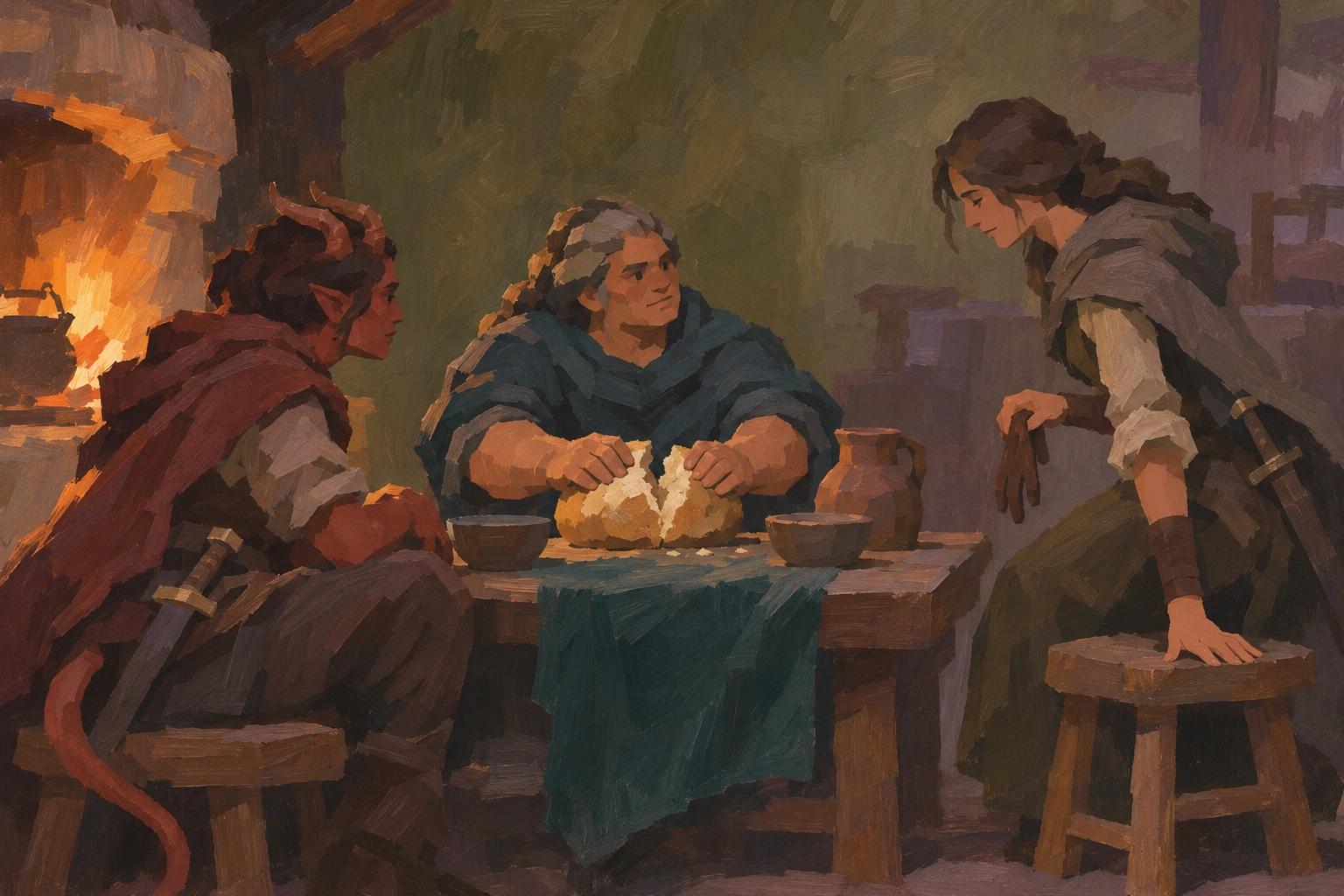
The Vigil Lamp
The farmhouse has one room with a bed in it, and the farmer's son has been in that bed for three days. His mother sleeps in a chair by the stove. His father went out to the barn an hour ago and hasn't come back, because he can't stand to listen any more. The cleric came at dusk with a satchel, a prayer book with a broken spine and a small lamp with a red glass chimney. She set it on the stool by the bed, and she has not left the stool since.
Some time after midnight the boy's breathing changes. The fever breaks the way a frozen river breaks, all at once and with a lot of noise, and then he is asleep, properly asleep, with his mouth open. The cleric could go now. Her work is done, and her back aches from the stool. Instead she trims the wick, adds a little oil, and stays where she is.
A vigil lamp isn't there to read by. It burns all night beside the sick and the dead and the newly born, so that whoever opens their eyes sees that somebody stayed. You can play a Cleric who marches at the front of a war host, and the power you carry is real enough to turn a battle. But the oldest part of the craft is the staying: the watch kept, the wound closed, the friend pulled back to their feet after everyone else had stopped hoping. When the boy wakes at dawn and asks for water, the lamp is still burning.
Playing a Cleric
A Cleric decides who gets back up. You are the party's healer, its warder and the second line of every fight, and often the voice the others send to talk first because people trust a holy symbol. Your best moments rarely look like yours: the Fighter who stands again, the Rogue who shrugs off a curse, the bargain that holds because you vouched for it. Channel Divinity is your engine. You start with two uses at level 2 and three at level 6, and you regain one on every Short Rest, so spend them in every fight rather than saving them for a fight that may never come.
Wisdom comes first. Constitution comes next if you mean to hold Concentration on Bless or Spirit Guardians while things hit you. Divine Order sets your posture at level 1: Protector for heavy armor at the front, Thaumaturge for an extra cantrip and lore, and this book adds the Pilgrim for a Cleric on the road and the Confessor for one who listens. Heal with Bonus Actions when you can, so that your action stays free for the spell that ends the fight. Prepared spells change after every Long Rest, so prepare for tomorrow's road: one spell for the fight, one for the talk, one for the locked door.
The SRD's Acolyte still suits any Cleric. Among this book's backgrounds, the Midwife fits a healer who has seen birth and death up close, the Camp Cook a Cleric who keeps a group fed and together, and the Watchfire Keeper one who has stood guard through long nights. Choose the Hearth Domain if you would rather sit enemies down than knock them down, the Threshold Domain if you like holding a door and then stepping through a wall, and the Offering Domain if you will give your own health to keep a friend standing. Keeper of Confessions suits a Hearth Cleric, Unbroken Prayer a Threshold Cleric who holds the line, and Herald of Grace an Offering Cleric who wants a friend's next swing to count.
A Cleric makes everyone around them braver, because they know someone will pick them up. Frontliners such as a Barbarian or a Paladin give you the time to cast, and a Wizard or a Bard covers the problems your spell list can't touch. Before a hard fight, tell the party whom you will reach first if things go wrong, so nobody wastes a turn wondering. In return, stay where you can see the whole party. A healer who charges ahead is one more person on the floor, and nobody else at the table can do your job.
Cleric Subclasses
There are three ways to keep a vigil lamp through the night. Choose the domain that matches how you keep watch, not which god you serve; all three work with any build in Playing a Cleric.
Cleric Subclasses at a Glance
| Subclass | Carried | Choose It If You Like |
|---|---|---|
| Hearth Domain | held high | turning a standoff into a shared meal and a fight into a conversation |
| Threshold Domain | hooded | closing the right door at the right moment, then using one nobody saw |
| Offering Domain | stoked | keeping a friend standing at a cost to yourself that everyone can see |
Hearth Domain
Set a Place for Every Guest
Every road has a house where a stranger can knock after dark and be let in. Clerics of the Hearth Domain keep the oldest law of that road: whoever eats at your table is safe there, and so are you. In a tense room they set out bread before they reach for a mace, and anyone who accepts is bound by something older than any treaty. At the table, a Hearth Cleric turns a standoff into a meal and a fight into a negotiation, then patches up whoever got hurt on the way. What pulls at them is the guest who won't sit down, and the day a guest breaks the law in front of everyone.
Shines on: the moment two sworn enemies sit down at your table.
Leaves in the dark: the enemy who never accepts the invitation.
Level 3: Hearth Domain Spells
When you reach a Cleric level specified in the Hearth Domain Spells table, you thereafter always have the listed spells prepared.
Hearth Domain Spells
| Cleric Level | Spells |
|---|---|
| 3 | Calm Emotions, Prayer of Healing, Purify Food and Drink, Sanctuary |
| 5 | Create Food and Water, Tiny Hut |
| 7 | Faithful Hound, Private Sanctum |
| 9 | Hallow, Telepathic Bond |
Level 3: Guest-Right
As a Magic action, you can expend one use of your Channel Divinity to offer guest-right to any number of creatures within 30 feet of yourself that can hear you. Each of them can accept or refuse (no action required), and each one that accepts becomes your guest for 1 hour. You can't offer guest-right again while it lasts.
While guest-right lasts, you have Advantage on Charisma checks you make to influence your guests, and each guest has Advantage on Charisma checks it makes to influence you.
Breaking Guest-Right. If you or a guest deals damage to you or another guest, or forces you or another guest to make a saving throw, guest-right ends for everyone. Each creature that was a guest knows who broke it, and the creature that broke it has Disadvantage on Charisma checks it makes to influence any of them until it finishes a Long Rest.
Level 3: Warm Welcome
When you cast a spell with a spell slot that restores Hit Points to a creature, that creature regains additional Hit Points equal to your Wisdom modifier (minimum of 1) and has Advantage on the next saving throw it makes before the end of its next turn. If the spell restores Hit Points to more than one creature, each of them gains these benefits, but a creature can gain them only once per spell.
For example, with a Wisdom of 16, your Healing Word restores 3 more Hit Points.
Level 6: Home Comforts
When you finish a Short Rest, you can choose a number of creatures equal to your Wisdom modifier (minimum of 1) that finished the same rest within 30 feet of you. Each of them regains one expended Hit Point Die.
In addition, you can use Guest-Right without expending a use of your Channel Divinity. Once you do so, you can't do so again until you finish a Long Rest.
Level 17: Table of Plenty
You always have Heroes' Feast prepared, and you can cast it without a spell slot. You must still provide its Material component, which the spell consumes. Once you cast it this way, you can't do so again until you finish a Long Rest.
When you do, you can use Guest-Right as part of the casting without expending a use of your Channel Divinity. That guest-right lasts 24 hours instead of 1 hour.
Threshold Domain
Hold the Door, Then Walk Through It
Every door is a promise about who gets in. Clerics of the Threshold Domain keep that promise, and break it when they need to. They tend the places between: gates, doorways, the chalk line drawn across a ruined hall. In a fight they shut one passage so that the party decides where the battle happens; in a dungeon they open passages nobody else knew were there. A Threshold Cleric is quiet for most of a scene, then settles it with one door. What pulls at them is the other side, always, and the suspicion that every wall was built to keep something in.
Shines on: the corridor the monsters can't follow you down.
Leaves in the dark: the part of the party still on the wrong side.
Level 3: Threshold Domain Spells
When you reach a Cleric level specified in the Threshold Domain Spells table, you thereafter always have the listed spells prepared.
Threshold Domain Spells
| Cleric Level | Spells |
|---|---|
| 3 | Alarm, Arcane Lock, Knock, Protection from Evil and Good |
| 5 | Glyph of Warding, Magic Circle |
| 7 | Banishment, Dimension Door |
| 9 | Passwall, Teleportation Circle |
Level 3: Sealed Threshold
As a Magic action, you can expend one use of your Channel Divinity to seal a threshold within 30 feet of yourself: an opening no wider than 10 feet that you can see, such as a doorway, gate or window, or a line up to 10 feet long traced on the ground. Creatures you choose when you seal it cross freely. The seal lasts for 1 hour, until you use this feature again or until you dismiss it (no action required).
Any other creature that tries to cross must succeed on a Charisma saving throw against your spell save DC. On a failed save, its movement ends, and it can't cross until the start of its next turn. A creature makes this save only once per turn. A door, gate or window in the opening can't be opened by a creature that can't cross. Attacks and spells pass normally.
Level 3: Step Between
As a Bonus Action, you can touch a door, wall, floor, ceiling or other solid barrier no more than 5 feet thick and teleport to an unoccupied space within 5 feet of its other side. You don't need to see that space. If there is no unoccupied space there, you don't teleport, and the use isn't expended.
You can use this feature a number of times equal to your Wisdom modifier (minimum of once), and you regain all expended uses when you finish a Long Rest.
Level 6: Doorkeeper
When a creature fails the saving throw against your Sealed Threshold, you can take a Reaction to make it take Force damage equal to 2d8 plus your Wisdom modifier, and you push it up to 10 feet straight away from the threshold.
In addition, when you use Step Between, you can bring one willing creature you are touching. It appears in an unoccupied space within 5 feet of you; if there is none, it stays behind.
Level 17: Linked Doors
As a Magic action, you can touch a door, gate or other opening and name another opening on the same plane of existence that you have passed through within the last 7 days. For 1 minute, the two openings are linked: any creature or object that passes through one of them emerges from the other, in the nearest unoccupied space. Once you use this feature, you can't use it again until you finish a Long Rest.
Offering Domain
Give of Yourself So Others Stand
Some clerics pray for the wounded. Clerics of the Offering Domain pay for them. Their faith rests on a simple trade: give up a little of your own strength, and someone else gets back far more than you gave. At the table, an Offering Cleric keeps a falling friend on their feet when no ordinary spell would be enough, then walks out of the fight grey in the face and slow on the stairs. Their friends learn to watch them as closely as they watch everyone else. What pulls at them is the arithmetic of it, and the friend who asks, one evening too many, whether they're all right.
Shines on: a friend back on their feet while you stagger.
Leaves in the dark: your own wounds, which nothing you do will close.
Level 3: Offering Domain Spells
When you reach a Cleric level specified in the Offering Domain Spells table, you thereafter always have the listed spells prepared.
Offering Domain Spells
| Cleric Level | Spells |
|---|---|
| 3 | Bless, Heroism, Lesser Restoration, Warding Bond |
| 5 | Beacon of Hope, Revivify |
| 7 | Death Ward, Freedom of Movement |
| 9 | Mass Cure Wounds, Raise Dead |
Level 3: Self-Offering
When you cast a spell with a spell slot that restores Hit Points to a creature other than you, or use Divine Spark to do so, you can reduce your Hit Point maximum by any amount up to your Cleric level (no action required). One creature other than you that regains Hit Points from that spell or Divine Spark regains additional Hit Points equal to three times the reduction, four times at Cleric level 6 and five times at Cleric level 11.
If your current Hit Points exceed your new maximum, they drop to it. Only finishing a Long Rest ends this reduction. You can use this feature only once per turn, and its total reduction can't exceed half of your unreduced Hit Point maximum. For example, at level 3, giving up 3 Hit Points of your maximum makes one Healing Word restore 9 more.
Level 6: Cleansing Offering
When you use Self-Offering, the creature that regains the additional Hit Points can also end one of the following conditions on itself: Blinded, Deafened, Frightened, Paralyzed or Poisoned. If it has more than one of them, it chooses which one ends.
For example, an ally Paralyzed by a ghoul's claws who regains Hit Points from your Healing Word can end the condition and act on its next turn.
Level 17: Great Offering
When you use Self-Offering with a spell that restores Hit Points to more than one creature, you can make every creature other than you that regains Hit Points from the spell regain additional Hit Points equal to twice the reduction, instead of one creature gaining the larger amount. Once you use this feature, you can't use it again until you finish a Long Rest.
For example, a reduction of 17 on Mass Cure Wounds gives each ally 34 additional Hit Points.
Cleric Options
Everything in this section is optional, and the Game Master (GM) decides what is available in a campaign. The Cleric has three option families: Divine Order options for level 1, Blessed Strikes options for level 7 and Channel Divinity effects that each replace one of the two base effects. Three variant features follow, then four General feats and an Epic Boon, three magic items for Clerics and a lamp anyone can use, the personal tables and the list of new Cleric spells. No Cleric domain in this book needs any of these options.
Divine Order Options
At level 1, the Divine Order feature offers Protector and Thaumaturge. You can choose one of the following options instead. Like those two, each one sets the posture of your Cleric between prayers: the Pilgrim belongs on the long road, the Confessor at the quiet table. Your choice is permanent unless your GM lets you change it.
Divine Order Options
| Option | You Gain | Instead Of |
|---|---|---|
| Pilgrim | Athletics or Survival, and 10 feet of Speed out of Heavy armor | Heavy armor and Martial weapons, or a cantrip and lore |
| Confessor | Insight, and your Wisdom modifier on Persuasion checks | Heavy armor and Martial weapons, or a cantrip and lore |
Pilgrim
Divine Order Option
Trained on the roads between distant shrines, you know how to keep moving. You gain proficiency in your choice of the Athletics or Survival skill. In addition, your Speed increases by 10 feet while you aren't wearing Heavy armor. For example, a Pilgrim in Medium armor with a Speed of 30 feet moves 40 feet.
Confessor
Divine Order Option
People tell you things they have never told anyone else. You gain proficiency in the Insight skill; if you already have this proficiency, you gain proficiency in another skill of your choice. In addition, when you make a Charisma (Persuasion) check, you gain a bonus to the check equal to your Wisdom modifier (minimum of +1).
Blessed Strikes Options
At level 7, the Blessed Strikes feature offers Divine Strike and Potent Spellcasting. You can choose one of the following options instead. Each option names what it gains at level 14, when Improved Blessed Strikes makes your choice more powerful. Both options turn your own hits into help for someone else, so they suit a Cleric who fights next to a friend.
Blessed Strikes Options
| Option | Level 7 | Level 14 |
|---|---|---|
| Warding Strikes | +2 AC for you or a friend | also Advantage on saving throws |
| Guiding Strikes | Advantage on the next attack by a friend | that attack adds your Wisdom modifier to its damage |
Warding Strikes
Blessed Strikes Option
Once on each of your turns when you hit a creature with an attack roll using a weapon, or when a creature takes damage from one of your Cleric cantrips, you can choose one creature you can see within 30 feet of yourself (you can choose yourself). That creature gains a +2 bonus to AC until the start of your next turn.
Improved Blessed Strikes. At Cleric level 14, the chosen creature also has Advantage on the next saving throw it makes before the start of your next turn. For example, a Fighter you ward stands behind a +2 bonus to AC and shrugs off a sudden spell more easily.
Guiding Strikes
Blessed Strikes Option
Once on each of your turns when you hit a creature with an attack roll using a weapon, or when a creature takes damage from one of your Cleric cantrips, you can choose that creature. The next attack roll made against it by a creature other than you before the start of your next turn has Advantage.
Improved Blessed Strikes. At Cleric level 14, if that attack hits, it deals extra damage equal to your Wisdom modifier, of the same type as the attack. For example, your Sacred Flame scorches an ogre, and the Rogue's next attack against it has Advantage and adds 5 damage.
Channel Divinity Options
At level 2, Channel Divinity gives you two effects, Divine Spark and Turn Undead. Each effect below replaces exactly one of them, named in its tag line, and you choose it when you gain Channel Divinity. You can't replace the same effect twice, and an effect you replace is gone: without Divine Spark, you can no longer deal damage with it, and without Turn Undead, you also lose Sear Undead. An effect that replaces Turn Undead also names what you gain at level 5 instead of Sear Undead. Each effect follows the rules of Channel Divinity, including its uses and recovery.
Channel Divinity Options
| Effect | Replaces | Action | At Level 5, Instead of Sear Undead |
|---|---|---|---|
| Swift Mercy | Divine Spark | Bonus Action | no change |
| Steadfast Prayer | Turn Undead | Magic action | Advantage on all Wisdom saving throws |
| Divine Censure | Turn Undead | Magic action | 2d8 Radiant damage on a failed save |
Swift Mercy
Channel Divinity Effect (Cleric; replaces Divine Spark)
As a Bonus Action, you can expend one use of your Channel Divinity to heal one creature you can see within 60 feet of yourself. It regains Hit Points equal to 1d6 plus your Wisdom modifier. The dice become 2d6 at Cleric level 7, 3d6 at 13 and 4d6 at 18. Features that modify Divine Spark's healing modify this healing instead.
Steadfast Prayer
Channel Divinity Effect (Cleric; replaces Turn Undead)
As a Magic action, you can expend one use of your Channel Divinity to steady your allies. Each creature of your choice within 30 feet of yourself that can hear you ends the Charmed and Frightened conditions on itself and has Advantage on saving throws against them for 1 minute.
Instead of Sear Undead. At Cleric level 5, this Advantage also covers Wisdom saving throws.
Divine Censure
Channel Divinity Effect (Cleric; replaces Turn Undead)
As a Magic action, you can expend one use of your Channel Divinity to censure one creature you can see within 60 feet of yourself. It makes a Wisdom saving throw against the spell save DC from this class's Spellcasting feature. On a failed save, until the end of its next turn, it has Disadvantage on attack rolls and its Speed is halved.
Instead of Sear Undead. At Cleric level 5, a creature that fails the save also takes 2d8 Radiant damage.
For example, a censured minotaur swings at the Fighter with Disadvantage and can't reach the Wizard.
Cleric Variant Features
Each variant replaces the named feature at the same level. Ask your GM before you take one. A variant is a different shape for the same job, not a better version of it, so choose one because it fits your character. No Cleric domain in this book needs a feature that a variant replaces.
Cleric Variant Features
| Level | Variant | Replaces | You Trade |
|---|---|---|---|
| 5 | Divided Grace | Sear Undead | damage against Undead for a heal you can split between two friends |
| 14 | Steadfast Devotion | Improved Blessed Strikes | a stronger strike or cantrip for a steadier hold on your spells |
| 20 | Answered Prayer | Greater Divine Intervention | one wish for a second ordinary intervention each day |
Level 5: Divided Grace
Cleric Variant Feature (replaces Sear Undead)
When you use Divine Spark to restore Hit Points, you can divide the Hit Points it restores between two creatures within its range, in any split you choose. If Swift Mercy has replaced Divine Spark, this variant applies to Swift Mercy instead. If a Channel Divinity effect from this book has replaced Turn Undead, this variant takes the place of that effect's level 5 benefit.
For example, a Divine Spark that totals 9 can restore 5 Hit Points to the Fighter at the door and 4 to the Wizard behind her.
Level 14: Steadfast Devotion
Cleric Variant Feature (replaces Improved Blessed Strikes)
You gain proficiency in Constitution saving throws. If you already have this proficiency, you gain proficiency in Dexterity saving throws instead. Your Blessed Strikes option keeps working as it does at level 7, without the improvement it would gain from Improved Blessed Strikes.
For example, a Cleric holding Spirit Guardians through a hard fight adds the Proficiency Bonus to every Constitution saving throw to maintain Concentration, and a Cleric holding Bless keeps the whole front line steadier for longer.
Level 20: Answered Prayer
Cleric Variant Feature (replaces Greater Divine Intervention)
When you finish a Short Rest, you regain your expended use of Divine Intervention. Once you regain it this way, you can't do so again until you finish a Long Rest. You can't choose Wish when you use Divine Intervention. Otherwise, Divine Intervention works as normal.
For example, you can use Divine Intervention to cast Flame Strike in the morning's fight, take a Short Rest at midday and cast Mass Cure Wounds with it after the evening's fight.
Cleric Feats
General feats require level 4+. Boon of the Vigil is an Epic Boon, a choice for the level 19 Epic Boon feature. Four of these feats build on Channel Divinity, so they also work for a Paladin or for any character with Cleric levels from multiclassing; Keeper of Confessions needs the Divine Order feature. Playing a Cleric suggests which feat suits which domain.
Herald of Grace
General Feat (Prerequisite: Level 4+, Channel Divinity Feature)
You gain the following benefits.
Ability Score Increase. Increase your Wisdom or Charisma score by 1, to a maximum of 20.
Herald's Call. When you expend a use of your Channel Divinity, one creature of your choice within 30 feet of yourself that can see or hear you gains Heroic Inspiration. Once you use this benefit, you can't use it again until you finish a Short or Long Rest. Choose a creature that lacks Heroic Inspiration, since a creature can't have more than one. For example, when you use Divine Spark to heal the Barbarian, you can also give the Barbarian Heroic Inspiration for the next swing.
Keeper of Confessions
General Feat (Prerequisite: Level 4+, Divine Order Feature)
You gain the following benefits.
Ability Score Increase. Increase your Wisdom or Charisma score by 1, to a maximum of 20.
Patient Listener. You gain proficiency in the Insight skill. If you already have this proficiency, you gain proficiency in another skill of your choice.
Sworn Words. You always have Zone of Truth prepared. You can cast it once without expending a spell slot, and you regain the ability to cast it in this way when you finish a Long Rest. Wisdom is your spellcasting ability for this spell. For example, you can open a tense meeting with a free Zone of Truth and keep your spell slots for whatever follows.
Renewed Devotion
General Feat (Prerequisite: Level 4+, Channel Divinity Feature)
You gain the following benefits.
Ability Score Increase. Increase your Wisdom or Constitution score by 1, to a maximum of 20.
Mid-Battle Prayer. As a Bonus Action, you can regain one expended use of your Channel Divinity. Once you use this benefit, you can't use it again until you finish a Long Rest. It works with the Channel Divinity feature of any class. For example, after you spend your last use on Divine Spark in the second fight of the day, a Bonus Action gives you one use back for the third.
Unbroken Prayer
General Feat (Prerequisite: Level 4+, Channel Divinity Feature)
You gain the following benefits.
Ability Score Increase. Increase your Wisdom or Constitution score by 1, to a maximum of 20.
Held Prayer. When you fail a Constitution saving throw to maintain Concentration on a spell, you can expend one use of your Channel Divinity to succeed instead (no action required). It works for any spell you maintain, including spells from another class. For example, when a troll's claws force a save to keep Spirit Guardians and you fail it, one use of Channel Divinity keeps the spirits circling.
Boon of the Vigil
Epic Boon Feat (Prerequisite: Level 19+, Channel Divinity Feature)
You gain the following benefits.
Ability Score Increase. Increase one ability score of your choice by 1, to a maximum of 30.
Ready Prayer. When you roll Initiative and have no uses of your Channel Divinity left, you regain one expended use. If you have Channel Divinity from more than one class, you choose which class's use you regain. For example, a Cleric who spent every use in the morning still starts the evening's fight with one use ready, and can open it with Divine Spark or a domain's Channel Divinity effect.
Cleric Magic Items
Clerics carry the tools of a long watch: beads to count prayers on, a bell to call the faithful, a shrine that fits in a pack. The first three items require attunement by a Cleric. The lamp works for anyone, Cleric or not, and does its work as well at noon as at midnight.
Mender's Beads
Wondrous Item, Uncommon (Requires Attunement by a Cleric)
This string of worn wooden beads has been counted through a great many sickroom prayers, and each bead is polished smooth on one side. The beads have 3 charges and regain 1d3 expended charges daily at dawn.
Counted Prayer. When you cast a spell with a spell slot that restores Hit Points while holding the beads, you can expend 1 charge. One creature that regains Hit Points from the spell regains an additional 2d4 Hit Points. You can expend only 1 charge per spell. The extra Hit Points don't depend on the spell's level, so the beads are at their best with a low-level spell such as Healing Word. For example, a Cure Wounds that would restore 13 Hit Points restores 13 plus 2d4 to its target.
Chapel Bell
Wondrous Item, Rare (Requires Attunement by a Cleric)
This small bronze hand bell once hung above the door of a roadside chapel, and its clapper is wrapped in a strip of old altar cloth. You can use the bell as a Holy Symbol.
Calling Peal. While holding the bell, you can take a Magic action to ring it and cast Guardian of Faith from it without expending a spell slot, using your spell save DC. Once you do so, you can't do so again until the next dawn.
Steadying Chime. When you expend a use of your Channel Divinity while holding the bell, each creature of your choice within 30 feet of you that can hear the bell has Advantage on the next saving throw it makes before the start of your next turn. For example, if you use Divine Spark before a dragon breathes, the friends you chose have Advantage on the save against its breath.
Traveler's Shrine
Wondrous Item, Very Rare (Requires Attunement by a Cleric)
This wooden shrine folds shut to the size of a book. Inside, three painted panels show a road, a door and a bed, and the paint never fades. While the shrine is on your person, you gain a +1 bonus to spell attack rolls and to the spell save DC of your Cleric spells. The bonus doesn't apply to spells from another class or to spells cast from other magic items.
Open Shrine. You can take a Magic action to unfold the shrine and cast Heal from it without expending a spell slot. The spell is cast at its lowest level. Once you do so, you can't do so again until the next dawn. The shrine must be on your person, but you don't need to hold it while you cast, so your hands stay free for a shield and a Holy Symbol. For example, when a poisoned friend drops to 0 Hit Points, you can unfold the shrine, restore 70 Hit Points to them and end the Poisoned condition, and still have your level 6 spell slot for the next fight.
Lamp of the Long Vigil
Wondrous Item, Uncommon
This lamp burns Oil like an ordinary Lamp, shedding Bright Light in a 15-foot radius and Dim Light for an additional 30 feet; a flask of Oil keeps it burning for 6 hours. Its chimney is red glass, and the wick never needs trimming.
Watchful Rest. While the lamp is lit, each creature that finishes a Short Rest within 15 feet of it regains 1 additional Hit Point for each Hit Point Die it spent during that rest. For example, a Fighter who spends three Hit Point Dice during a Short Rest beside the lamp regains 3 more Hit Points than the dice show. A creature gains this benefit only once per Short Rest, even if several of these lamps are lit nearby.
Cleric Personal Tables
Roll on each table or choose an entry that fits your character. Every entry is a person, a place, an object or a secret, and each one is a hook your GM can use in the first session. None of them has a rules effect, and none of them names your god, so they fit any faith your character keeps.
How It Was Lit
| d6 | Beginning |
|---|---|
| 1 | You kept a dying stranger company through the night, and at dawn something answered the prayer you'd made up. |
| 2 | The keeper of your village shrine vanished one winter, and you took up the key because someone had to. |
| 3 | You were left as a baby on a temple step with a coin in your fist and a name pinned to your blanket. |
| 4 | During a flood you carried an old wooden idol to high ground, and it hasn't stopped speaking to you since. |
| 5 | You struck a bargain in prayer to save a sibling; they lived, and the bargain isn't finished. |
| 6 | You stayed behind to bury the dead after a fever swept your town, and the rites came to you unasked. |
What Feeds the Flame
| d6 | Drive |
|---|---|
| 1 | You mean to rebuild a shrine you watched fall, stone by stone, wherever the road ends. |
| 2 | Someone you healed went on to do terrible things, and you need to know why you were allowed to. |
| 3 | Your faith has a question you can't answer, so you ask it of everyone you meet. |
| 4 | You keep a list of names you prayed for and visit them whenever the road allows. |
| 5 | A sign told you to travel until a stranger offered you bread; so far, nobody has. |
| 6 | You're paying back the god who answered you, one kindness at a time, and you keep count. |
Soot
| d6 | Mark |
|---|---|
| 1 | Your hands are always warm, even in deep winter, and people notice when you shake theirs. |
| 2 | You can't pass a crossroads without leaving something small behind for whoever comes next. |
| 3 | A river town still sets a place for you at every feast and asks you to bless the bread. |
| 4 | You flinch at bells; one rang through the worst night of your life, and you still hear it. |
| 5 | Your prayers sometimes come out in an old language you never learned and can't translate. |
| 6 | A scar in the shape of a hand covers your shoulder, and it aches before every storm. |
Beyond the Edge
| d6 | Out There |
|---|---|
| 1 | A pilgrim keeps arriving in each town a day before you, preaching your exact words. |
| 2 | A carved idol you once carried to safety is wanted back by the people who drowned it. |
| 3 | Someone has written a hymn about your first miracle, and the details are wrong in a dangerous way. |
| 4 | A rival priest claims your god spoke to them first, and they have brought witnesses. |
| 5 | Someone you prayed back to health sends letters signed with a name that isn't theirs. |
| 6 | Somewhere ahead walks a stranger you buried in your dreams last winter, very much alive. |
New Cleric Spells
These spells are on the Cleric spell list. You'll find them in Spells A–L and Spells M–Z.
New Cleric Spells
| Spell Level | Spells |
|---|---|
| Cantrip | Holy Admonition, Latchward, True Measure |
| Level 1 | Hear the Lie, Planted Feet, Small Again, Splint and Salve |
| Level 2 | Flag of Truce, Hundred-Mile Blessing, Quiet Council, Slip Free |
| Level 3 | Pang of Conscience, Quickset Hedge, Unfolded Map, Unmasking Glare |
| Level 4 | Closed Ranks, Lamp in the Window, Sympathetic Wounds |
| Level 5 | Bronze Guardian, Compelled Confession, Restoring Refrain |
| Level 6 | Expose Weakness, Mass Absolution |
| Level 7 | Nothing Hidden, Rebuilding Word |
| Level 8 | Back from the Brink, Hold the Keep |
| Level 9 | Call Them Home |