
The Candle Flame
The night market fills the square from the fountain to the tanners' gate. Two porters argue over a handcart, then over each other's mothers, and then one of them swings. The crowd opens like a dropped sack of grain. A table goes over, and a candle-seller's whole stock rolls across the cobbles, one tall taper still lit and tumbling toward a bale of straw.
A traveler in a plain coat steps through the gap. She doesn't hurry. She catches the taper a hand's width above the straw and sets it upright on the rim of the fountain, and in the same breath the two porters are sitting on the cobbles, blinking, with no idea who put them there. She hands one of them his cap, rights the table with her foot, and helps the candle-seller gather what rolled under the cart. Then she buys two tapers, pays the full price, and walks on. Nobody saw her hit anyone, and most of the crowd would swear she didn't.
A candle is the smallest light anyone carries, and the easiest to put out. That is the point of it. It doesn't roar against the wind or fill a hall. It stays where it is, upright in a cupped hand or on a windowsill, so steady that you could read by it in a moving cart. Your whole art is that stillness, kept while everything around you moves. In a fight you are the quietest thing in it and the fastest. You reach the place where the trouble starts before the trouble knows you're there, and you leave it settled. When it's over, the flame on the rim of the fountain has barely moved.
Playing a Monk
A Monk is the fastest skirmisher in the group and, from level 5, one of its best controllers. Unarmored Movement lets you reach anyone on the battlefield, the archer on the wall or the caster behind the shield line, and Stunning Strike can stop that creature where it stands. Focus Points are your fuel, and they come back on every Short Rest. Spend them in every fight, ask the group for the rest when you're empty, and remember that Uncanny Metabolism refills you when you roll Initiative, so you can start the big fight of the day full even after a hard morning.
Dexterity and Wisdom both carry you: Dexterity for your attacks and Armor Class, Wisdom for Armor Class and the save DC of everything you do to an enemy. Keep Constitution respectable, because your Hit Point Die is small and you stand where the blows land. Deflect Attacks is a large part of your survival, so think about when you'll need your Reaction before you spend it on something else. Out of combat you're the scout who crosses rooftops and rivers first; Stealth, Athletics and Insight are the skills that use that best. Among this book's backgrounds, the Beekeeper suits a patient, quiet Monk, the Midwife a Monk who looks after others, the Watchfire Keeper a Monk who stands at the front, and the Torchrunner one who never stops moving. The SRD's Acolyte and Soldier work as well as they always have.
The three warriors in this chapter pull in different directions. Choose the Warrior of the Bell if you like rallying the group, the Warrior of the Needle if you like precise, quiet control, and the Warrior of the Crucible if you want to trade safety for momentum where everyone can see it. Serene Voice suits a Bell, Joint Lock and Long Leap suit a Needle who works alone, and a Crucible Monk gets the most from Long Leap, which carries it into the middle of the enemy line. Rebounding Palm helps any Monk who keeps its Reaction free.
You make the group better by going where nobody else can: the Fighter holds the door while you take the archers apart, and the Wizard casts in peace because the enemy caster is busy with you. In return you need someone who can heal you after you've overreached, and a frontliner who stands still so you don't have to. A Bard or a Cleric who hands out help makes your small pool of Hit Points last a lot longer. Tell the group before the fight which enemy you mean to reach first, so nobody fills the space you were going to run through.
Monk Subclasses
There are three ways to keep a candle steady while the room moves around it. Choose the one that matches your temper, not your fists; all three work with any build in Playing a Monk.
Monk Subclasses at a Glance
| Subclass | Carried | Choose It If You Like |
|---|---|---|
| Warrior of the Bell | held high | steadying frightened friends and pulling the group together around you |
| Warrior of the Needle | hooded | precise, quiet control and guards who never raise the alarm |
| Warrior of the Crucible | stoked | dropping your guard on purpose and turning every blow into momentum |
Warrior of the Bell
Ring Out So Others Stand Firm
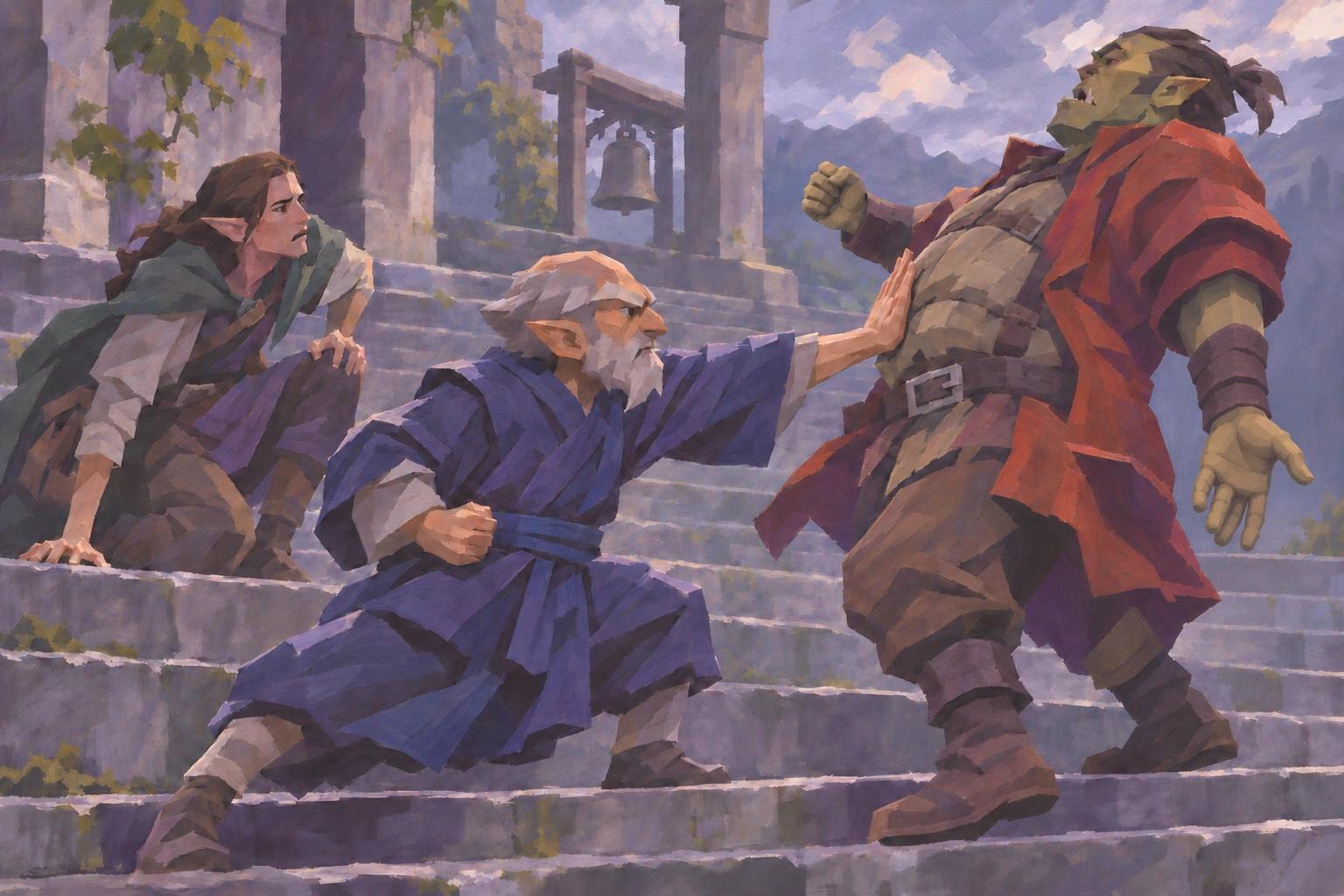
Monasteries keep time with a bell: one stroke to wake, one to eat, one to stop and breathe. Warriors of the Bell learned to strike the way the bell is struck, cleanly and once, so that the sound carries. A blow from a Bell Monk throws an enemy back, and the note it makes reaches every frightened friend on the field and tells them to stand up straight. At the table, a Bell Monk is the player who turns a panicked retreat into a held line. What pulls at them is the silence before the stroke, and the fear that one day the note will come a moment too late.
Shines on: the friend who stops shaking at the sound.
Leaves in the dark: secrecy, since everyone hears you coming.
Level 3: Bell Strike
Once on each of your turns when you hit a creature with an Unarmed Strike, you can spend 1 Focus Point to make the blow ring. The target must succeed on a Strength saving throw or be pushed up to 10 feet straight away from you. The save DC equals 8 plus your Wisdom modifier and Proficiency Bonus.
Whether the target succeeds or fails, the Frightened condition ends on each ally of your choice within 30 feet of you who can hear the blow. An ally doesn't need to see you; hearing the blow is enough. You can use Bell Strike with an Unarmed Strike from the Attack action, from the Bonus Action of your Martial Arts feature, or from Flurry of Blows. For example, when a frightened ally freezes beside a ghoul, your next punch can shove the ghoul away and end that ally's fear in the same moment.
Level 6: Gathering Peal
As a Bonus Action, you can spend 1 Focus Point to ring out a gathering peal. Each ally of your choice within 30 feet of you who can hear you can take a Reaction to move up to half its Speed toward you without provoking Opportunity Attacks. Each ally must end this movement closer to you than it started. The peal doesn't move you, and it has no effect on a creature that can't hear it.
Level 11: Ringing Echo
When you use Bell Strike, each other creature of your choice within 5 feet of the target must also succeed on a Strength saving throw against the same DC or be pushed up to 10 feet straight away from the target. Each of these creatures makes the save whether the target succeeds or fails, and each is pushed only once. For example, a single strike can scatter three goblins crowding around the one you hit.
Level 17: Great Bell
As a Bonus Action, you can spend 4 Focus Points. Each creature of your choice in a 30-foot Emanation originating from you must succeed on a Wisdom saving throw (DC 8 plus your Wisdom modifier and Proficiency Bonus) or have the Frightened condition for 1 minute, repeating the save at the end of each of its turns to end it. Roll two Martial Arts dice; each ally of your choice in the Emanation gains that many Temporary Hit Points.
Warrior of the Needle
Find the Point That Stops Everything
Healers who work with needles know that the body has points where a light touch does more than a heavy blow. Warriors of the Needle learned those points from the other side. They don't hit hard; they hit exactly, and the creature they touch finds its feet rooted to the floor or its voice gone halfway through a spell. They keep their charts in their heads and their hands in their sleeves, and they rarely raise their voices. Outside a fight, a Needle Monk is the one who walks up behind the sentry and lowers it gently to the ground. What pulls at them is precision itself, and the knowledge of how little separates a cure from a weapon.
Shines on: the guard who sits down and doesn't get up.
Leaves in the dark: loud solutions to quiet problems.
Level 3: Nerve Strike
Once on each of your turns when you hit a creature with an Unarmed Strike, you can spend 1 Focus Point to strike a nerve point. The target makes a Constitution saving throw. The save DC equals 8 plus your Wisdom modifier and Proficiency Bonus.
On a failed save, the target suffers one of the following effects of your choice for 1 minute. At the end of each of its turns, the target repeats the save, ending the effect on itself on a success. On a successful save, the target's Speed is halved until the start of your next turn, and it suffers neither effect. A creature can be affected by only one of your Nerve Strikes at a time; a new Nerve Strike against it ends the old one.
Pin. The target's Speed is 0.
Mute. The target can't speak, so it can't cast spells that have a Verbal component.
Level 6: Silent Takedown
You gain proficiency in Stealth, or Expertise if you already have it. When you hit a creature with an Unarmed Strike while it can't see you and hasn't rolled Initiative, you can spend 2 Focus Points. It must succeed on a Constitution saving throw (DC 8 plus your Wisdom modifier and Proficiency Bonus) or have the Unconscious condition for 10 minutes. The condition ends early if it takes damage other than this strike's, if it is attacked, or if a creature takes an action to wake it.
Level 11: Deeper Points
When a creature fails its saving throw against your Nerve Strike, you can impose two of its effects on it instead of one. Both effects end together when the creature succeeds on a repeated save. You can also choose the following additional effect for Nerve Strike.
Numb. The target has Disadvantage on attack rolls.
For example, a Pinned and Numb archer can neither walk away from you nor shoot straight.
Level 17: Still Point
When you hit a creature with an Unarmed Strike, you can spend 4 Focus Points to strike its still point. It must succeed on a Constitution saving throw (DC 8 plus your Wisdom modifier and Proficiency Bonus) or have the Paralyzed condition for 1 minute, repeating the save at the end of each of its turns to end it. Only one creature at a time can be under this effect from you.
Warrior of the Crucible
Let Every Blow Make You Harder
A crucible is the clay pot a smith sets in the hottest part of the forge, the place where metal is tested until it is either ruined or stronger. Warriors of the Crucible stand in that place on purpose. They drop their guard, step into the blow, and come out of it with more focus than they took in. Their scars are a record of every lesson, and they will happily explain each one. At the table, a Crucible Monk is the one who stops dodging, and everyone can see what it costs. What pulls at them is the next test, and the question of how much they can take before they stop getting harder and simply break.
Shines on: the hit you could have dodged, taken on purpose.
Leaves in the dark: the fight where nothing touches you.
Level 3: Into the Crucible
At the start of each of your turns, you can enter the crucible (no action required). You stay in the crucible until the start of your next turn, when you can choose to enter it again.
While you're in the crucible, you can't take Reactions, so you can't use Deflect Attacks or make Opportunity Attacks, and you can't use Patient Defense. The first time each round that a hostile creature you can see deals damage to you while you're in the crucible, you regain 1 Focus Point. You can't exceed your Focus Point maximum this way. For example, if an orc hits you on its turn, you regain 1 Focus Point; a second hit from another orc before the start of your next turn gives you nothing. Damage you deal to yourself never restores Focus Points.
Level 3: Tempered Strike
While you're in the crucible, once on each of your turns when you hit a creature with an Unarmed Strike, the target takes extra Force damage equal to your Wisdom modifier (minimum of 1). This extra damage costs no Focus Points. It can apply to an Unarmed Strike from the Attack action, from the Bonus Action of your Martial Arts feature, or from Flurry of Blows, and it is Force damage even before you gain Empowered Strikes. For example, at level 3 with a Wisdom of 16, the first Unarmed Strike you land each turn deals your Martial Arts die plus your Dexterity modifier in Bludgeoning damage and 3 extra Force damage.
Level 6: Hard Lessons
While you're in the crucible, when a hostile creature within 5 feet of you hits you with an attack roll, you can spend 1 Focus Point (no action required) to deal Force damage to that creature equal to one roll of your Martial Arts die. You can't pay with a Focus Point you regain from that same hit. You can use this feature only once per round.
Level 11: Forge-Hardened
While you're in the crucible, you have Advantage on Strength and Constitution saving throws. In addition, when you fail a saving throw against an effect created by a hostile creature, you regain 1 Focus Point. This counts as the regain of Into the Crucible, so the two features together restore no more than 1 Focus Point each round.
Level 17: Heart of the Crucible
While you're in the crucible, when you hit a creature with an Unarmed Strike, you can spend 4 Focus Points. The target takes extra Force damage equal to six rolls of your Martial Arts die and must succeed on a Constitution saving throw (DC 8 plus your Wisdom modifier and Proficiency Bonus) or have the Stunned condition until the start of your next turn. You can use this feature only once per turn.
Monk Options
Everything in this section is optional, and the Game Master (GM) decides what is available in a campaign. The Monk has no option family of its own. Instead, this section offers four variant features that each trade one Monk feature for another of the same level, four General feats and an Epic Boon for characters with Monk training, three magic items made for Monks and a lamp anyone can use, then the personal tables.
Monk Variant Features
Each variant replaces the named feature at the same level; you gain the variant instead of that feature. Ask your GM before you take one. A variant is a different shape for the same job, not a better version of it, so choose one because it fits your character. You can take more than one, as long as each replaces a different feature. No Monk subclass in this book needs a feature that a variant replaces.
Monk Variant Features
| Level | Variant | Replaces | You Trade |
|---|---|---|---|
| 2 | Second Breath | Uncanny Metabolism | a full refill when a fight starts for half a refill whenever you choose |
| 4 | Catching Hands | Slow Fall | protection from your own falls for protection of your friends |
| 7 | Unshaken Body | Evasion | safety from Dexterity effects for safety from Constitution effects |
| 9 | Inner Eye | Acrobatic Movement | running up walls and across water for sensing what you can't see |
Level 2: Second Breath
Monk Variant Feature (replaces Uncanny Metabolism)
As a Bonus Action, you can pause and breathe. You regain a number of expended Focus Points equal to half your Monk level (round up), and you regain Hit Points equal to one roll of your Martial Arts die plus your Wisdom modifier (minimum of 1). Once you use this feature, you can't use it again until you finish a Long Rest.
Unlike Uncanny Metabolism, Second Breath works at any moment, in or out of combat. For example, a level 6 Monk who has spent everything in the second fight of the day can regain 3 Focus Points and 1d8 plus 3 Hit Points, and walk into the third fight without waiting for a rest.
Level 4: Catching Hands
Monk Variant Feature (replaces Slow Fall)
When a creature other than you that you can see within 30 feet of yourself falls, you can take a Reaction to reduce any damage it takes from the fall by an amount equal to five times your Monk level. You don't need to reach the creature; your shout, your timing or a well-placed shove breaks its landing. This feature never reduces damage from your own falls.
For example, a level 4 Monk can reduce the damage of a friend's 30-foot fall by 20, usually to nothing, but takes the full damage of the same fall itself.
Level 7: Unshaken Body
Monk Variant Feature (replaces Evasion)
When you're subjected to an effect that allows you to make a Constitution saving throw to take only half damage, you instead take no damage if you succeed on the saving throw and only half damage if you fail. You don't benefit from this feature if you have the Incapacitated condition.
Unshaken Body does nothing against effects that call for a Dexterity saving throw, such as Fireball; you take those as any creature does. For example, when a Shatter spell bursts around you, a successful Constitution save means you take no damage at all, and a failed one means you take half.
Level 9: Inner Eye
Monk Variant Feature (replaces Acrobatic Movement)
While you aren't wearing armor or wielding a Shield, you have Tremorsense with a range of 10 feet. Within that range, you can pinpoint the location of a creature that is touching the same surface or substance as you, even if it has the Invisible condition or stands in Darkness or fog. You can't move along vertical surfaces or across liquids the way Acrobatic Movement allows.
For example, inside a Fog Cloud, you know which space the bandit beside you is in, so you don't have to guess where to strike, but you can't locate the archer 20 feet away.
Monk Feats
General feats require level 4+. Boon of the Unending Flurry is an Epic Boon, a choice for the level 19 Epic Boon feature. Each feat builds on a Monk feature named in its prerequisite, so it works for any character who has that feature, including a character with Monk levels from multiclassing. Playing a Monk suggests which feat suits which warrior.
Monk Feats
| Feat | Builds On | Good For |
|---|---|---|
| Joint Lock | Martial Arts | holding one enemy so it can't hurt anyone |
| Long Leap | Martial Arts | crossing gaps and reaching the back line |
| Rebounding Palm | Deflect Attacks | turning heavy blows back on the attacker |
| Serene Voice | Monk's Focus | talking a fight down before it starts |
| Boon of the Unending Flurry | Monk's Focus | one more blow in every Flurry of Blows |
Joint Lock
General Feat (Prerequisite: Level 4+, Martial Arts Feature)
You gain the following benefits.
Ability Score Increase. Increase your Strength or Dexterity score by 1, to a maximum of 20.
Locked Arm. Once on each of your turns when you hit a creature that has the Grappled condition from your grapple with an Unarmed Strike, you can twist its arm into a lock. Until the start of your next turn, that creature has Disadvantage on attack rolls against you. The Grappled condition already gives it Disadvantage on attack rolls against any target other than you, so while the lock lasts it attacks every target with Disadvantage. For example, an ogre you grapple and lock can't take out its anger on you or on the Wizard beside you without Disadvantage.
Long Leap
General Feat (Prerequisite: Level 4+, Martial Arts Feature)
You gain the following benefits.
Ability Score Increase. Increase your Strength or Dexterity score by 1, to a maximum of 20.
Standing Spring. The distance you can cover with a Long Jump or a High Jump is doubled, and you don't need to move at least 10 feet on foot first to cover the full distance. This doubling stacks with the jump distance of Step of the Wind. Each foot you jump still costs a foot of movement. For example, a Monk with a Strength of 14 can clear a 28-foot gap from a standing start, or a 56-foot gap after using Step of the Wind, as long as it has that much movement left.
Rebounding Palm
General Feat (Prerequisite: Level 4+, Deflect Attacks Feature)
You gain the following benefits.
Ability Score Increase. Increase your Dexterity or Wisdom score by 1, to a maximum of 20.
Turn the Blow. When you use Deflect Attacks and the attack's damage isn't reduced to 0, you can still spend 1 Focus Point to redirect some of the attack's force, exactly as Deflect Attacks allows when the damage is reduced to 0. You still take the reduced damage. For example, when a giant's club would deal you 30 damage and Deflect Attacks reduces it to 14, you take the 14 and can spend 1 Focus Point to force a creature within 5 feet of you to make the Dexterity saving throw against the redirected blow.
Serene Voice
General Feat (Prerequisite: Level 4+, Monk's Focus Feature)
You gain the following benefits.
Ability Score Increase. Increase your Wisdom or Charisma score by 1, to a maximum of 20.
Even Tone. When you make a Charisma (Persuasion) check, you can make it using Wisdom instead of Charisma.
Settle the Room. You can spend 2 Focus Points to cast Calm Emotions without a spell slot. Wisdom is your spellcasting ability for it, and you must maintain Concentration on it as normal. Once you cast it this way, you can't do so again until you finish a Long Rest. For example, when a tavern brawl is a breath away from knives, you can still the crowd and then talk to the one person who started it.
Boon of the Unending Flurry
Epic Boon Feat (Prerequisite: Level 19+, Monk's Focus Feature)
You gain the following benefits.
Ability Score Increase. Increase one ability score of your choice by 1, to a maximum of 30.
One More Blow. When you use Flurry of Blows, you can make one additional Unarmed Strike as part of it. The Focus Point cost is unchanged. The additional strike can benefit from features that trigger when you hit with an Unarmed Strike, such as Stunning Strike, but each such feature's once-per-turn limit still applies. For example, a level 19 Monk with Heightened Focus makes four Unarmed Strikes with a single Flurry of Blows instead of three.
Monk Magic Items
Monks carry little, so the items they value look like nothing at all. The first three require attunement by a Monk and work with Focus Points or Unarmed Strikes. The lamp works for anyone and is as useful in a sunlit courtyard as in a cell at midnight.
Cord of Held Breath
Wondrous Item, Uncommon (Requires Attunement by a Monk)
This length of plain hemp cord is worn around the wrist or the waist and tied with a single knot. Nobody who watches it being tied can say quite how the knot was made.
Deep Lungs. While you wear the cord, you can hold your breath for up to 1 hour.
Untied Knot. As a Bonus Action, you can untie the cord's knot to regain 2 expended Focus Points. The knot reties itself at dawn, and you can't use this property again until then. Only the cord's attuned wearer can untie the knot. For example, after a hard fight you can untie the knot, use Flurry of Blows twice more before the next rest, and still have your Focus Points back in full after a Short Rest.
Robe of the Quiet Guard
Wondrous Item, Rare (Requires Attunement by a Monk)
This undyed robe is patched at the elbows and knees, and it moves with its wearer like a second skin. The patches never wear through.
While you wear the robe and aren't wearing armor or wielding a Shield, you have a +1 bonus to Armor Class and saving throws.
Turned Edge. When you spend a Focus Point to use Patient Defense while wearing the robe, you also have Resistance to Bludgeoning, Piercing, and Slashing damage until the start of your next turn. This property doesn't work when you use Patient Defense without spending a Focus Point. For example, a level 5 Monk who takes the Disengage and Dodge actions this way halves every blade and arrow that still finds it before its next turn, while the robe's +1 bonus keeps working in every round.
Staff of Unbroken Rhythm
Weapon (Quarterstaff), Very Rare (Requires Attunement by a Monk)
This plain ash staff is worn smooth in two places, a hand's width apart, where generations of practice have gripped it. When it strikes, it knocks like a wooden gong, and the sound always falls on the beat. You gain a +2 bonus to attack rolls and damage rolls made with this magic weapon. As a Quarterstaff, it is a Simple Melee weapon with the Versatile property and the Topple mastery property, so it counts as a Monk weapon for your Martial Arts feature.
Staff and Fist. Once on each of your turns when you hit a creature with this staff as part of the Attack action, you can make one Unarmed Strike as part of the same action. The +2 bonus doesn't apply to that Unarmed Strike. If you have the Extra Attack feature, this Unarmed Strike comes in addition to those attacks, but you can still make it only once per turn. For example, a level 11 Monk who takes the Attack action can make two attacks with the staff and one extra Unarmed Strike, then still use a Bonus Action for Flurry of Blows.
Lamp of the Still Flame
Wondrous Item, Uncommon
This lamp burns Oil like an ordinary Lamp, shedding Bright Light in a 15-foot radius and Dim Light for an additional 30 feet; a flask of Oil keeps it burning for 6 hours. Its small flame doesn't move in wind, however hard it blows, and a gust that would put out an ordinary Lamp leaves this one burning.
Stilled Flame. While the lamp is lit, you can take a Magic action to still its flame. For 10 minutes, each creature of your choice that is within 15 feet of the lamp has Advantage on Constitution saving throws to maintain Concentration and on Wisdom (Perception) checks. The effect ends early if the lamp goes out. Once used, this property can't be used again until the next dawn. This property works at noon as well as at midnight; the lamp only needs to be lit.
Monk Personal Tables
Roll on each table or choose an entry that fits your character. Every entry is a person, a place, an object or a secret, and each one is a hook your GM can use in the first session. None of them has a rules effect. If two entries pull against each other, keep both.
How It Was Lit
| d6 | Beginning |
|---|---|
| 1 | You swept a mountain stair every morning for years before anyone showed you a single strike. |
| 2 | An old woman at the ferry taught you to breathe through panic, and the rest followed. |
| 3 | You were a pickpocket until someone caught your wrist without looking and offered lessons instead of a beating. |
| 4 | A fever kept you in bed for a season; you learned stillness first and movement later. |
| 5 | You copied a stranger's morning forms in the market until she started correcting you. |
| 6 | After a brawl you started, you spent a year learning how never to start another. |
What Feeds the Flame
| d6 | Drive |
|---|---|
| 1 | You're searching for the teacher who left one morning without finishing your last lesson. |
| 2 | You want to master one perfect motion, and you'll know it when you see it. |
| 3 | Your hands once hurt someone badly, and you mean them to do only good now. |
| 4 | You promised a dying friend to see the sea, and you walk toward it whenever you can. |
| 5 | A rival teaches your style as their own, and you mean to correct them, politely. |
| 6 | You want to be so calm that fear simply gives up on you. |
Soot
| d6 | Mark |
|---|---|
| 1 | You eat slowly, sleep little, and fold your clothes with suspicious precision. |
| 2 | Your knuckles are flat and callused; children ask if you punch walls, and you say yes. |
| 3 | You hum the same three notes while thinking, and nobody knows the rest of the song. |
| 4 | You walk barefoot whenever anyone lets you, and sometimes when they don't. |
| 5 | Strangers tell you their troubles, because you listen without fidgeting. |
| 6 | A pale scar runs along your palm where a blade once stopped against your grip. |
Beyond the Edge
| d6 | Out There |
|---|---|
| 1 | Your teacher's other student chose the opposite path and wants to test you. |
| 2 | Someone stole the bell you swore to return to its stair, and they're getting away. |
| 3 | A warlord you once humbled has spent years training to meet you again. |
| 4 | You owe someone a debt of silence, and they're about to call it in. |
| 5 | Your home village believes you died; a single letter would change everything, and you haven't written it. |
| 6 | A traveling healer carries a book of nerve points that should never have been copied. |