
The Spark
A harvest supper is winding down at dusk. The trestle tables are sticky with cider, the fiddler is on his third reel without a break, and a girl of about nine is carrying a full jug from the kitchen to the long table because nobody else will. Halfway across the yard she trips on a loose cobble. The jug leaves her hands. Before it reaches the flagstones, a blue-white crack jumps from her fingers with a sound like a snapped twig, and the jug stops in the air, a hand's width above the stones, still full.
The fiddler stops in the middle of a bar. Forty guests look at the jug, then at the girl, then at each other. Somebody laughs, too loudly. Her grandmother puts down her own cup, walks over, takes the jug out of the air and sets it on the table. Then she goes on pouring for the guests as if nothing had happened, and says over her shoulder that the cider won't drink itself. After a moment the fiddler starts again. The girl stays where she is in the middle of the yard and looks at her hands for a long time.
A spark doesn't wait to be asked. It jumps from wool on a dry night, from a cat's back, from a girl's fingers, and it lands where it likes. Once it has jumped, nobody can take it back. A sorcerer's craft is learning where it will land, and then learning to aim. The good ones learn to catch the jug themselves.
Playing a Sorcerer
A Sorcerer is the party's most flexible caster from one turn to the next. You know fewer spells than a Wizard prepares, but Metamagic lets one spell do the work of three: it reaches farther, lasts longer, arrives without a sound or spares the friends standing in the blast. Choose spells that solve different problems, one control spell, one area spell, one escape and one utility spell, before you pick a second spell that only deals damage. Sorcery Points are the day's budget. Decide early whether they become spell slots or Metamagic; a Sorcerer who splits them evenly often finds both halves too small. Innate Sorcery is the switch for the fight you can't afford to lose, so plan the turn you flip it and say so. After each fight, ask yourself which spell you never cast, and trade it away when you gain a level; your list is short enough that every unused entry hurts.
Charisma comes first and Constitution second. You hold Concentration more often than you expect, and a d6 Hit Die makes every hit count. Dexterity helps as well, because without armor it carries most of your Armor Class. Among this book's backgrounds, the Camp Cook and the Chandler both bring Constitution and Charisma; the SRD's Acolyte and Sage still suit a Sorcerer who studies the gift instead of trusting it. Choose Flint Sorcery if your best evening is a friend's lucky hit, Glass Sorcery if you like to look first and act once, and Fever Sorcery if you like the table holding its breath. Among the feats in this chapter, Surging Presence suits a Flint sorcerer who stands near the front, Spell Reader suits a Glass sorcerer who wants to know what comes next, and Deep Font gives a Fever sorcerer one more spell at the end of a hard day. Sorcerous Rebuke helps any Sorcerer who keeps getting hit.
A Sorcerer makes a good turn better for everyone around it. Twinned and Careful spells reward a party that stands close together, so tell them before the fight where you plan to aim. In return you need a front line and someone who can get you back on your feet, because you won't survive many hits. A Paladin or a Fighter beside you and a Cleric or a Bard behind you is the classic shape. Ask the Cleric which spell they would most like to see twinned, and ask the Rogue whether a quiet casting would help more than a loud one. Tell the table which Metamagic you're saving and why, so nobody spends a turn on the door you were about to open.
Sorcerer Subclasses
There are three ways to carry a spark that jumps on its own. Choose by temper, not by spell list: hand it to a friend, look through the world with it, or let it run hot and cast before it cools.
Sorcerer Subclasses at a Glance
| Subclass | Carried | Choose It If You Like |
|---|---|---|
| Flint Sorcery | held high | handing a friend the perfect reroll and watching the swing land |
| Glass Sorcery | hooded | knowing what waits behind the door before anyone opens it |
| Fever Sorcery | stoked | casting fast and hot while one hit could shake the spell loose |
Flint Sorcery
Put Your Power in Other Hands
A flint does nothing on its own. Strike it against steel, and what leaps from it catches in someone else's tinder. Sorcerers of Flint Sorcery work the same way: their magic is at its best in another person's hands. With a nod or a tap on the shoulder, they lay a piece of their sorcery on a friend, and the friend's next spell or swing comes out truer than it had any right to. At the table, they are the player who watches other people's dice. What pulls at them is the question every generous person asks sometimes: would anyone notice if they stopped? Most of them were the quiet child who handed out the tools.
Shines on: the nod across the table before someone else rolls.
Leaves in the dark: the sorcerer's name in the story of the fight.
Level 3: Flint Spells
When you reach a Sorcerer level specified in the Flint Spells table, you thereafter always have the listed spells prepared.
Flint Spells
| Sorcerer Level | Spells |
|---|---|
| 3 | Aid, Heroism, Longstrider, Magic Weapon |
| 5 | Haste, Protection from Energy |
| 7 | Freedom of Movement, Stoneskin |
| 9 | Greater Restoration, Wall of Stone |
Level 3: Flint and Steel
As a Bonus Action, you can spend the Sorcery Point cost of a Metamagic option you know, other than Quickened Spell, to give it to another creature you can see within 60 feet of yourself. Within the next minute, that creature can apply the option (no action required) to one spell it casts, using your Charisma modifier and spell save DC. It can instead apply Empowered Spell or Seeking Spell to a damage roll or attack roll it makes with a weapon or an Unarmed Strike. The option then ends. A new option from this feature replaces any the creature holds, and it counts toward that creature's limit of Metamagic options per spell.
Once per Long Rest, you can give an option that costs 1 Sorcery Point without spending Sorcery Points. From Sorcerer level 6, the number of such uses equals your Charisma modifier (minimum of once), and you regain all expended uses when you finish a Long Rest.
Level 6: Catching Sorcery
When you activate Innate Sorcery, you can choose one other creature you can see within 30 feet of yourself. While your Innate Sorcery is active, that creature has Advantage on the first attack roll it makes on each of its turns. This benefit ends early if the creature ends its turn more than 60 feet away from you.
For example, a Fighter makes the first of its two attacks each turn with Advantage.
Level 14: Strike Upon Strike
As a Bonus Action, you can use Flint and Steel without spending Sorcery Points on any number of other creatures you can see within 60 feet of yourself. Each creature can receive a different option that costs 2 Sorcery Points or fewer, but not Quickened Spell. Each option lasts 1 minute.
Once you use this feature, you can't use it again until you finish a Long Rest unless you spend 5 Sorcery Points (no action required) to restore your use of it.
Level 18: Steel in Every Hand
When you use Flint and Steel, you can choose two creatures instead of one. You spend the option's cost, or one of your uses without Sorcery Points, only once, and both creatures receive the same option. Each creature applies its option separately, and each option ends when that creature uses it or when the minute ends. For example, one use of Seeking Spell gives both the Fighter and the Paladin a second chance at a missed attack.
Glass Sorcery
Look Through It Before You Touch It
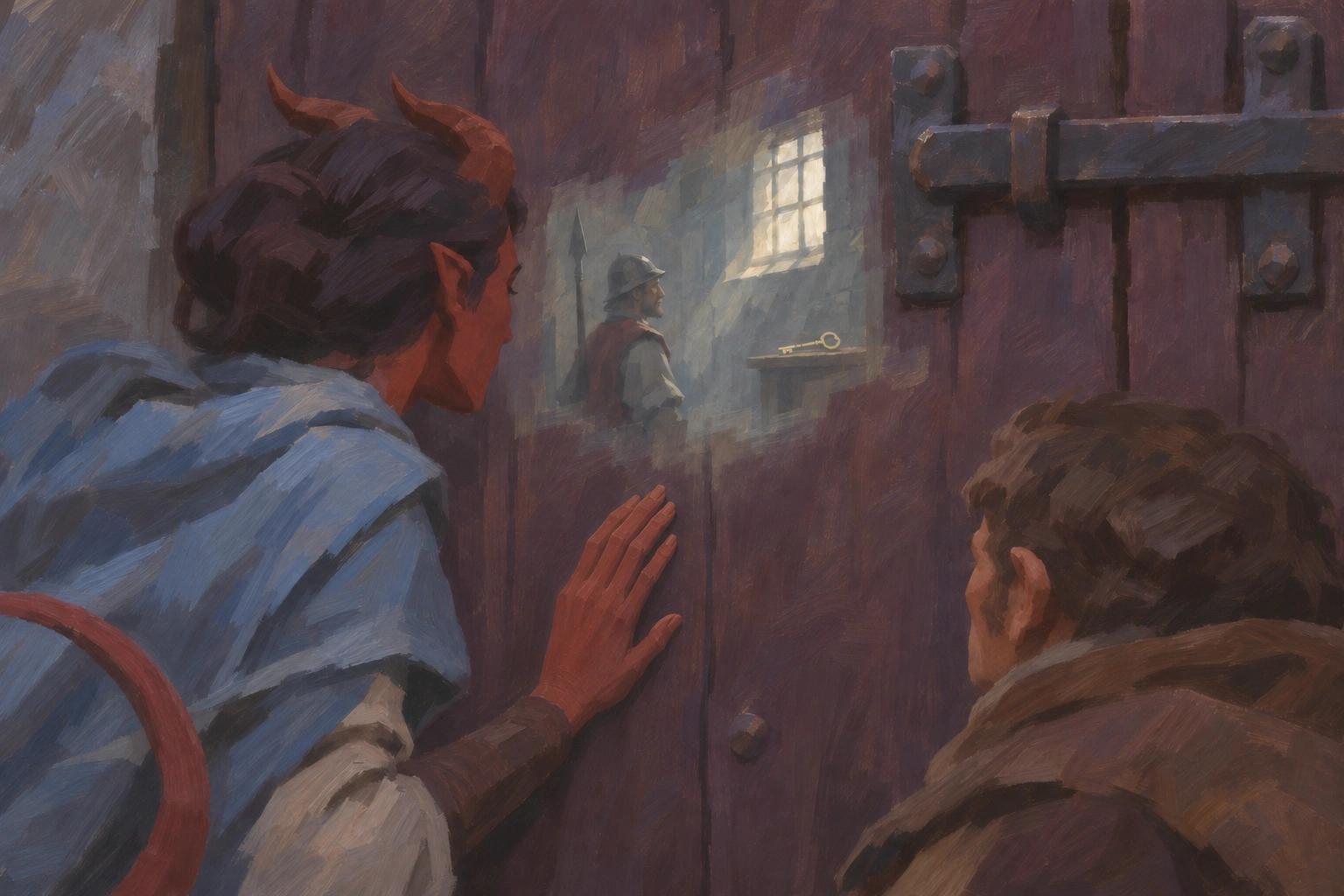
Glass is the only wall you can see through. Sorcerers of Glass Sorcery carry that quality in their eyes: a door, a sealed letter or a strongbox thins under their stare until they can read what is behind it. They are the party's scouts without ever leaving the corridor. At the table, they spend long stretches quiet, counting guards and reading orders through envelopes, and then they say one sentence that changes the plan. What pulls at them is the habit itself. Once you can look through everything, it gets hard to be surprised, and harder to trust anything you haven't looked through yet. Many of them were the child who found every present before the holiday.
Shines on: the quiet count of who waits in the next room.
Leaves in the dark: the thrill of not knowing what comes next.
Level 3: Glass Spells
When you reach a Sorcerer level specified in the Glass Spells table, you thereafter always have the listed spells prepared.
Glass Spells
| Sorcerer Level | Spells |
|---|---|
| 3 | Color Spray, Identify, Mirror Image, See Invisibility |
| 5 | Clairvoyance, Nondetection |
| 7 | Arcane Eye, Greater Invisibility |
| 9 | Scrying, Wall of Force |
Level 3: Glass Sight
As a Bonus Action, you can see into and through solid nonmagical matter within 30 feet of yourself for 10 minutes. Solid objects in that radius appear transparent to you. Your sight passes through up to 1 foot of stone, 1 inch of common metal, or 3 feet of wood or earth; thicker matter or a thin sheet of lead blocks it. You can also read writing inside a closed container or under a seal within that range. Seeing a creature through a barrier doesn't let you target it, and the barrier still gives it Total Cover. Glass Sight doesn't grant Darkvision.
You can use this feature a number of times equal to your Charisma modifier (minimum of once), and you regain all expended uses when you finish a Long Rest.
Level 6: Refraction
Once per turn, when a Sorcerer spell you cast using a spell slot deals damage to only one creature, you can refract part of the spell into a second creature you can see within 10 feet of the first. The second creature takes Force damage equal to your Charisma modifier (minimum of 1). This damage requires no attack roll or saving throw.
For example, a Chromatic Orb that hits a gnoll also deals 4 Force damage to the bandit beside it.
Level 14: Through the Glass
While Glass Sight is active, when you cast a Sorcerer spell that targets only one creature, and you can see that creature through a barrier with Glass Sight, you can spend 3 Sorcery Points to let the spell pass through that barrier. The barrier doesn't block the spell, the target gains no Cover from it, and the barrier is unharmed. The spell can pass through only one barrier, and a spell that affects an area can't benefit from this feature.
Level 18: Clear as Glass
As a Bonus Action, you can become as clear as glass for 1 minute. For the duration, you have the Invisible condition, which doesn't end when you make an attack, deal damage or cast a spell, and Glass Sight is active without expending a use.
Once you use this feature, you can't use it again until you finish a Long Rest unless you spend 7 Sorcery Points (no action required) to restore your use of it.
Fever Sorcery
Run Hot and Cast Through It
Some magic arrives like a fever, with heat behind the eyes and a shake in the hands. Sorcerers of Fever Sorcery don't wait for it to pass. They call it up on purpose and cast through it, faster and harder than they ever could with a cool head. The cost is plain to see. A sorcerer in a fever can barely hold a spell steady, and one good hit can shake it loose. At the table, they are the player who goes all in on a quick plan and dares the enemy to interrupt it. What pulls at them is the heat itself, and the moment it breaks.
Shines on: the moment your hands shake and it lands anyway.
Leaves in the dark: the slow plan, abandoned for the quick one.
Level 3: Fever Spells
When you reach a Sorcerer level specified in the Fever Spells table, you thereafter always have the listed spells prepared.
Fever Spells
| Sorcerer Level | Spells |
|---|---|
| 3 | Blindness/Deafness, Expeditious Retreat, Heat Metal, Hideous Laughter |
| 5 | Fear, Haste |
| 7 | Confusion, Phantasmal Killer |
| 9 | Dream, Hold Monster |
Level 3: Fever Spike
As a Bonus Action, you can start a fever that lasts for 1 minute. Only the Incapacitated condition or a feature of this subclass ends it early. If you are concentrating on a spell when you start a fever, you immediately make a DC 10 Constitution saving throw with Disadvantage to maintain that Concentration. While the fever runs, you gain the following benefits and drawback.
Racing Pulse. Once on each of your turns, when you deal damage with a Sorcerer spell, you can add your Charisma modifier (minimum of 1) to one damage roll of that spell. In addition, your Speed increases by 10 feet.
Shaking Hands. You have Disadvantage on Constitution saving throws to maintain Concentration, and you can't have Advantage on them.
You can start a fever twice, and you regain all expended uses when you finish a Long Rest. From Sorcerer level 6, the number of uses equals your Charisma modifier (minimum of twice).
Level 6: Fever Grip
While your fever runs, once per turn when you deal damage to a creature with a Sorcerer spell, you can force that creature to make a Constitution saving throw against your spell save DC. On a failed save, the creature shakes with your fever and has Disadvantage on the next attack roll it makes before the start of your next turn. For example, an ogre that fails the save swings at the Fighter with Disadvantage.
Level 14: The Fever Breaks
As a Bonus Action, you can break a running fever, ending it, and each creature of your choice in a 30-foot Emanation originating from you makes a Constitution saving throw against your spell save DC, taking 7d10 Psychic damage on a failed save or half as much damage on a successful one.
Once you use this feature, you can't use it again until you finish a Long Rest unless you spend 5 Sorcery Points (no action required) to restore your use of it.
Level 18: Fever Peak
While your fever runs, the damage bonus from Racing Pulse equals twice your Charisma modifier, and creatures have Disadvantage on the saving throw against Fever Grip. Shaking Hands still applies.
Sorcerer Options
Everything in this section is optional, and the Game Master (GM) decides which options are available. It offers eight Metamagic options and three variant features. Then come four General feats and an Epic Boon, three magic items for Sorcerers and a lamp anyone can use, the personal tables and the new Sorcerer spells.
Metamagic Options
When you gain a Metamagic option from the Metamagic feature, you can choose one of the following options instead of one from that feature, and you can replace one with another when you gain a Sorcerer level. Each option's cost in Sorcery Points is in its header. You can use only one Metamagic option on a spell unless an option says otherwise. If an option calls for a check against you, it uses your spell save DC.
New Metamagic Options
| Option | Cost | What It Does |
|---|---|---|
| Disguised Spell | 1 | onlookers mistake your spell for a different one of the same level |
| Opening Spell | 1 | another creature's next attack against your target has Advantage |
| Hurling Spell | 1 | a creature your spell damages is pushed 10 feet away from you |
| Patient Spell | 1 | holding a readied spell doesn't require Concentration |
| Penetrating Spell | 2 | one creature's Resistance doesn't reduce your spell's damage |
| Rallying Spell | 1 | willing targets of your spell gain a few Temporary Hit Points |
| Reshaped Spell | 1 | a Cone becomes a Line, or a Line becomes a Cone |
| Rooting Spell | 1 | one creature that fails its save against your spell can't move |
Disguised Spell
Metamagic Option (Cost: 1 Sorcery Point)
When you cast a spell, you can spend 1 Sorcery Point to make the casting look like that of another spell of the same level. A creature that tries to identify the spell, such as with an Intelligence (Arcana) check, sees the false spell unless it succeeds on that check against your spell save DC. The real effect happens as normal, and the spell can still be countered. For example, your Suggestion can pass for Calm Emotions.
Opening Spell
Metamagic Option (Cost: 1 Sorcery Point)
When you hit a creature with a spell attack roll, you can spend 1 Sorcery Point. The next attack roll that a creature other than you makes against that target before the end of your next turn has Advantage. You can use this option on only one creature per spell. For example, your Ray of Frost hits the troll, and the Fighter's next attack against it has Advantage.
Hurling Spell
Metamagic Option (Cost: 1 Sorcery Point)
When a spell you cast deals damage to a Large or smaller creature, whether on a hit or a failed saving throw, you can spend 1 Sorcery Point to push one such creature up to 10 feet straight away from you. For example, a Shatter that damages a hobgoblin on the edge of a ledge can also push it off.
Patient Spell
Metamagic Option (Cost: 1 Sorcery Point)
When you take the Ready action to cast a spell, you can spend 1 Sorcery Point so that holding the spell's energy doesn't require Concentration. If the spell itself requires Concentration, that Concentration starts normally when you release the spell. If the trigger never comes, the spell slot is still expended. For example, you can keep Haste running while you hold Shatter for the door.
Penetrating Spell
Metamagic Option (Cost: 2 Sorcery Points)
When you cast a spell that deals damage, you can spend 2 Sorcery Points to choose one creature the spell affects. That creature doesn't benefit from Resistance to the spell's damage. Immunity is unaffected. For example, a creature with Resistance to Cold damage takes the full damage of your Cone of Cold, while the others in the Cone with Resistance still take half.
Rallying Spell
Metamagic Option (Cost: 1 Sorcery Point)
When you cast a spell that targets one or more creatures other than you, you can spend 1 Sorcery Point. Each of those targets that is willing gains Temporary Hit Points equal to your Charisma modifier (minimum of 1). For example, if you cast Haste on the Paladin, the Paladin also gains Temporary Hit Points equal to your Charisma modifier.
Reshaped Spell
Metamagic Option (Cost: 1 Sorcery Point)
When you cast a spell whose area is a Cone or a Line, you can spend 1 Sorcery Point to change its shape. A Cone becomes a Line that is twice the Cone's length and 5 feet wide; a Line becomes a Cone half the Line's length (minimum of 15 feet). For example, Cone of Cold can become a 120-foot Line that runs past your friends.
Rooting Spell
Metamagic Option (Cost: 1 Sorcery Point)
When a creature fails a saving throw against a spell you cast, you can spend 1 Sorcery Point to choose one creature that failed the save. Its Speed is 0 until the start of your next turn. For example, after a Thunderwave, the bandit captain who failed the save can't follow you when you step back.
Sorcerer Variant Features
Each variant replaces the named feature at the same level. Ask your GM before you take one. A variant is a different shape for the same job, not a better version of it. No subclass in this book needs a feature that a variant replaces, and Sorcerous Calm counts as Innate Sorcery for every feature that refers to it.
Sorcerer Variant Features
| Level | Variant | Replaces | You Trade |
|---|---|---|---|
| 1 | Sorcerous Calm | Innate Sorcery | a sharper attack for a steadier defense |
| 5 | Sorcerous Surge | Sorcerous Restoration | points after a rest for points when a fight starts |
| 7 | Welling Up | Sorcery Incarnate | bought uses and doubled Metamagic for free uses after each rest |
Level 1: Sorcerous Calm
Sorcerer Variant Feature (replaces Innate Sorcery)
As a Bonus Action, you can steady your magic for 1 minute. For the duration, you have Advantage on Constitution saving throws to maintain Concentration, and you gain a +1 bonus to Armor Class. You can use this feature twice, and you regain all expended uses when you finish a Long Rest.
Any feature that refers to Innate Sorcery, such as Sorcery Incarnate, treats this feature as Innate Sorcery. For example, at level 7 you can spend 2 Sorcery Points to steady your magic again, and while it lasts you can use two Metamagic options on a spell. A feature that says you can't have Advantage on those saves still applies.
Level 5: Sorcerous Surge
Sorcerer Variant Feature (replaces Sorcerous Restoration)
When you roll Initiative, you can regain expended Sorcery Points, up to a number equal to half your Sorcerer level (round down). Once you use this feature, you can't use it again until you finish a Long Rest.
For example, a level 8 Sorcerer who spent the morning's points opening a sealed gate regains 4 Sorcery Points when the ambush on the other side begins. The amount is the same as that of Sorcerous Restoration; only the moment changes, which helps a party that rarely rests and costs a party that rests often.
Level 7: Welling Up
Sorcerer Variant Feature (replaces Sorcery Incarnate)
When you finish a Short Rest, you regain one expended use of Innate Sorcery. You can't spend Sorcery Points to use Innate Sorcery, and while it is active you can still use only one Metamagic option on a spell unless an option says otherwise.
For example, on a day with two Short Rests you can use Innate Sorcery up to four times without spending a single Sorcery Point, but once your uses are gone, you can't buy another with Sorcery Points.
Sorcerer Feats
General feats require level 4+. Boon of the Wellspring is an Epic Boon, a choice for the level 19 Epic Boon feature. Each feat builds on Font of Magic or Innate Sorcery, so it works for any character who has that feature, including a character with Sorcerer levels from multiclassing. Playing a Sorcerer suggests which feat suits which subclass.
Deep Font
General Feat (Prerequisite: Level 4+, Font of Magic Feature)
You gain the following benefits.
Ability Score Increase. Increase your Constitution or Charisma score by 1, to a maximum of 20.
Wider Reserve. Your Sorcery Point maximum increases by 2.
Rich Conversion. When you convert a spell slot into Sorcery Points, you gain 1 additional Sorcery Point, which can't take you above your Sorcery Point maximum. Once you use this benefit, you can't use it again until you finish a Long Rest. For example, a level 4 Sorcerer with this feat has 6 Sorcery Points and turns a level 2 slot into 3 points instead of 2.
Sorcerous Rebuke
General Feat (Prerequisite: Level 4+, Font of Magic Feature)
You gain the following benefits.
Ability Score Increase. Increase your Constitution or Charisma score by 1, to a maximum of 20.
Answering Crack. When a creature you can see within 60 feet of yourself deals damage to you, you can take a Reaction and spend 1 to 3 Sorcery Points. The creature makes a Dexterity saving throw against your spell save DC, taking 1d10 Force damage for each Sorcery Point spent on a failed save or half as much damage on a successful one. For example, spending 3 Sorcery Points deals 3d10 Force damage on a failed save.
Spell Reader
General Feat (Prerequisite: Level 4+, Font of Magic Feature)
You gain the following benefits.
Ability Score Increase. Increase your Intelligence or Charisma score by 1, to a maximum of 20.
Name the Casting. When a creature you can see within 60 feet of yourself casts a spell, you can take a Reaction and spend 1 Sorcery Point to learn the spell's name and level. You then have Advantage on saving throws against that casting of the spell. For example, you learn that the cult leader is casting Hold Person and make the Wisdom save with Advantage.
Practiced Reader. You have Advantage on Intelligence (Arcana) checks to identify spells and magical effects.
Surging Presence
General Feat (Prerequisite: Level 4+, Innate Sorcery Feature)
You gain the following benefits.
Ability Score Increase. Increase your Constitution or Charisma score by 1, to a maximum of 20.
Standing Tall. When you activate Innate Sorcery, you gain Temporary Hit Points equal to your Sorcerer level plus your Charisma modifier, and you have Immunity to the Frightened condition until your Innate Sorcery ends. For example, a level 8 Sorcerer with a Charisma of 18 gains 12 Temporary Hit Points.
Boon of the Wellspring
Epic Boon Feat (Prerequisite: Level 19+, Font of Magic Feature)
You gain the following benefits.
Ability Score Increase. Increase your Charisma score by 1, to a maximum of 30.
Fresh Spring. When you roll Initiative and have fewer than 4 Sorcery Points, you regain expended Sorcery Points until you have 4. For example, after a morning of creating spell slots, you start the afternoon's fight with 4 points for Metamagic.
Sorcerer Magic Items
Sorcerers rarely need tools, but many keep a favorite anyway. The first three items require attunement by a Sorcerer and work with Sorcery Points or Innate Sorcery. The lamp works for anyone, Sorcerer or not, and is as useful at noon as at midnight.
Striker Charm
Wondrous Item, Uncommon (Requires Attunement by a Sorcerer)
This charm is a chip of flint and a sliver of steel bound together on a leather cord. The charm has 2 charges and regains 1d2 expended charges daily at dawn.
Struck Cost. When you spend Sorcery Points on a Metamagic option while wearing the charm, you can expend 1 charge to reduce that option's cost by 1 Sorcery Point (to a minimum of 0). You can use this property only once per spell. For example, Quickened Spell costs you 1 Sorcery Point instead of 2.
Prism Rod
Rod, Rare (Requires Attunement by a Sorcerer)
This rod of clear glass is as long as a forearm and cut with six flat faces. The rod has 3 charges and regains 1d3 expended charges daily at dawn.
Bent Casting. While holding the rod, when you cast a Sorcerer spell using a spell slot, you can expend 1 charge to choose one of the following effects: the spell's damage changes to Force or Radiant damage (your choice), or the spell's range increases by 60 feet if its range is 30 feet or more. You can use this property only once per spell. For example, a Shatter can deal Force damage to a creature that has Resistance to Thunder damage, or reach a rooftop 120 feet away.
Crown of the Brimming Font
Wondrous Item, Very Rare (Requires Attunement by a Sorcerer)
This thin silver circlet hums faintly when its wearer is angry, and the hum rises before every spell.
Brimming Sorcery. While wearing the crown, you can use Innate Sorcery one additional time, and you regain this use when you finish a Long Rest. For example, a level 12 Sorcerer can use Innate Sorcery three times between Long Rests before spending any Sorcery Points on it.
Overflow. While wearing the crown, you can cast a Sorcerer spell of level 6 or lower that you have prepared without expending a spell slot. The spell is cast at its lowest level. Once you use this property, you can't use it again until the next dawn. For example, you can cast Disintegrate once a day and keep every spell slot for later.
Crackling Lamp
Wondrous Item, Uncommon
This lamp burns Oil like an ordinary Lamp, shedding Bright Light in a 15-foot radius and Dim Light for an additional 30 feet; a flask of Oil keeps it burning for 6 hours. Its glass is fine as a soap bubble, and it crackles faintly when touched.
Static Release. While holding the lamp, you can take a Magic action to release the stored static at one creature you can see within 15 feet of yourself. The creature makes a Dexterity saving throw (DC 13), taking 3d6 Lightning damage on a failed save or half as much damage on a successful one. Once used, this property can't be used again until the next dawn. It works in daylight and whether or not the lamp is lit.
Sorcerer Personal Tables
Roll on each table or choose an entry that fits your character. Every entry is a person, a place, an object or a secret, and each one is a hook your GM can use in the first session. None of them has a rules effect. Sorcery tends to run in families and in rumors, so let the entries tangle.
How It Was Lit
| d6 | Beginning |
|---|---|
| 1 | Your first spell slammed a door in a stranger's face, and that stranger still asks every village who did it. |
| 2 | You were born during a storm that stopped when you first cried, and the midwife has written to you every year since. |
| 3 | A fever nearly took you as a child; when it broke, the cup of water by your bed was frozen solid. |
| 4 | You sneezed at a funeral and every bell in the village rang once. Your family moved away that same winter. |
| 5 | Your grandmother had it too. She made you promise to hide it, and you broke that promise in front of witnesses. |
| 6 | A bully's stone stopped in the air and dropped onto his own boot. He grew up, and he still remembers. |
What Feeds the Flame
| d6 | Drive |
|---|---|
| 1 | You want to find one other sorcerer whose magic feels exactly like yours, just to know you're not alone. |
| 2 | You owe a farmer a new barn roof, and you mean to pay for every board your magic split. |
| 3 | Someone you loved called you a danger to everyone near you. You intend to prove them wrong in public. |
| 4 | You're searching for the place your magic came from; a smell of hot stone keeps leading you on. |
| 5 | You promised your younger sibling you'd master it before theirs woke up. Theirs woke up last month. |
| 6 | You live for the silence after a spell works, when everyone stares. You'd cross a sea for that silence. |
Soot
| d6 | Mark |
|---|---|
| 1 | Your hair stands on end when you're nervous, and card players refuse to share a table with you. |
| 2 | Mirrors you look into for too long grow a hairline crack, and innkeepers have started to charge you for them. |
| 3 | A blue scar runs across your left palm where the first spell left you, and compasses spin when you hold one. |
| 4 | Animals won't settle near you, except one stubborn mule who follows you everywhere for reasons of her own. |
| 5 | You talk in your sleep in a language nobody has recognized, and you wake up hoarse and thirsty. |
| 6 | Small metal things go missing around you and turn up later, warm, in your own pockets. |
Beyond the Edge
| d6 | Out There |
|---|---|
| 1 | A collector of strange talents has heard of you and sent a polite letter that mentions your mother. |
| 2 | Somewhere ahead lives a hermit who sealed away his own magic, and he offers to teach you how, for a price. |
| 3 | A town you saved from a flood now blames you for it, and its reeve keeps a drawing of your face. |
| 4 | Another sorcerer is following your trail one town behind, leaving small gifts you never asked for. |
| 5 | A tower of glass stands on a hill you dream about, and last week a traveler described it exactly. |
| 6 | Your magic answered a call once, from very far away. Whatever called is still calling, a little louder each month. |
New Sorcerer Spells
These spells are on the Sorcerer spell list. You'll find them in Spells A–L and Spells M–Z.
New Sorcerer Spells
| Spell Level | Spells |
|---|---|
| Cantrip | Beckon Object, Latchward, Lost Thread, True Measure |
| Level 1 | Beneath Notice, Ink Spatter, Rain of Caltrops, Splinter Burst, Unyielding Grip |
| Level 2 | Clear Pane, Dizzy Spell, Slip Free, Vanishing Act, Weight of Lead |
| Level 3 | Conjure Stagehand, Force Hammer, Hornet Swarm, Stonefall |
| Level 4 | Exchange of Stations, Force Pillory, Looking-Glass Door, Storm of Shards |
| Level 5 | Bellows Blast, Bone-Deep Weariness, Sudden Sinkhole |
| Level 6 | Break the Spell, Creeping Frost, Wasting Fever |
| Level 7 | Rearrange the Rooms, Shrink to Truth |
| Level 8 | Compound Interest, Siege Barrage |
| Level 9 | Bar the Planes, Ruinous Implosion |