
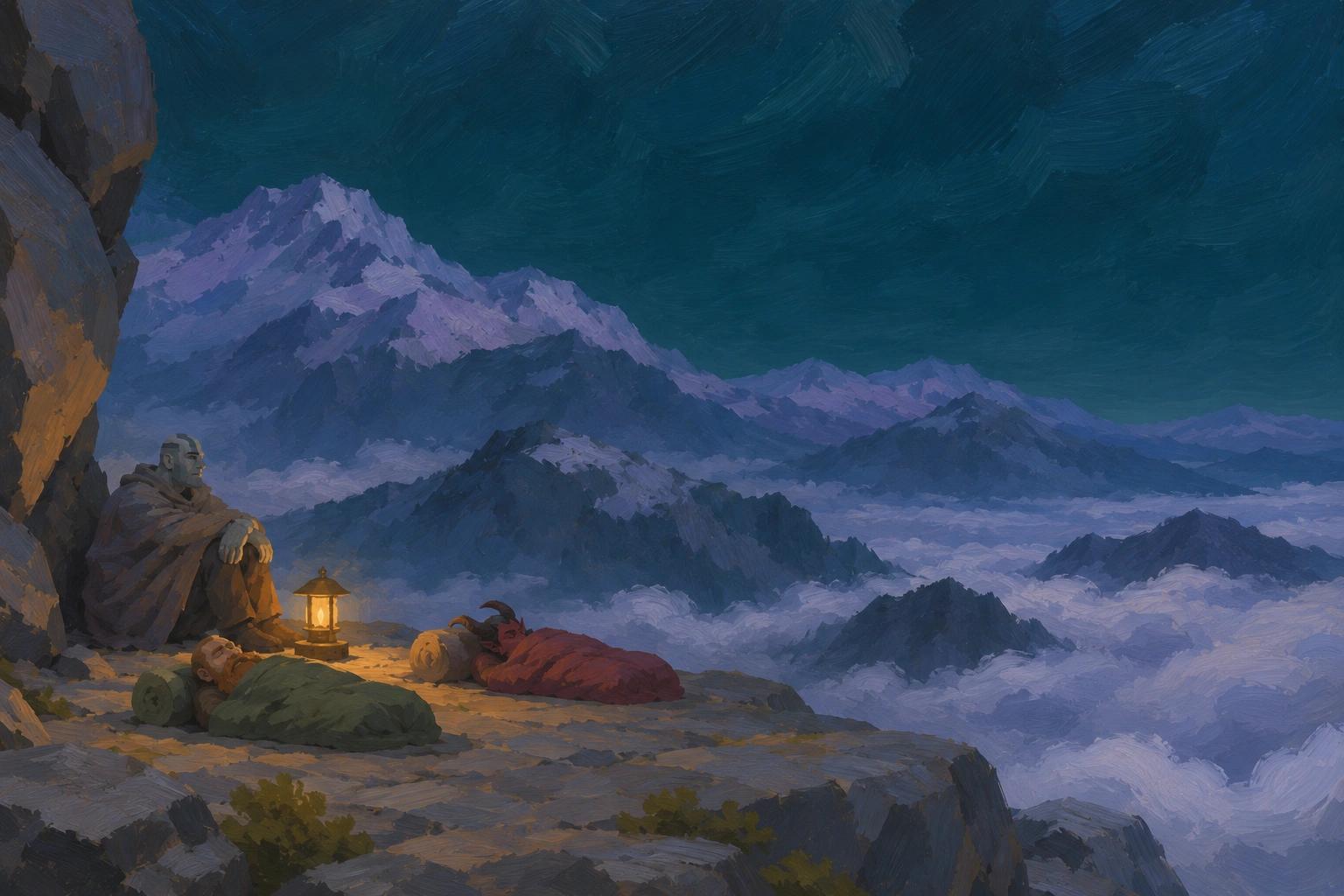
Optional Module
Most adventuring days end with the same sentence: "We make camp and take a Long Rest." Then the table rolls Hit Point Dice back, crosses off a few Rations and moves on to morning. This module turns that sentence into five minutes of play. The characters set watches, one of them asks another a question, and somewhere in the night something happens that nobody planned. Nothing in the rest of this book needs it. You can use it at every Long Rest, at the first rest of each session, or only when the camp itself is worth a scene.
This chapter is written for you, the Game Master (GM). It has four parts: the procedure, which fits on one page; the watch activities; the question lists; and The Dark Hour, a d20 table for each kind of place the characters camp in. The path scenes that mark a character's arrival at level 3 follow in the next part of the chapter.
The Procedure
Use these four steps whenever the characters take a Long Rest somewhere that needs a watch: on the road, in the wild, in a ruin. In a locked room at an inn, skip step 1 and keep the rest.
1. Set the Watches. A Long Rest lasts at least 8 hours. Divide the night into four watches of 2 hours each. Each character can keep one watch, which counts as the 2 hours of light activity a Long Rest allows. The players decide who keeps which watch; two characters can share one. Each character on watch chooses one watch activity from the lists in this chapter. A watch nobody keeps is unwatched.
2. Ask One Question. The player whose character holds the lamp asks one other character a question from that character's class list. If the player answers in character, the character gains Heroic Inspiration. Passing is always allowed. If a character reaches level 3 at this rest, play that character's path scene instead of the question.
3. Roll The Dark Hour. Roll a d4 to find the watch in which it happens, then roll once on The Dark Hour table for the place the characters camp in. The characters on that watch meet it first. If the watch is unwatched, the event finds a sleeping camp.
4. Greet the Morning. Unless the rest was interrupted, the characters finish the Long Rest and gain its benefits. The lamp passes to the player on the holder's left for the next Long Rest. Watch activity effects that last "until the rest ends" end now; effects that last until a character's next Long Rest stay with that character.
Heroic Inspiration. A character can gain Heroic Inspiration from this module only once per Long Rest, whether from the question, a path scene or anything else in this chapter. A character who already has Heroic Inspiration gains nothing more, since a character can't have more than one.
At the Table
The procedure is fast because each step asks one decision of one person. Step 1 belongs to the players: they say who keeps which watch and what they do, and you note it. Step 2 belongs to two players: the one holding the lamp and the one being asked. Step 3 belongs to you. Step 4 is bookkeeping. A table that knows the procedure finishes a camp in five minutes, and most of that is the answer to the question.
Give the lamp a body at the table. A real candle in a jar, a small brass lamp, a die you set in front of the player: anything that moves from hand to hand and says "your turn to ask." The holder in the story can be the character tending the camp's lamp or simply the one still awake. The token is for the players; nobody in the camp needs to know it exists.
Keep the order. Watches first, because the players need to know who is awake before The Dark Hour arrives. The question second, because it is easier to answer by the fire before anything goes wrong. The Dark Hour last, because it can end the rest early. If The Dark Hour falls in the first watch and ends in a fight, the question waits until the camp is settled again.
When the Rest Is Interrupted
The module changes none of the rules for resting. A Long Rest stops if a character rolls Initiative, casts a spell other than a cantrip, takes any damage or spends an hour walking or doing other strenuous work. A character who rested at least 1 hour before the interruption gains the benefits of a Short Rest, and the characters can resume the Long Rest afterward, adding 1 hour for each interruption.
When the rest resumes, do not set the watches again. Each watch activity keeps the effect it already produced, and a watch activity whose effect starts "at the end of your watch" produces it only if that watch ended before the interruption. Do not roll The Dark Hour a second time; one event per Long Rest is the rule even when that event was a fight.
Short Rests and Safe Rooms
A Short Rest is too short for watches, but a table that likes the question can use step 2 alone during one. Heroic Inspiration from the question still counts against the limit of once per Long Rest, so a character who answered during a Short Rest gains none from the question at the next Long Rest.
When the characters sleep behind a barred door, in a friend's house or in a room at an inn, nobody needs to keep watch. Skip step 1, keep step 2, and roll The Dark Hour on a table that fits the building, or not at all. Some of the best nights in a campaign are the ones where the only event is the question.
Example of Play
Four characters camp below a ruined watchtower after a long day on the road: a barbarian, a bard, a cleric and a rogue. The players set the watches. The barbarian takes the first watch and chooses Raise the Barricade, stacking packs and stones along the open side of the camp. The rogue takes the second and chooses Keep the Camp Low. The bard and the cleric share the third: the cleric chooses Mend the Kit for a split shield strap, and the bard chooses Rehearse the Plan, talking the cleric through tomorrow's meeting with the tower's new owner. Nobody keeps the fourth watch.
The rogue's player holds the lamp. She rolls a d12 on the Barbarian list and asks the barbarian, "Who taught you to stop, and did it work?" The barbarian's player thinks about it and answers in character: an aunt who sat on him until he laughed, and no, it never worked on anyone else. The barbarian gains Heroic Inspiration.
You roll a d4 for The Dark Hour and get a 2: the rogue's watch. You roll on the Ruin table, since the camp sits against the tower, and get a 4. An owl family in the broken tower watches the camp all night. The rogue's player decides her character watches back, and the two of them spend an hour pretending not to notice each other. Nothing else happens. In the morning the cleric has Advantage on the first Charisma check she makes, the shield strap is whole, the barricade comes down, and the lamp passes to the barbarian's player.
The First Night
Introduce the module at the first Long Rest of a campaign, or at the first one after the characters reach the road. Explain it in three sentences: everyone on watch picks one thing to do, the lamp holder asks one question, and something happens in the night. Hand the lamp token to the player on your left. Let the players read the watch activities while you roll The Dark Hour, so the first night shows every part of the procedure once.
The first question takes longest, because nobody knows yet how long an answer should be. If the first answer is a single sentence, say thank you and move on; that sets the length. If it runs to a story, let it, and the next player will know a story is welcome too.
Variants
Tables differ. These variants change the procedure without changing what it gives; use any that suit your group.
Once per Session. In a campaign with several Long Rests per session, run the full procedure only at the first rest of each session. The others are ordinary Long Rests. Heroic Inspiration still comes only from the question.
Quiet Watches. Some tables like the question and The Dark Hour but not the bookkeeping of watch activities. Skip the activities; the players still set the watches, and the d4 still finds who meets the night.
The Hidden Hour. Roll the d4 for The Dark Hour behind your screen instead of in the open. The players then set their watches without knowing which one matters, and an unwatched gap feels like a risk. Roll in the open when the table prefers to see the dice.
One or Two Players. With a single character, the holder is always the same player, so you ask the question instead, from the character's list. With two characters, the players simply ask each other in turn. A companion or hireling can ask too, in your voice.
Watch Activities
Each character on watch chooses one watch activity. A watch activity does one thing, written in the terms of the core rules. None of them adds a new number, sets a new DC or restores a resource; recovering Hit Points, spell slots and feature uses is the job of the Long Rest itself. Watch activities make the night a little safer and the morning a little better prepared.
The rules for all watch activities:
- A character chooses one watch activity per Long Rest, on the watch that character keeps.
- Each watch activity can be chosen by only one character per Long Rest, unless it says otherwise.
- A watch activity limited to a class or background names it at the start of its text. A character who has that class at any level, or that background, can choose it.
- A watch activity that needs a tool names it; the character must have the tool with them.
- A watch activity's effect lasts as long as its text says. If it says nothing, the effect ends when the rest ends.
- A character can always keep a watch without choosing an activity. That character simply stays awake and alert.
The general activities are open to everyone. The class and background activities belong to the characters who have those classes and backgrounds, and they tend to do one thing that only that kind of person thinks of doing at night.
Setting the Watches
Four watches of 2 hours cover an 8-hour Long Rest. How many of them are kept depends on the size of the group.
Watches by Group Size
| Characters | Watches Kept | Notes |
|---|---|---|
| 1 | 1 of 4 | Three watches are unwatched; a lone traveler sleeps through most of The Dark Hour. |
| 2 | 2 of 4 | The players choose which two; the first and last watch are the usual pair. |
| 3 | 3 of 4 | One watch is unwatched; the players choose which. |
| 4 | 4 of 4 | Every watch is kept. |
| 5 or more | 4 of 4 | Extra characters share watches; each chooses a different activity. |
A character whose traits let them finish a Long Rest in less than 8 hours, such as an Elf's Trance, can keep a second watch, but still chooses only one watch activity per Long Rest. Companions, familiars and hirelings can keep watch too; they keep the watch without choosing an activity.
The unwatched watch matters only when The Dark Hour falls in it. Let the players decide where to leave the gap. Leaving the middle of the night empty is the common choice, and it is a real choice.
General Watch Activities
Any character on watch can choose one of these activities.
Cook a Hot Meal. You need Cook's Utensils. Each creature that eats the meal at the end of the rest has Advantage on Constitution saving throws it makes to avoid Exhaustion before it finishes its next Long Rest.
Guard Against the Cold. You keep the fire fed, wrap the sleepers and turn them from the wind. Until the rest ends, creatures sleeping in the camp automatically succeed on saving throws against extreme cold.
Keep the Camp Low. You shield the fire, muffle loose gear and keep voices down. Until the rest ends, creatures outside the camp have Disadvantage on Wisdom (Perception) checks to notice it.
Mend the Kit. You need any set of Artisan's Tools. You repair a single break or tear in one object in the camp, as if you had cast Mending on it.
Practice Your Craft. You work quietly with one set of tools you have proficiency with. You have Advantage on the first ability check you make with those tools before you finish your next Long Rest.
Read the Sky. You watch the clouds, the wind and the stars through the night. At the end of your watch, you know what the weather will be at the camp for the next 24 hours, as if you had cast Druidcraft.
String the Pans. You hang cookware and cord around the camp, which must fit in a 20-foot Cube. Until the rest ends, the camp is warded as if by the Alarm spell with an audible alarm.
Trim the Wick. You tend one Lamp, Hooded Lantern or Bullseye Lantern through your watch. It burns until the rest ends without using up its flask of Oil.
Barbarian Watch Activities
Barbarians keep watch with their bodies: on their feet, at the edge, between the camp and whatever is out there.
Walk the Edge. Barbarian only. You pace the camp's outer edge for your whole watch. Until your watch ends, you have Advantage on Wisdom (Perception) checks to notice creatures approaching the camp.
Raise the Barricade. Barbarian only. You stack packs, logs and stones into a low wall. Until the rest ends, creatures inside the camp have Half Cover against ranged attacks from outside it.
Bard Watch Activities
Bards keep watch with their voices, low enough not to wake anyone who should stay asleep.
Soft Tune. Bard only. You play quietly through your watch. One creature of your choice that sleeps during your watch has Advantage on its first saving throw against the Frightened condition before it finishes its next Long Rest.
Rehearse the Plan. Bard only. You talk through tomorrow's plan with one creature that keeps watch with you. That creature has Advantage on its first Charisma check before it finishes its next Long Rest.
Cleric Watch Activities
Clerics keep watch with a prayer under their breath, and they pray for the sleepers before they pray for the road.
Keep the Vigil. Cleric only. You pray over the sleepers through your watch. Until the rest ends, creatures sleeping in the camp have Advantage on saving throws they make to avoid or end the Charmed and Frightened conditions.
Road Prayer. Cleric only. You bless the party's boots and packs for tomorrow. Each creature in your party has Advantage on the first saving throw it makes to avoid or end the Poisoned condition before it finishes its next Long Rest.
Druid Watch Activities
Druids keep watch with the land around the camp, which has been awake all along and will tell them so.
Listen to the Night. Druid only. You listen to the animals around the camp through your watch. Until your watch ends, you and one other creature keeping watch with you have Advantage on Wisdom (Perception) checks.
Coax the Brambles. Druid only. You coax roots and brambles across the open ground around the camp. Until the rest ends, a 5-foot-wide ring of ground along the camp's outer edge is Difficult Terrain.
Fighter Watch Activities
Fighters keep watch the way they were drilled to: on a fixed route, with the gear checked twice.
Make the Rounds. Fighter only. You walk a fixed route past every sleeper and every approach. If combat starts during your watch, no creature in the camp has Disadvantage on its Initiative roll for being surprised.
Weapons to Hand. Fighter only. You lay every sleeper's weapon and Shield within reach. If combat starts before the rest ends, a creature that wakes can don its Shield as part of standing up.
Monk Watch Activities
Monks keep watch the way they meditate: upright, unmoving and listening to everything at once.
Measured Forms. Monk only. You move through slow, measured forms beside the camp all watch. You have Advantage on the first Dexterity saving throw you make before you finish your next Long Rest.
Listen in the Stillness. Monk only. You sit perfectly still and listen past the fire. Until your watch ends, creatures approaching the camp have Disadvantage on Dexterity (Stealth) checks to avoid your notice.
Paladin Watch Activities
Paladins keep watch as if someone had asked them to, and sooner or later someone always has.
Tend the Wounded. Paladin only. You check bandages and change dressings through your watch. One creature of your choice in the camp has Advantage on its first Death Saving Throw before it finishes its next Long Rest.
Recite the Oath. Paladin only. You stand awake and repeat your oath quietly. You have Advantage on your first saving throw to avoid or end the Frightened condition before you finish your next Long Rest.
Ranger Watch Activities
Rangers keep watch outside the ring of the fire, where the ground still has something to say.
Walk the Perimeter. Ranger only. You circle the camp and read every track. At the end of your watch, you learn the number and creature type of any creatures that passed within 100 feet of the camp since dusk.
Brush Out the Tracks. Ranger only. You walk back along the way your group came and sweep its trail with a branch. Until the rest ends, creatures following your group's tracks to the camp have Disadvantage on Wisdom (Survival) checks to do so.
Rogue Watch Activities
Rogues watch the things other people forget to watch: the ways into the camp, and the purses.
Set Tells. Rogue only. You lay thread across the paths and balance pebbles on the packs. If a creature enters the camp or touches your group's gear before dawn, you learn which way it came and what it touched.
Mind the Purse. Rogue only. You sleep lightly with a hand on the group's valuables. Until dawn, a creature trying to take an object from a sleeping member of your group has Disadvantage on the Dexterity (Sleight of Hand) check.
Sorcerer Watch Activities
Sorcerers keep watch with the magic awake under their skin, which is restless company and a fair alarm.
Raised Hackles. Sorcerer only. You sit with your magic stirring and every hair on end. If combat starts during your watch, you don't have Disadvantage on your Initiative roll for being surprised.
Quiet Practice. Sorcerer only. You let small magic run through your fingers until it settles into a new shape. When the rest ends, you can replace one Sorcerer cantrip you know with another Sorcerer cantrip.
Warlock Watch Activities
Warlocks keep watch in company nobody else can see, and on watch they are rarely as alone as they look.
Recite the Terms. Warlock only. You go over your bargain under your breath, clause by clause. When the rest ends, you have Advantage on the next Charisma (Deception or Persuasion) check you make before you finish your next Long Rest.
Shuttered Camp. Warlock only. You ask what lends you power to watch the dark beyond the camp. At the end of your watch, you know whether any creature watched the camp from outside it during your watch, and from which direction.
Wizard Watch Activities
Wizards keep watch with the spellbook open on their knees, which is less useful against wolves than they claim.
Margin Work. Wizard only. You copy by the fire. The hours of your watch count toward the time you need to copy a spell into your spellbook; you still pay the usual GP.
Listen for Magic. Wizard only. You sit with your spellbook open and your senses on the dark. At the end of your watch, you know whether a spell was cast within 30 feet of the camp during your watch, and its school.
Background Watch Activities
Each background in this book has one watch activity: the habit a character brings from the work they did before adventuring. A character with that background can choose it.
Forage the Hedgerows. Beekeeper only. You walk the hedges and field edges near the camp. At the end of your watch, you have gathered food equal to one day of Rations, provided anything edible grows within a mile of the camp.
Stretch the Rations. Camp Cook only. You portion out the group's food and stretch it into something thin and hot. When the Long Rest ends, your group expends one fewer day of Rations than it otherwise would that day.
Take Inventory. Chandler only. You go through every pack and pouch by the fire and count what is there. At the end of your watch, you know whether any object your group carries has gone missing since the Long Rest began, and which one.
Face the Wind. Charcoal Burner only. You sit away from the fire with your face to the breeze. At the end of your watch, you know whether any other fire is burning upwind within 1 mile of the camp, and in which direction.
Rehearse the Act. Fire-Eater only. You run through your routine in silence, without the fire. You have Advantage on the first Charisma (Performance) check you make before you finish your next Long Rest.
Mend the Glass. Glassblower only. You need Glassblower's Tools. Working over the fire, you repair one broken glass object no larger than a 1-foot Cube, such as a Vial or a Glass Bottle.
Settle the Animals. Herder only. You walk among the mounts and pack animals, talking low. Until the Long Rest ends, Beasts in the camp have Advantage on saving throws to avoid or end the Frightened condition.
Check the Locks. Lamplighter only. You try every latch and lid in the camp. At the end of your watch, you know whether any lock, door or container in the camp was opened or tampered with since the Long Rest began.
Count the Lights. Lighthouse Keeper only. You watch the far edge of the night instead of the fire. At the end of your watch, you know whether any creature carrying a light source came within sight of the camp during your watch, and from which direction.
Look In on the Sleepers. Midwife only. You move quietly from bedroll to bedroll, checking breath and brow. One creature in the camp that has the Poisoned condition has Advantage on the next saving throw it makes to end that condition.
Tap the Walls. Miner only. You knock on stone and listen to what answers. At the end of your watch, you know whether any stone, ceiling or ground within 30 feet of the camp is unstable or hollow.
Check the Fittings. Smith only. You go over every buckle, rivet and strap in the camp by the fire. When the rest ends, you and one ally of your choice can don armor in half the usual time.
Chart the Stars. Stargazer only. You fix the camp's place against the night sky. You have Advantage on the next Wisdom (Survival) check you make to find your way before you finish your next Long Rest.
Loosen Up. Torchrunner only. You stretch, rub out your calves and walk the stiffness out of your legs. You have Advantage on the first Strength (Athletics) or Dexterity (Acrobatics) check you make before you finish your next Short or Long Rest.
Stay on Guard. Watchfire Keeper only. You keep your eyes off the fire and your weapon within reach. If combat starts during your watch, you have Advantage on your Initiative roll.
Pick Through the Debris. Wrecker only. You comb the ground around the camp for anything dropped, washed up or thrown away. At the end of your watch, you have salvaged one piece of Adventuring Gear worth 1 GP or less, chosen by the GM.
Running the Watch
Ask for the watches before anything else, and ask quickly: "Who has first watch, and what are you doing?" Most players will answer with an activity from the list. Some will answer with a description, such as "I sit with my back to the fire and sharpen my axe." Find the activity that matches and say its name back, or let the description stand without an activity. A watch without an activity is still a watch.
Write the activities down where everyone can see them. Several effects wait for a later moment, like the first Charisma check or the first saving throw against the Frightened condition, and players forget them by noon. A row of index cards on the table works; so does a line next to each character's name.
The activities are small on purpose. Advantage on one roll, a known weather forecast, a repaired strap. None of them changes what a character can do in a fight, and none of them should become the reason a group camps. If a player finds a combination that matters, such as Keep the Camp Low with String the Pans on a dangerous night, that is the module working: the group planned its night and the plan held.
When a player asks for an activity that isn't on the list, write one on the spot with the guidance at the end of this part. The answer to "Can I do this?" is almost always yes.
One Question
Once per Long Rest, the player whose character holds the lamp asks another character one question. Each class has a list of twelve; the holder rolls a d12 on the list of the character being asked, or picks a question from it. If the player answers in character, the character gains Heroic Inspiration. That is the whole rule. Everything below is about asking well.
The questions are about the character, never about the plot. They don't ask where the treasure is or what the villain wants. They ask what the character broke on purpose, which song they refuse to play, who taught them to stop. The answer is something the player invents on the spot, and it belongs to the player from then on. You can use it later, but you never contradict it.
Asking and Answering
- Who asks. The player whose character holds the lamp. The lamp passes left after each Long Rest, so every player asks in turn.
- Who answers. Any other character, chosen by the holder. A character with more than one class can be asked from any of their class lists.
- What counts. Any answer given in the character's voice, of any length. One sentence is enough. You never judge whether an answer was good.
- The reward. The answering character gains Heroic Inspiration, within the module's limit of once per Long Rest. The holder gains nothing for asking.
- Passing. The asked player can always pass, without a reason and without a cost. The holder can then ask someone else or let the question go until the next Long Rest.
- Crossing off. Once a character answers a question, cross it off that character's list. When all twelve are gone, the player writes new ones with the guidance at the end of this part.
Some questions touch on loss, anger or fear. Your table's usual safety tools apply here as everywhere. A player can answer a question sideways, change it to a gentler one, or pass. Nobody asks why. A table where passing is easy is a table where people answer.
A player who is quiet at the table often answers the question best, because it gives them a minute when everyone is listening and nothing depends on a die. Make sure the lamp reaches them. If the holder keeps asking the same character, gently suggest someone who hasn't been asked yet.
Using the Answers
Every answer is a gift to you. Write it down in a word or two next to the character's name. Over a campaign, those notes become the list of people, places and promises the character cares about, and none of them had to be pulled out of a backstory sheet.
Use an answer when it can return as something good or something hard, never as a punishment for answering. The bravest person a barbarian ever met can turn up at a crossroads. The song a bard refuses to play can be requested by someone who matters. The quietest place a character ever felt safe can be the place the next adventure threatens, as long as the character gets the chance to protect it.
An answer can also contradict an earlier one. Characters change, and players discover them as they play. Treat the newer answer as the truer one, or as a sign that the character tells different people different things. Both are interesting.
Questions for a Barbarian
Questions for a Barbarian
| d12 | Question |
|---|---|
| 1 | What's the last thing you broke on purpose? |
| 2 | Who taught you to stop, and did it work? |
| 3 | What does your anger sound like from the inside? |
| 4 | When did you last walk away from a fight? |
| 5 | What would you carry out of a collapsing house? |
| 6 | Who is the bravest person you've ever met? |
| 7 | Which smell takes you straight back home? |
| 8 | What promise did you make while angry, and keep anyway? |
| 9 | Which scar has the best story, and is it true? |
| 10 | What do you want people to say about you when you're old? |
| 11 | What scares you that you'd never admit out loud? |
| 12 | Where is the quietest place you've ever felt safe? |
Questions for a Bard
Questions for a Bard
| d12 | Question |
|---|---|
| 1 | Which song do you refuse to play, and who asked you to? |
| 2 | What did the last audience that booed you get right? |
| 3 | Whose applause would mean more to you than a full house? |
| 4 | What's the one line you always forget, and why that one? |
| 5 | Which of us would you write a ballad about, and what's it called? |
| 6 | Which lie have you told so often it became a true story? |
| 7 | Where did you learn your first chord, and who was listening? |
| 8 | What do you hum when you're afraid? |
| 9 | Which instrument would you save from a flood, and why? |
| 10 | What story about you do you hope never reaches us? |
| 11 | Who taught you that a pause can be louder than a shout? |
| 12 | What would your last performance be, and who sits in the front row? |
Questions for a Cleric
Questions for a Cleric
| d12 | Question |
|---|---|
| 1 | What do you pray for when nobody is listening? |
| 2 | Which of us would your god like least, and why? |
| 3 | What sign did you ignore before you finally answered the call? |
| 4 | Whose death are you still arguing with? |
| 5 | What is the hardest thing your faith has asked you to forgive? |
| 6 | Which rite do you keep even when you're alone? |
| 7 | What would make you put down your holy symbol for good? |
| 8 | Who taught you the first prayer you ever learned? |
| 9 | When did your god stay silent, and what did you do? |
| 10 | Which kindness from a stranger do you still owe back? |
| 11 | Which promise to your god have you already broken? |
| 12 | What do you hope waits at the end of your road? |
Questions for a Druid
Questions for a Druid
| d12 | Question |
|---|---|
| 1 | Which animal's shape would you never take, and why? |
| 2 | Which place in the wild do you call home? |
| 3 | Which of us would you trust to look after your favorite tree? |
| 4 | What did the wild take from you that never came back? |
| 5 | When did you last eat something you grew yourself? |
| 6 | Which season do you dread, and which do you wait for? |
| 7 | What sound tells you a place is sick? |
| 8 | Who first noticed you were different, and what did they do? |
| 9 | Which town comfort do you secretly enjoy? |
| 10 | Which promise have you made to a place rather than a person? |
| 11 | What would you plant on my grave? |
| 12 | What does the wind smell of right now, and what does it mean? |
Questions for a Fighter
Questions for a Fighter
| d12 | Question |
|---|---|
| 1 | Who taught you to hold a weapon, and what did they get wrong? |
| 2 | Which fight would you take back if you could? |
| 3 | Which piece of your gear would you never sell, and why? |
| 4 | What do you do with your hands when there's nothing to fight? |
| 5 | Who's the best fighter you've ever seen, and could you beat them? |
| 6 | What do you check first when you walk into a strange room? |
| 7 | Which scar did you get doing something stupid? |
| 8 | Who do you protect without them knowing it? |
| 9 | What would you do if you never had to fight again? |
| 10 | What's the worst order you ever followed? |
| 11 | Which of us would you trust to watch your back, honestly? |
| 12 | What does a perfect day of training look like to you? |
Questions for a Monk
Questions for a Monk
| d12 | Question |
|---|---|
| 1 | What is the first thing you were ever taught? |
| 2 | When did you last lose your temper, and what did it cost? |
| 3 | Which sound calms you down the fastest? |
| 4 | Who would you like to see you fight, just once? |
| 5 | What do you think about when you're perfectly still? |
| 6 | Which of your teacher's rules do you secretly break? |
| 7 | What can't you do with your hands, no matter how hard you train? |
| 8 | Where would you walk if you had a whole year? |
| 9 | What do you owe your body that you haven't paid back? |
| 10 | Who taught you to fall, and how long did it take? |
| 11 | Which fight do you still replay in your head before you sleep? |
| 12 | What do you hear right now that the rest of us don't? |
Questions for a Paladin
Questions for a Paladin
| d12 | Question |
|---|---|
| 1 | What exactly did you promise, and who heard you say it? |
| 2 | Which rule of your oath would you bend first, and why? |
| 3 | Who in this group would you carry out of a fire, no questions asked? |
| 4 | What does mercy cost you that it doesn't cost others? |
| 5 | When did you last doubt your oath, and what kept you going? |
| 6 | What would you never do, even to save all of us? |
| 7 | Which enemy do you think deserves a second chance? |
| 8 | What did you give up on the day you swore? |
| 9 | Who would you most like to see your deeds, and are they still alive? |
| 10 | What is the hardest thing you have ever forgiven? |
| 11 | When you pray, what do you actually ask for? |
| 12 | What will people say about you if you fail? |
Questions for a Ranger
Questions for a Ranger
| d12 | Question |
|---|---|
| 1 | Which place have you walked through that you never want to see again? |
| 2 | What do you listen for when everyone else is asleep? |
| 3 | Which animal would you trust more than any of us? |
| 4 | When were you most lost, and how did you find your way? |
| 5 | What is the one thing you always pack, even when you travel light? |
| 6 | Who taught you to read tracks, and what did they get wrong? |
| 7 | Which trail would you follow even if it cost you everything? |
| 8 | What do towns get wrong about the wild? |
| 9 | Where would you go if nobody needed you to lead them? |
| 10 | What did you leave behind the last time you broke camp in a hurry? |
| 11 | Which of us would you lose first in the woods, honestly? |
| 12 | What creature have you hunted that you now regret hunting? |
Questions for a Rogue
Questions for a Rogue
| d12 | Question |
|---|---|
| 1 | What was the first thing you ever stole, and do you still have it? |
| 2 | Who in this group would you never steal from, and why? |
| 3 | Which lock have you never managed to open? |
| 4 | What is the closest you have come to getting caught? |
| 5 | Which lie do you tell most often? |
| 6 | What would you do with the score that sets you up for life? |
| 7 | Who taught you to watch people, and what did they miss? |
| 8 | What do you check before you fall asleep? |
| 9 | Which job would you undo if you could? |
| 10 | When did honesty actually work out for you? |
| 11 | What do you carry that nobody else knows about? |
| 12 | If you had to vanish tomorrow, where would you go? |
Questions for a Sorcerer
Questions for a Sorcerer
| d12 | Question |
|---|---|
| 1 | What did your magic do the first time you were truly afraid? |
| 2 | Who taught you to hide what you can do? |
| 3 | What would you give up to make your magic go quiet? |
| 4 | Which spell feels most like you, and why that one? |
| 5 | What does your magic smell or taste like when it wakes? |
| 6 | Who in your family would be proud of you tonight? |
| 7 | What did you break by accident that you still think about? |
| 8 | When did your magic help someone you didn't like? |
| 9 | What do you do with your hands when the magic itches? |
| 10 | Which of us would you trust to stop you if it went wrong? |
| 11 | What rumor about you is closest to the truth? |
| 12 | If your magic could talk, what would it ask you for? |
Questions for a Warlock
Questions for a Warlock
| d12 | Question |
|---|---|
| 1 | Which exact words did you say yes with, if you remember? |
| 2 | What does your patron want that it has never asked for? |
| 3 | Who would you warn about your patron, if you could? |
| 4 | What do you say to your patron when no one is listening? |
| 5 | Which of your patron's gifts would you return first? |
| 6 | What did you have to give up to say yes? |
| 7 | When did your patron last surprise you? |
| 8 | Who else knows about the bargain, and how did they find out? |
| 9 | What would make you break the pact today? |
| 10 | What do you do with the hours your patron doesn't need? |
| 11 | Which of us do you think your patron likes best? |
| 12 | If the debt were paid tomorrow, what would you do first? |
Questions for a Wizard
Questions for a Wizard
| d12 | Question |
|---|---|
| 1 | Which book would you save first if the library burned? |
| 2 | What is the one spell you're afraid to learn? |
| 3 | Who taught you the most, and did they mean to? |
| 4 | What did your first spell actually do, honestly? |
| 5 | Which question keeps you awake on nights like this? |
| 6 | What would you write in a book nobody else will read? |
| 7 | When were you last wrong in front of everyone? |
| 8 | Which of us would make the best wizard, and why? |
| 9 | What do you never write down? |
| 10 | What did you give up to have time to study? |
| 11 | Which mistake in your spellbook have you never fixed? |
| 12 | If you could ask any dead wizard one thing, what would it be? |
The Dark Hour
Every Long Rest has one moment when something happens. It might be a stranger at the edge of the camp, a sound from below the floor or an animal that wants the last of the stew. This is The Dark Hour. It isn't always dangerous, and on most nights it isn't a fight. It is the thing the characters talk about in the morning.
Each table has twenty entries. Entries 1 to 10 never lead to combat: they are encounters, discoveries and small troubles. Entries 11 to 20 bring a threat that can turn into a fight, depending on what the characters do.
Running The Dark Hour
Choosing the Table. Use the table that matches where the characters sleep, not where they traveled that day. A camp beside the road under a ruined wall can use either table; pick the one that makes the better night.
A Quiet Night. When the characters are already badly hurt, or the session has had enough fighting, roll a d10 instead of a d20. You then always get an entry without combat. You can also simply choose an entry. The table is a tool for surprising you as well as the players, but it never decides for you.
Who Meets It. The characters on the watch in which The Dark Hour falls meet it first. Their watch activities apply: a barbarian who chose Walk the Edge has Advantage on the Perception check to notice wolves circling the camp. If the watch is unwatched, the event reaches the sleepers. For entries 1 to 10, the characters find what happened when they wake; for entries 11 to 20, the threat arrives at a sleeping camp, and anyone it surprises has Disadvantage on Initiative as usual.
Checks. When an entry calls for an ability check, set the DC as you would for any check: 10 for an easy task, 15 for a medium one, 20 for a hard one. The tables never set a DC of their own.
Threats. Entries 11 to 20 name a kind of creature, never a stat block. Choose stat blocks that suit the place and the party's level. Every threat entry also says what the creatures want, so a quick-thinking watch can often end the trouble without rolling Initiative. A fight in The Dark Hour interrupts the Long Rest as described above.
Replacing Random Encounters. If you already roll for random encounters during rests, The Dark Hour replaces that roll for the night. Don't roll both.
Using the Result. Most entries leave a thread: a sealed letter, a footprint, a warm candle stub. Let the players pull on it or leave it in the camp. A thread nobody pulls on was still a good night, because it made the world bigger than the road.
Under the Corpse Star. Some tables want the night to have a face. If yours does, let The Dark Hour belong to Zhudun, the Corpse Star: on a 20, the event happens under a star that should not be in the sky, and whatever the entry brings, it also brings a sign of the star's lesson that a person should empty themselves. Nothing changes in the rules; the entry plays as written. Keep the sign small, such as a cold patch of starlight or a dead bird that is breathing again, and the name becomes something the players whisper instead of something you explain.
Road
Use this table when the characters camp beside a road, a cart track or a trade route: a place where other people travel too. Most of what happens on the road is other travelers, and most travelers want to get somewhere, not to fight.
The Dark Hour: Road
| d20 | Event |
|---|---|
| 1 | A cart with a broken axle stops nearby. Its tired driver asks to share the fire until morning. |
| 2 | Hard rain sets in. Until it stops, the watch has Disadvantage on Wisdom (Perception) checks that rely on hearing. |
| 3 | A rider gallops past without slowing and drops a sealed letter in the road. Nobody comes back for it. |
| 4 | A milestone at the camp's edge bears fresh chalk: a warning, a price or a name crossed out. |
| 5 | A thin dog trots into camp, finishes whatever is left in the pot, and lies down beside the watch. |
| 6 | Pilgrims pass in the dark, singing softly. One leaves a small wrapped offering at the camp's edge. |
| 7 | At dawn, fresh hoofprints cross the camp's edge though the watch heard nothing. They leave the road and stop. |
| 8 | A lone traveler asks the way to the next village, listens, and turns back the way she came. |
| 9 | Someone's pack has been opened in the night. Nothing is missing, but something small has been added. |
| 10 | A lamp bobs up the road: a toll keeper who wants to know who is camping on his master's land. |
| 11 | Two bandits creep toward the tethered animals, planning to cut them loose and run rather than fight. |
| 12 | Wolves circle beyond the fire, testing whether the camp is awake. Noise and steel send them off. |
| 13 | A band of highwaymen hails the camp and demands a toll. Refused rudely, they draw weapons. |
| 14 | A wounded deserter stumbles in, begging to hide. The soldiers chasing him arrive within the hour. |
| 15 | A hungry bear finds the food bag. It wants the food, not the people, unless someone stands in its way. |
| 16 | A covered wagon stops for the night beside the camp. Near midnight, something knocks inside the coffin it carries. |
| 17 | Hunting hounds bay closer and closer. Their masters have mistaken the camp's tracks for their quarry's. |
| 18 | A friendly stranger asks to warm his hands. He is counting heads for a larger band down the road. |
| 19 | Rats pour out of the ditch, drawn by the food, and bite whoever sleeps nearest the packs. |
| 20 | Ghostly riders thunder down the road at midnight, and one of them reins in to stare at the camp. |
Wild
Use this table when the characters camp in a forest, on a moor, in the hills or anywhere far from roads. In the wild, most of what comes to the camp is an animal, and most animals want food or to be left alone, not a fight.
The Dark Hour: Wild
| d20 | Event |
|---|---|
| 1 | A herd of deer drifts past the edge of the firelight, unafraid, and is gone before anyone can count them. |
| 2 | Fog rolls in after midnight. Until dawn, the area beyond 30 feet of the fire is Lightly Obscured. |
| 3 | An old tree groans and drops a heavy branch across the spot where someone almost laid a bedroll. |
| 4 | A cairn stands just beyond the camp. Someone has added a fresh stone tonight, still damp with earth. |
| 5 | A fox steals one boot and sits just out of reach with it, waiting to see what the watch will do. |
| 6 | The watch finds someone else's snare holding a live hare. The knot is one nobody in the camp knows. |
| 7 | A single fire burns on a distant hilltop and goes out the moment the watch starts looking at it. |
| 8 | A hermit gathering mushrooms by moonlight asks for salt and pays for it with directions to a clean spring. |
| 9 | The wind turns, and with it comes the smell of smoke from a forest fire many miles away. |
| 10 | A child's shoe lies in the grass at the camp's edge, small and dry, though the dew is heavy. |
| 11 | Wild boars root through the camp's food. They want the food and charge anyone who comes between them and it. |
| 12 | An owlbear crashes through the brush, following the smell of the stew. It wants a meal and isn't picky about which. |
| 13 | Giant wasps nest in a hollow tree beside the camp. Smoke or noise sends them out to defend the nest. |
| 14 | Goblins creep up to steal the packs, planning to vanish into the trees the moment anyone shouts. |
| 15 | A venomous snake slides into a warm bedroll and coils there. It wants the warmth and bites only if disturbed. |
| 16 | Hunters take the characters for poachers on their master's land and close in with bows drawn, wanting names and a fine. |
| 17 | Stirges smell warm blood and drift down from the branches toward the sleepers nearest the trees. |
| 18 | A pale floating glow bobs between the trees, trying to lead the watch into a sinkhole and feed on the fear. |
| 19 | Hyenas on the hunt cross the camp's trail. They want fresh meat and go for the pack animals first. |
| 20 | A hag in the shape of a lost grandmother asks to share the fire and offers a bargain for someone's true name. |
Heights
Use this table when the characters camp in the mountains, in a high pass, on a cliff ledge or anywhere the ground falls away on at least one side. Up here the weather is the loudest thing in the night, and whatever lives this high is used to having the rock to itself.
The Dark Hour: Heights
| d20 | Event |
|---|---|
| 1 | The wind drops all at once after midnight, and in the silence the watch hears bells from a valley far below. |
| 2 | Cloud settles on the ledge. Until dawn, the area beyond 30 feet of the fire is Heavily Obscured. |
| 3 | Snow falls quietly for an hour. By dawn it has covered the trail, and the way on must be found again. |
| 4 | A rockslide rumbles down the far slope. In the morning, a scar of pale stone runs where the trail used to be. |
| 5 | Goats pick their way along a ledge above the camp, and one kid climbs down to beg at the fire. |
| 6 | A frozen climber sits in a niche beside the trail, roped to an iron spike, a sealed map case in her lap. |
| 7 | The clouds sink below the camp. The peaks stand up like islands, and a second fire burns on one of them. |
| 8 | Lightning walks along the ridge for an hour without thunder, and every metal buckle in the camp hums faintly. |
| 9 | A shepherd climbs up in the dark, looking for a lost ewe, and trades cheese for a promise to watch for it. |
| 10 | Frost forms on the bedrolls before dawn. One patch of it looks very much like a map of the pass. |
| 11 | Wild rams on the slope above kick stones down onto the camp. They want the strangers off their grazing ground. |
| 12 | A griffon circles the camp and drops toward the pack animals. It wants horseflesh and leaves if it is denied. |
| 13 | Raiders who work the pass spot the fire and climb toward it. They want the packs and anyone worth a ransom. |
| 14 | Harpies roost on the cliff overhead and sing, trying to lure a sleepy watch to the edge of the drop. |
| 15 | A bear wakes in the hollow the camp backs onto, hungry after a long sleep. It wants its den back. |
| 16 | Toll-takers who guard the pass come down at midnight with crossbows. They want coin, and the camp gone by dawn. |
| 17 | An ogre wanders down the scree, sniffing for meat. Food can buy it off, and the drop can end it. |
| 18 | A wyvern lands on the ridge and eyes the pack animals. It wants a meal it can carry away. |
| 19 | Winter wolves follow the camp's scent through the snow, calling to each other. They want the weakest sleeper. |
| 20 | A manticore settles on the rock above the fire and offers to spare the camp in exchange for its best pack animal. |
Water
Use this table when the characters camp beside a river, a lake, a marsh or the sea, or sleep aboard a boat at anchor. Water carries sound a long way and brings things in from far off, so much of what happens here arrived on it.
The Dark Hour: Water
| d20 | Event |
|---|---|
| 1 | Every frog in the reeds falls silent at once, then starts again a minute later, louder than before. |
| 2 | The water rises farther than anyone expected and soaks the nearest bedroll. The packs stay dry if someone moves them now. |
| 3 | A bottle washes up at the waterline, its stopper sealed with wax. The paper inside is perfectly dry. |
| 4 | A bell rings out on the water, slow and regular, though no boat ever comes into view. |
| 5 | A fisher poles a flat boat past at midnight and offers the night's smallest catch in exchange for news. |
| 6 | An empty rowboat drifts against the bank, oars shipped neatly, a dry cloak folded on the seat. |
| 7 | The water drops overnight and uncovers old stone steps leading down into the riverbed, worn smooth by feet. |
| 8 | Mist rises off the water. Until dawn, the watch has Disadvantage on Wisdom (Perception) checks that rely on sight. |
| 9 | Lights move slowly under the surface far out, like a procession, and fade before the watch can count them. |
| 10 | An otter hauls itself onto the rocks near the camp and watches the fire, unblinking, until the watch looks away. |
| 11 | Giant crabs scuttle up the shore toward the food. They want the fish and pinch whoever is closest to it. |
| 12 | Smugglers land a boat at the camp's cove, expecting it empty. They want their cargo ashore unseen and any witnesses quiet. |
| 13 | A crocodile drifts toward the bank, eyes just above the water, after the nearest sleeper. Noise and fire drive it off. |
| 14 | Merrow climb out of the water at the darkest hour to drag a pack animal or a sleeper into the deep. |
| 15 | A swarm of insects rises off the marsh toward the warmth of the camp. Thick smoke sends it back. |
| 16 | Pirates row in quietly to take the camp's food and water. Met with steel, they would rather bargain. |
| 17 | Giant frogs push up through the mud beneath the bedrolls, hungry for anything small enough to swallow. |
| 18 | Fish-folk raiders surface to count the people sleeping on their shore, and they want none left to tell of it. |
| 19 | A drowned sailor, dead and walking, wades ashore after the cargo that sank with it and attacks whoever holds it. |
| 20 | A sea hag sings from the rocks, offering to return one lost thing if someone walks into the water to take it. |
Town
Use this table when the characters sleep rough in a village or a town: in a stable loft, a market square, a churchyard or a yard behind a warehouse. In town the night belongs to people, and most of them have their own reasons for being out.
The Dark Hour: Town
| d20 | Event |
|---|---|
| 1 | A night watchman passes, counts the characters, writes something down and moves on without a word. |
| 2 | A dog barks in the next street, then every dog in town answers, and then all of them stop at once. |
| 3 | A window above opens, and someone lowers a basket on a cord with bread in it and a note that says "for later." |
| 4 | Chimney smoke settles low over the roofs. Until dawn, the area beyond 30 feet of the camp is Lightly Obscured. |
| 5 | A cat leaves a dead rat on the nearest bedroll, then sits beside it and waits to be thanked. |
| 6 | A drunk singer stops under the camp, forgets the second verse, and asks the watch whether they know it. |
| 7 | Someone slips a handbill under a pack: a reward for a face that looks a little like one of the characters. |
| 8 | The bakery ovens start before dawn, and the warm smell brings the street's children out to stand near the camp. |
| 9 | A funeral procession passes at midnight in complete silence, carrying a coffin far too small for its eight bearers. |
| 10 | A door across the lane opens and closes all night for one visitor after another, and nobody ever comes out. |
| 11 | Pickpockets work the sleepers. They want purses and nothing else, and they run the moment a hand closes on theirs. |
| 12 | The town watch arrives with clubs and orders to clear vagrants from the square. Coin or a good story turns them. |
| 13 | Thugs hired by someone the characters crossed come to break a few fingers as a warning, then leave. |
| 14 | Rats boil up out of a drain after the food and bite anyone who sleeps between them and it. |
| 15 | Cultists carry a struggling bundle down the alley. They want no witnesses, and they want it done before the bells. |
| 16 | Burglars climb into the yard where the camp sleeps, after the warehouse beyond it, and silence anyone who wakes. |
| 17 | A mob hunting a stranger through the streets decides the characters are hiding him, and wants him handed over. |
| 18 | A shape-changer wearing the face of the last person the characters spoke to returns, wanting one of their secrets. |
| 19 | Hungry dead climb over the graveyard wall behind the camp, drawn by the warmth of the living. |
| 20 | A pale, beautifully dressed stranger asks to be invited into the shelter, and can't come in until someone says yes. |
Ruin
Use this table when the characters camp inside a ruin, a cellar, a crypt or any old place built by people who are gone. Ruins are quiet, but they are full of things left behind, and some of those things are still awake.
The Dark Hour: Ruin
| d20 | Event |
|---|---|
| 1 | A loose block shifts somewhere overhead. Dust sifts down for a minute, then everything is still again. |
| 2 | Wind finds a gap in the stones and plays one low note until morning. Nobody sleeps near it willingly. |
| 3 | Behind fallen plaster, the watch finds old scratches on the wall: a tally of days that stops suddenly. |
| 4 | A family of owls nests in the broken upper floor and watches the camp the whole night. |
| 5 | Water drips through the ceiling all night. By morning it has filled a forgotten basin carved with faces. |
| 6 | A steady draft rises from a crack in the floor. Something far below, much deeper than expected, echoes back. |
| 7 | In the next room sits an earlier traveler's cold campfire, a bedroll still laid out, and one boot. |
| 8 | Morning light reveals a floor mosaic: this place as it once was, with a door nobody has found. |
| 9 | A row of candle stubs stands in a wall niche. One of them is still warm. |
| 10 | A young scavenger picking through rubble freezes when seen, then offers a secret about the ruin for food. |
| 11 | Bones rattle in the crypt below. Skeletons climb the stairs, following an old order to clear the halls. |
| 12 | Rival scavengers arrive by torchlight, sure the ruin is empty. They want the same room and the same loot. |
| 13 | Giant spiders lower themselves from the vaulted ceiling toward the warmth of the sleepers. |
| 14 | The floor gives way under the packs. Anyone who reaches for them falls into the room below. |
| 15 | A ghost walks the hall, repeating its last errand. Standing in its way makes it angry. |
| 16 | A swarm of bats bursts from a side passage, startled by something deeper in. Whatever startled them follows. |
| 17 | A chest stands in the corner that wasn't there at dusk. It opens its lid when someone comes close. |
| 18 | Ghouls dig upward through a sealed tomb, drawn by the smell of the camp's food and its people. |
| 19 | Something translucent slides down the corridor, gathering everything in its path, including the camp's gear. |
| 20 | A stone statue on the old roof turns its head toward the camp, then spreads its wings. |
Other Places
When a camp falls between two tables, pick the one that matches what is most likely to come to it. A road over a mountain pass uses Heights at the top and Road below the tree line. A river town uses Town in its streets and Water on its quays. A ruin inside a living town uses Ruin below ground and Town on the surface. Underground places with no walls built by anyone, such as caves and mine shafts, use Ruin for what was left behind or Wild for what lives there. On a ship at sea, use Water.
Writing Your Own
Your table will outgrow these lists: an activity a player describes, a question for a character who has answered all twelve, a table for a place your campaign knows. New material fits beside the old when it keeps the same shape.
- Watch Activities. One small effect in twenty to forty words: Advantage on one kind of roll, a piece of knowledge, a repaired object, a condition avoided. Use Advantage, Disadvantage, cover, conditions and existing spell effects; never a bonus, a DC or Hit Points of your own, never recovery beyond what the Long Rest gives, and never Heroic Inspiration. Say when the effect ends. A good class or background activity is a habit that kind of person has anyway; find the habit first, then the smallest rule that rewards it.
- Questions. Six to fourteen words, open rather than yes or no, asking for one concrete thing about the character, never about the adventure's secrets or the player's own life. The best ones have a second half that turns the answer, like "and did it work?" Players can write questions for each other, too.
- Dark Hour Entries. Twelve to twenty-five words that start with what the watch notices and leave one detail unexplained. A threat says what the creatures want. Keep at least half of a table free of combat, and leave out the names of people, towns and gods.
A good entry, like a good activity or question, works at any level. Let the characters' level change how the scene plays, not what is written.
Path Scenes
When a character reaches level 3 at a Long Rest and chooses a subclass, play that subclass's path scene instead of the question. The scene takes about five minutes and has three beats: you set up the first, the players play the second, and the third closes it. Each beat names who acts; change any detail to fit your world and your camp.
When the scene ends, the character who reached level 3 gains Heroic Inspiration. This replaces the question's reward and counts against the module's limit of once per Long Rest. The lamp stays with its holder until the next Long Rest.
If two characters reach level 3 at the same rest, play one scene now and the other at the next Long Rest. A character who reached level 3 before your table used this module can play their scene once, at any later Long Rest.
Barbarian
Path of the Saga
First Beat. Someone at the camp dares the barbarian to name the deed people will retell about them one day. It can start as a joke over the last of the stew. Ask the barbarian's player which companion makes the dare, and how it is said, in a single line.
Second Beat. The barbarian names the deed aloud, plainly, in front of everyone: a wall to climb, a debt to settle, a monster to face. One companion promises to be there to see it. Ask that companion's player what their character swears by, in one sentence.
Third Beat. Before sleep, the witness ties a knot in a length of cord and hands it over: the first line of the saga. The barbarian keeps the cord. Nobody explains the knot, and nobody needs to. The deed is now something the whole camp is waiting for.
Path of the Banked Fire
First Beat. Late at night, on watch, the barbarian covers the coals with ash instead of adding more wood. The camp goes darker and colder. Another character wakes and sees it. Ask that character's player what they say, and whether it is a complaint or a question.
Second Beat. Asked why, the barbarian tells the story of the one time they struck too soon, and what it cost: a friend, a fight, a home. The barbarian's player tells it in a few sentences; the listener's player asks one question and gets one answer. Nobody else at the camp hears the story.
Third Beat. At dawn the barbarian uncovers the coals and blows once. The fire answers at once, hotter than it was at midnight. The listener is the one who puts the kettle on it, and from now on that character leaves the coals to the barbarian.
Path of the Unquenched
First Beat. The barbarian can't sleep. Their hands still shake from the last fight, and they won't lie down, however often they are told to. Describe the shaking in one sentence; ask the barbarian's player what the barbarian does with their hands, and whether anyone else notices.
Second Beat. A companion offers water. The barbarian drinks all of it and is still thirsty. Ask the companion's player whether their character stays awake too or goes back to sleep, and what they say before deciding.
Third Beat. The barbarian keeps watch all night by choice, well past their own turn, and meets the morning wrecked but ready. Whoever wakes first finds them already on their feet, pack on, waiting for the road. Nobody tells them to rest again.
Bard
College of Acclaim
First Beat. A companion fumbles a simple camp task: a knot that won't hold, a pot that tips into the ashes, a tent pole that snaps. The others laugh. Ask the companion's player what their character tries to do and exactly how it goes wrong. Keep it small and funny; nobody is hurt, and nothing important is lost.
Second Beat. The companion tries again, and the bard cheers the second attempt so loudly that the whole camp joins in, even the ones who were laughing. Let every player describe how their character cheers, one sentence each, the bard first.
Third Beat. The attempt succeeds. Everyone remembers the cheer, and by morning nobody mentions the fumble. The companion is the one who repeats the story the next day, and tells it as a triumph. The bard's name is not in it.
College of the Prompter
First Beat. Someone at the fire must give a hard apology to someone else in the camp, and freezes mid-sentence. Ask two players whose characters have an old grievance; they choose who owes the apology and what for. If nobody has a grievance yet, the speaker owes one for a sharp word spoken earlier that day.
Second Beat. The bard, out of sight behind the speaker, quietly mouths the next words. The bard's player whispers a line or passes a note to the speaker's player, who may use it as written or find a better one of their own.
Third Beat. The apology lands. Only the bard and the speaker know who wrote it, and neither says so. If the other character ever asks, the bard was busy tuning an instrument the whole time and heard nothing at all.
College of the Finale
First Beat. The night is cold, the fire is low, and everyone is too tired to sing or even talk. Describe the silence in one sentence; let each player say what their character is doing instead of sleeping. Nobody has said a word since sundown, and the bard notices first.
Second Beat. The bard plays everything they have, faster and louder, song after song, until their fingers ache and a string gives out. Ask the bard's player for the names of three songs and which companion each one is for.
Third Beat. The last song ends, and the bard is spent. For once, nobody asks for more. Someone puts another blanket over the bard, someone else feeds the fire, and the camp sleeps better than it has in days.
Cleric
Hearth Domain
First Beat. A stranger approaches the camp at night, wary and hungry, and stops at the edge of the firelight. Describe one thing about the stranger that doesn't fit the road. Ask the watch's player whether their character calls out or waits.
Second Beat. The cleric sets out a bowl, fills it from the pot and speaks the old words of welcome. Ask the cleric's player for those words, or for the one line of them the cleric is sure of. The stranger sits down only after hearing them.
Third Beat. The stranger eats, and over the meal tells who has been following the party for the last three days: how many, how close, and what they asked about. Before dawn the stranger is gone, and the bowl is washed and set upside down beside the fire.
Threshold Domain
First Beat. The party camps in a ruin with far too many doorways: arches, gaps, a trapdoor, a hole where a window was. Ask each player which doorway their character keeps glancing at, and let the cleric's player count them all.
Second Beat. The cleric walks each threshold in turn and seals it with a prayer, a line of salt or a word scratched into the stone. One companion follows and holds the lamp. Ask that companion's player what their character asks on the way round.
Third Beat. In the small hours something tries a door. The watch hears the latch lift, then fall back, then footsteps going away. The seal holds. In the morning the dust on the far side of that threshold shows bare footprints that stop at the line and turn around.
Offering Domain
First Beat. A companion is hurt worse than the cleric's spells can mend tonight. The wound is the kind that keeps a person awake. Ask that companion's player where it hurts and what their character says through their teeth.
Second Beat. The cleric presses a hand to the wound and holds it there until their own arm goes cold. Ask the cleric's player what the cleric looks at while they wait, and what they say when they finally let go.
Third Beat. At dawn the companion wakes whole and hungry. The cleric is pale and slow over breakfast, and smiling. Ask the companion's player what their character does first: thank the cleric, or quietly carry the cleric's pack for the morning.
Druid
Circle of the Orchard
First Beat. The supplies are nearly gone, and the whole camp is looking at the last crust of bread. Nobody wants to be the one who takes it. Ask the druid's player which companion pushes the crust toward someone else, and who that someone is.
Second Beat. The druid buries a seed beside the fire, kneels over it and sings to it under their breath, long after the others lie down. Whoever has the next watch hears the song. Ask that character's player whether their character joins in, and what the druid says when asked what the seed will be.
Third Beat. At dawn a sapling stands by the cold fire, bent under its fruit, one for each traveler and none for the druid. The companion who pushed the crust away the night before is the one who picks the first fruit and hands it to the druid anyway.
Circle of the Fen
First Beat. Rain sets in after dark and doesn't stop. The ground turns to mud under every bedroll, and somebody's boots fill with water. Ask the players whose character complains first and loudest, and whose character says nothing and just sits in it.
Second Beat. The druid takes off their boots and wades out into the worst of the mire, then stands there in the rain, talking to it quietly. One companion follows to the edge. Ask that companion's player what their character hears the druid ask for, and whether it sounds like a request or a bargain.
Third Beat. By morning the mud has drawn back into a perfect ring around the camp, and the ground inside it is dry. Outside the ring, the mire is deeper than before. The druid doesn't say what was promised in return, and the companion who followed doesn't ask twice.
Circle of the Molt
First Beat. In the night the druid's skin itches and cracks along old seams at the wrists and the back of the neck. The druid scratches until it bleeds a little. Ask the druid's player how long the druid hides it, and which companion notices anyway.
Second Beat. The druid slips away from the fire to shed the skin alone, where nobody can watch. The companion who noticed decides whether to follow. Ask that companion's player what their character does: keep the druid's place by the fire, stand guard at a distance, or turn their back and wait.
Third Beat. At dawn the druid returns soft and new, the voice a little different, and the old skin hangs in a tree like a flag. The companion who waited is the first to speak to the new druid, and the druid answers to whatever name they use.
Fighter
Bodyguard
First Beat. While the others unpack, the fighter quietly moves the bedrolls around so that one companion sleeps nearest the wall, farthest from the open side of the camp. Ask the fighter's player which companion it is, and whether the fighter does it in front of them or while they are away fetching water.
Second Beat. That companion notices and asks why. The fighter answers with a question of their own: who is it that wants this companion dead, or worse? Ask the companion's player for one honest sentence in reply, and whether it is the first time they have said it aloud.
Third Beat. By morning the two of them have agreed, without ever saying so, who watches whom. The companion lets the fighter walk half a step ahead on the road. From now on, nobody else at the camp moves that bedroll.
Arbalist
First Beat. By the fire, the fighter strips the crossbow down to its parts, oils each one and counts the bolts twice. Nobody asks for help, and nobody offers. Ask the fighter's player which part of the weapon the fighter checks last, and why that one.
Second Beat. A companion asks about the longest shot the fighter ever made. The answer is about waiting, not distance: how long the fighter lay still, what they were thinking, what they let pass first. Ask the fighter's player to tell it in a few sentences, and the companion's player what their character takes from it.
Third Beat. The fighter sleeps facing the approach, the crossbow spanned and resting across a log within reach. Whoever keeps the last watch sees that the fighter's eyes open once at every sound, then close again. Nobody touches the crossbow.
Forlorn Hope
First Beat. Over the meal, the group plans tomorrow's assault. Before anyone has asked, the fighter volunteers to go in first, as if it were a small thing like fetching water. Ask the fighter's player how the fighter says it, in a single line.
Second Beat. Someone objects. The fighter laughs and shows the old scars from the last time they went first, one by one, with a short story for each. Ask the objecting player whether their character is convinced, or only quiet, and what they say.
Third Beat. Late at night, the fighter writes a short note by the fire, folds it twice and gives it to the companion they trust most. Nobody reads it. Ask that companion's player where their character keeps it, and whether they plan to give it back.
Monk
Warrior of the Bell
First Beat. After the meal, the monk taps a tin cup with a spoon, again and again, adjusting the grip each time, until a single note rings clearly across the camp. Conversations stop. Ask the monk's player where the monk learned to find that note, and who first heard them do it.
Second Beat. The monk asks each companion to name one thing that frightens them, out loud or in a whisper. For each answer, the monk rings the cup once and says nothing else. Ask each player in turn whether their character answers truthfully, jokes, or stays silent; silence gets a note too.
Third Beat. As the last note fades, the monk sets the cup down and says only this: next time you'll hear it in the fight. Ask one companion's player what their character does with that, whether they laugh, nod, or take the cup and try the note themselves.
Warrior of the Needle
First Beat. The monk notices a companion rubbing an old ache, a wrist, a knee, a shoulder, and holds out a hand for it without a word. They press one point, firmly, for the space of three breaths, and the ache fades. Ask the companion's player where the ache came from and how long they've carried it.
Second Beat. Still holding the hand, the monk explains, calmly, how the same point, pressed another way, would drop a guard without a sound. Ask the companion's player whether their character pulls the hand back, keeps it still, or asks to be shown.
Third Beat. The companion asks to learn. The monk shows them how to find the point and nothing more: where it is, how it feels under the thumb. Ask the monk's player why they stop there, and what they say when the companion asks for the rest.
Warrior of the Crucible
First Beat. The monk asks the strongest companion to hit them in the shoulder, honestly, with everything they have. The others go quiet. Ask that companion's player whether their character agrees, refuses, or holds back, and what the monk says to make them do it properly.
Second Beat. The blow lands. The monk takes it without flinching, rolls the shoulder once and asks for one more. Ask the monk's player what the monk's face does between the two blows, and ask the companion's player whether the second one is harder or softer than the first.
Third Beat. Afterward, bruised and smiling, the monk sits by the fire and explains what the pain is for. Ask the monk's player for the explanation in a sentence or two. Nobody at the camp has to agree with it, but everyone remembers it the next time the monk walks into a blow on purpose.
Paladin
Oath of Homecoming
First Beat. At the fire, the paladin quietly asks each companion where they would go if everything went wrong tomorrow. Go round the table. Each player answers in one sentence, as their character, or shrugs.
Second Beat. One companion admits they have nowhere to go back to. Ask which player's character it is, or let a player volunteer. The paladin offers to walk them, one day, to a place worth calling home. Ask the paladin's player what that place looks like, in a single detail.
Third Beat. Before sleeping, the paladin walks round the camp and touches each sleeping companion's shoulder, counting them the way a shepherd counts sheep at the gate. Nobody wakes, or nobody admits to it. In the morning, the companion with nowhere to go is the first one up.
Oath of the Scales
First Beat. The paladin sets pebbles on a flat stone by the fire, one for every harm done to the group today. Ask the paladin's player to name each harm as the pebble goes down. The others can add one each, if they want.
Second Beat. A companion asks whether the paladin ever forgives. The answer is a story about a debt cancelled honestly: who owed, what they owed and why the paladin let it go. Ask the paladin's player for it in three sentences or fewer.
Third Beat. At dawn the paladin sweeps the pebbles off the stone and into the grass, all but one, which goes into a pocket for the next day. Ask the paladin's player which harm that pebble stands for. The paladin doesn't say it out loud.
Oath of Fervor
First Beat. The paladin can't sit still. They sharpen a blade that is already sharp and pray in short, hard bursts between strokes of the stone. Describe the sound. Ask another player whether their character tries to make the paladin rest.
Second Beat. That companion asks what happens when the strength runs out. The paladin laughs and says it never has yet. Ask the companion's player whether their character believes it, and what they say next.
Third Beat. Late at night, alone, the paladin binds both hands with fresh linen and whispers the oath, louder than before. Whoever has the last watch hears it from across the camp. Ask that player whether their character says anything about it in the morning, or keeps it.
Ranger
Waymaker
First Beat. After supper the ranger scratches tomorrow's route into the dirt with a stick: the river, the ridge, the long climb. Then the ranger asks each companion where they struggle most on a road like that. Ask each player for a short answer, honest or not.
Second Beat. Later, when the others are asleep, the weakest climber comes back to the drawing and admits a fear of heights. Ask that character's player how they say it. The ranger listens, nods, rubs out the ridge with a boot and draws a longer way around it, without a word about why.
Third Beat. Before dawn the ranger walks the first mile alone and comes back with mud to the knees and the path already cleared of brush. Nobody else knows the route changed. The climber who confessed knows, and walks right behind the ranger all day.
Trapper
First Beat. The ranger sits apart from the fire, knotting cord into loops and testing each one around a wrist until it pulls tight. Ask the ranger's player what the ranger is thinking about while the hands work, and which companion comes over to watch.
Second Beat. The companion asks to learn. The ranger teaches one knot, slowly, twice, and refuses to teach the second one. Ask the companion's player whether their character pushes for an answer. If they do, the ranger says only who taught it to them, and what happened to that person.
Third Beat. In the morning the three snares around the camp hold a hare, a fox and nothing at all, though the last one has been sprung. The companion who learned the knot is the one who finds the empty snare, and the ranger studies it for a long time before breakfast.
Bloodhound
First Beat. The ranger keeps a scrap of cloth taken from the enemy and smells it again and again by the fire, then stares out past the edge of the camp. Ask the ranger's player what the cloth smells of, and which companion notices the ranger isn't eating.
Second Beat. That companion sits down beside the ranger and asks what happens when the chase is over. The ranger can't answer. Ask the companion's player whether their character fills the silence or leaves it, and what the ranger does with the cloth while they decide.
Third Beat. At dawn the ranger is already packed, crouched over a print in the mud at the camp's edge, waiting for everyone else. The companion from the night before is the one who brings the ranger breakfast, and the ranger eats it walking.
Rogue
Thief-Taker
First Beat. After the meal, the rogue spreads a blanket and lays out everything the group knows about its enemy, item by item, like evidence: a torn letter, a coin, a description, a rumor written on a scrap. Ask each player to add one thing their character remembers, in a single sentence.
Second Beat. One companion's story doesn't quite fit the rest. The rogue asks one gentle question, and then one question too many. Ask the companion's player whether their character answers it, dodges it, or walks away from the blanket, and how the rogue takes it.
Third Beat. By morning the rogue has a name, or a face, or a place where the enemy will be. The rogue tells it to the whole group at once, before anyone else can be told first. Whatever the companion was hiding stays between the two of them.
Saboteur
First Beat. By the fire, the rogue takes apart a crossbow's trigger, lays the pieces in a row on a cloth and puts it back together blindfolded. It takes less time than it should. Ask the rogue's player who taught the rogue to do it, and what the lesson cost.
Second Beat. A companion asks what the rogue would break first in the enemy's camp. The answer is a single small part, never the obvious one: a hinge pin, a well rope, a cook's knife. Ask the rogue's player to name it and say why, in one or two sentences.
Third Beat. At dawn the rogue hands that part, filed thin, to a friend and asks them to remember where it goes. Ask the friend's player where their character keeps it. Nobody mentions it again until the day it is needed.
Gambler
First Beat. The rogue deals cards for coppers and lets everyone win the first three hands. The table gets louder, and the stew gets cold. Ask each player at the game how their character plays: carefully, loudly, or badly on purpose.
Second Beat. Then the stakes rise to secrets instead of coins, and someone loses something true. Ask the losing player what their character gives up, in a single sentence, and ask the rogue's player whether the rogue keeps it or hands it back across the fire.
Third Beat. Late at night, after the others sleep, the rogue rolls one die alone, again and again, and smiles at a single number. Whoever keeps the next watch sees it. Ask that player whether their character asks which number, and whether the rogue answers.
Sorcerer
Flint Sorcery
First Beat. A companion fumbles a simple task by the fire: a knot that won't hold, a needle that won't thread, a pot handle too hot to grip. The sorcerer feels their magic tug toward the companion's hands. Ask the companion's player what the task is.
Second Beat. The sorcerer lets the magic go to them. The task works on the next try, cleanly, and the companion stares at their own fingers. Ask the sorcerer's player what passing it felt like: a spark, a pull, a cold spot in the palm.
Third Beat. The companion asks what the sorcerer did. The sorcerer's player decides how much to explain, and the companion's player decides what their character makes of the answer. Whatever is said, the companion ties the next knot themselves.
Glass Sorcery
First Beat. Something taps on the far side of a wall nobody can see through: a rock face, a barn wall, the side of a wagon. Three taps, a pause, three more. Ask who is on watch and whether they wake the sorcerer.
Second Beat. The sorcerer looks, and the wall thins under their stare until it is clear as a pane. Ask the sorcerer's player what is knocking. You can add one detail; the player decides the rest.
Third Beat. The wall clouds over again. The sorcerer chooses whether to tell the others what they saw, or to wait and watch the next night. Ask the sorcerer's player which, and let nobody else at the table ask why.
Fever Sorcery
First Beat. A heat rises in the sorcerer during the rest. The companions feel it from across the camp, like standing too close to an oven. Ask one player whose character wakes first, and what they notice.
Second Beat. The sorcerer lets the heat climb instead of pushing it down, and the night air shimmers around them. Frost melts off the grass in a ring. Ask the sorcerer's player how long the character lets it go, and what it shows them.
Third Beat. When it passes, the sorcerer is shaking and stronger. The companion who woke offers water and one question. Ask that companion's player for the question, and the sorcerer's player for the answer, in a sentence each.
Warlock
Genius Loci Patron
First Beat. Before anyone unrolls a blanket, the warlock kneels and introduces the party to the ground of tonight's camp, one name at a time, as politely as at a stranger's door. Ask the warlock's player how they greet a place, and ask one companion's player whether their character joins in or watches from the side.
Second Beat. Something in the earth answers: a draft through the grass, a creak in the nearest tree, a sudden calm in the wind. Describe the answer in one sentence. Ask the warlock's player what it means, and ask whether the warlock tells the others or keeps it to themselves.
Third Beat. By morning everyone has slept better than the ground should allow. The warlock knows one thing this place saw before the party came, and decides when to say it. Ask the warlock's player what the place told them, in a single line. You can use that line later.
Moth Patron
First Beat. In the quiet hours, moths gather around the warlock, more of them than the season allows, settling on sleeves, hair and the backs of the hands. Ask one companion's player whether their character comments, brushes them off the warlock, or pretends not to see.
Second Beat. The warlock sits so still that the others lose sight of them for a while, though nobody saw them move. Ask each companion's player where their character thinks the warlock is, and whether they say it aloud. Don't tell anyone who was right.
Third Beat. When the warlock moves again, the moths lift all at once, and the warlock knows where everyone in the camp has been looking all night. Ask the warlock's player which glance they mention aloud, and which one they keep. The companion whose glance it was gets to answer.
Creditor Patron
First Beat. A ledger the warlock didn't pack is in the warlock's pack, bound in someone else's leather, already half filled with a neat hand that isn't theirs. Ask the warlock's player how the warlock reacts, and whether anyone else sees the ledger appear.
Second Beat. The warlock opens it at tonight's page and reads the entry aloud. The others hear a sum they don't understand, in a currency nobody names. Ask one companion's player what their character asks about it, and let the warlock's player answer as much or as little as they like.
Third Beat. The warlock signs at the bottom of the page. The party watches the ink dry violet before anyone speaks, and the ledger is gone from the pack in the morning. Ask the warlock's player what the warlock says to break the silence, or whether they say nothing at all.
Wizard
Tutor
First Beat. A companion asks, half joking, whether they could ever learn a spell. Nobody laughs as hard as expected. Ask the companion's player what their character would want to cast, if they could, and ask the wizard's player whether the wizard says yes at once or makes them ask twice.
Second Beat. The wizard tries to explain it by the fire, with a stick in the dirt and a borrowed cup. The first attempt fails, the second fails worse, and on the third something small works for the companion: a spark, a cold breath, a stone that rolls by itself. Ask the companion's player what it was.
Third Beat. The companion doesn't sleep for an hour, and the wizard doesn't either, watching them practice the same small thing in the dark. Neither says much. In the morning the companion is the first one up.
Cryptographer
First Beat. While the camp settles, the wizard finds a message hidden inside an ordinary letter that someone in the camp carries: a pattern in the spacing, a word that recurs too often. Ask the wizard's player whose letter it is, and how the wizard came to be holding it.
Second Beat. The wizard decides whether to read the hidden message, and then whether to tell the letter's owner. Ask the wizard's player for both decisions. If the wizard tells, ask the owner's player whether their character knew the message was there.
Third Beat. Before dawn, the wizard writes a hidden line of their own into the margin of the same letter, small and careful, and puts the letter back where it was. Ask the wizard's player what the line says. Nobody else at the camp will find it unless the wizard shows them.
Insomniac
First Beat. Everyone else falls asleep, and the wizard opens the spellbook again, turned toward the coals so the light falls on the page. Whoever keeps watch sees it. Ask that player whether their character says anything, and whether the wizard hears it.
Second Beat. At the darkest hour of the night, a page the wizard has read a hundred times finally makes sense. Ask the wizard's player what the wizard does in that moment: laughs, swears, writes, or sits very still. The watch sees only the wizard's face.
Third Beat. At dawn the wizard is pale, shaking and grinning, with one more spell than yesterday. The companions find them still sitting where they were at midnight. Ask one of them to hand the wizard breakfast, and the wizard's player whether the wizard eats it.