
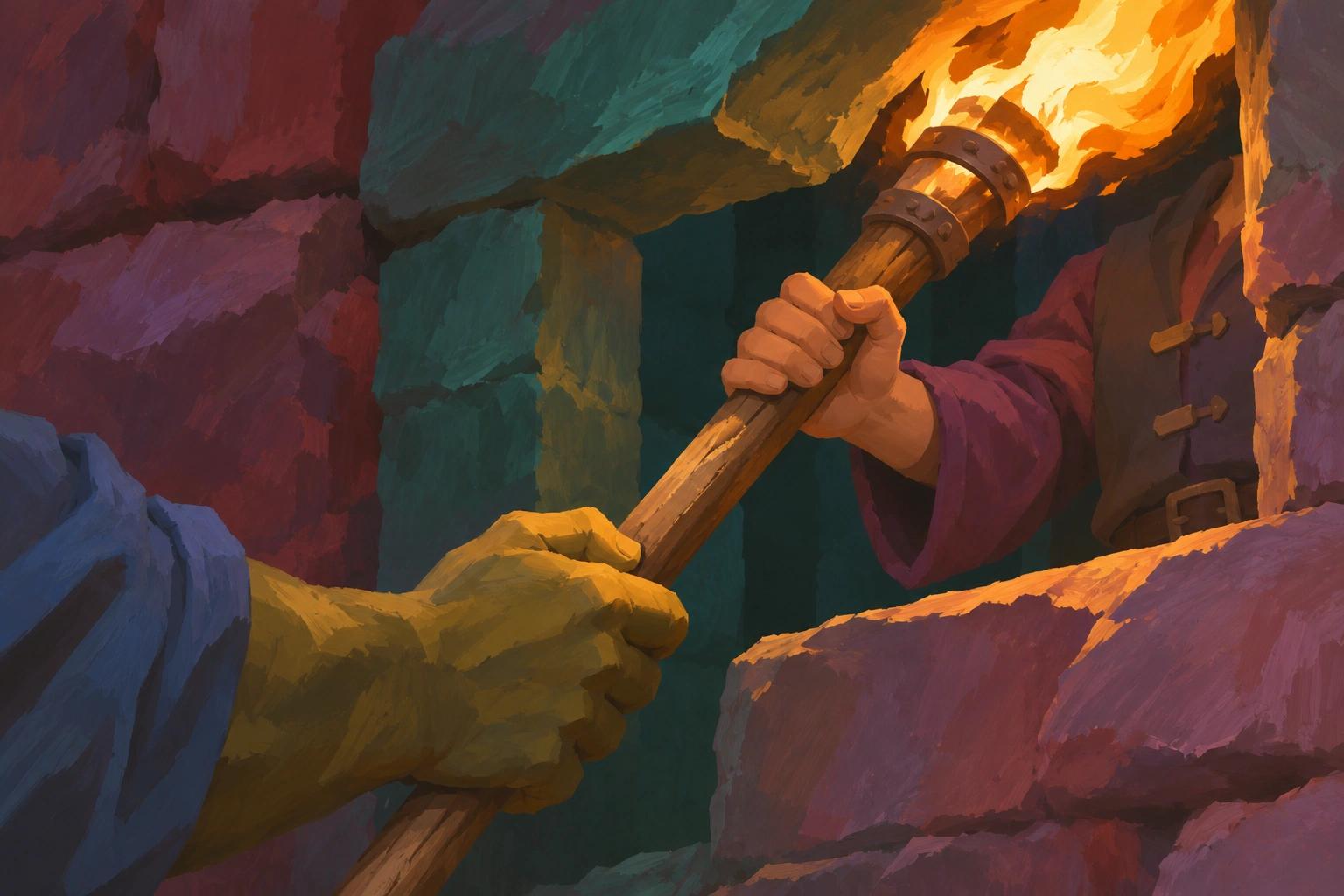
Hold up the lamp, and the bugbear is only a beetle.
A bugbear used to be the thing in the dark: the shape at the foot of the bed, the noise behind the cellar door. Then somebody brings a lamp down the stairs, and the shape is a coat on a hook and the noise is a beetle on the boards. This book is about the people who bring the lamp. It gives each of the twelve classes in the System Reference Document 5.2.1 (SRD 5.2.1) three new subclasses and a chapter of new options, so that every character who walks into the dark can carry their light in a way that suits the person at the table.
The title is a warning that lamp-carriers pass along. Somewhere past the last star wanders Zhudun, the Corpse Star: a dead light that still arrives long after it went out. Its lesson is always the same: empty yourself, and you can swallow the sky. Every light in this book answers that lesson. A light held high gives itself away and is never emptied; a hooded light waits and is never swallowed; a stoked light burns hotter and knows exactly what it spends. Zhudun never appears in the rules, and no option asks you to believe in it. It is the dark the lamps are carried against, and a name for any GM who wants one.
The Twelve Lights
Every class in this book is a light, and every light does one job. A torch is passed down a line of hands; a candle flame stays still in a draught; a dark lantern shows exactly one thing and never the hand that holds it. The light names the class's habit at the table. It is a way to remember what the class is for, not a rule, and nothing in the rules text refers to it.
Each class chapter opens with its light: a short scene, a few lines on what that class does for the group, and how to build one. Then come its three subclasses, its options, feats, magic items and four personal tables. If you play a Rogue, the Rogue chapter holds everything you need, apart from the spells, which sit in their own two chapters, and the backgrounds, which every class shares.
The Twelve Lights
| Class | Light | What It Does at the Table |
|---|---|---|
| Barbarian | The Firebrand | Goes first into the place where everyone else hesitates. |
| Bard | The Footlights | Sits at the edge of the stage so others are seen. |
| Cleric | The Vigil Lamp | Keeps watch so someone is there when a friend wakes. |
| Druid | The Firefly | Knows where the ground will hold and leads the way. |
| Fighter | The Torch | Walks first and makes sure the line never stops. |
| Monk | The Candle Flame | Stays perfectly still while everything around it moves. |
| Paladin | The Beacon | Stands its ground so everyone knows where home is. |
| Ranger | The Campfire | Turns a stretch of wild road into a place to sleep. |
| Rogue | The Dark Lantern | Shows one thing clearly and hides the hand that holds it. |
| Sorcerer | The Spark | Jumps on its own; the craft is learning where it lands. |
| Warlock | The Borrowed Flame | Burns well in any weather and always comes with terms. |
| Wizard | The Midnight Oil | Costs sleep and buys the answer nobody else can give. |
You don't need to remember the table. It is here so that the chapter openers make sense when you flip through the book, and so that a new player who asks what a Paladin is can get a one-line answer before getting a page of rules.
Three Ways to Carry It
A light can be carried in three ways, and every class in this book gets one subclass for each. The three ways are not rules. They describe how a subclass feels to play and what kind of moment it creates at the table. Read them as a temperament test: the one that makes you grin is probably yours.
Held high. You lift the light so that others can see. A held-high subclass makes the group better, braver or faster, and its best moment is usually a friend's roll. You enjoy the cheer when the Fighter lands the hit you set up. If you like being the reason the plan worked without being the one who swung the sword, start here.
Hooded. You cover the light and open it at the right moment. A hooded subclass plans, waits and strikes when the time is right. Its preparation pays off: a cue given an hour ago, a snare laid before the fight, a reaction held all round. You may be quiet for a long stretch of the session, and then you decide the scene. If you like patience and the satisfaction of a trap closing, start here.
Stoked. You feed the light until it roars, and everyone sees what it costs. A stoked subclass accepts risk. Its big moments are paid for in one ordinary resource from the SRD, such as Hit Point Dice, your Bardic Inspiration until you rest, your Hit Point maximum until a Long Rest, or the Reactions you give up. The price is stated plainly, it has a cap, and the subclass never quietly pays it back. If you like the table holding its breath when you push, start here.
Every stoked subclass pays in a different resource, so no two feel alike. None of them uses a new currency or tracker; the price is always something already on your character sheet.
In each class chapter the three subclasses appear in the same order: held high, hooded, stoked. The Barbarian, for example, gets the Path of the Saga, which announces a great deed and lifts an ally when it succeeds; the Path of the Banked Fire, which keeps its Rage for the moment someone strikes; and the Path of the Unquenched, which rages hotter and longer and pays in Hit Point Dice. Three players at one table can each pick one and never step on each other.
A carrying mode is never a keyword. No feature says "held high", no spell checks whether you are hooded, and nothing in one subclass works better because another subclass shares its mode. You can mix freely: a party of three stoked characters is loud and short-lived, a party of three hooded ones is very patient, and both are fine. The Finder at the back of the book sorts all 36 subclasses by mode, so you can choose by temperament before you read a single rule.
Choosing as a group. When a party builds characters together, it helps to say your mode out loud. One held-high character makes the others shine, one hooded character gives the group a plan, and one stoked character gives it a deadline. That spread is a good default, not a requirement. What matters more is that each player picks the mode that makes them want to come back next week, because a subclass you enjoy will outlast any subclass you chose to fill a gap.
Reading a Subclass
Every subclass in this book is laid out the same way, so you can read any of them in a minute and know whether it is for you.
Name and tagline. The heading gives the subclass name. Directly under it, a short imperative line in italics tells you what the subclass wants to do, such as "Save the Show from Behind the Curtain" for the College of the Prompter.
Intro. One paragraph says who these characters are, what they do at the table, and what pulls at them. It is the part to read aloud when someone asks what your character does.
Signature. Two short lines follow the intro. Shines on names a moment you can see at the table, one that happens again and again when you play this subclass. Leaves in the dark names what the subclass leaves behind: the thing it never does, the person it forgets, the cost it doesn't count. For the College of the Prompter, the signature reads like this:
Shines on: the moment before a friend falters.
Leaves in the dark: the Prompter, every time.
The printed signatures are suggestions. Your character is yours, and so is your signature. If you play a Prompter who loves the spotlight after all, write your own two lines and put them on your character sheet; players are welcome to do so for every subclass in this book. A good signature names something the rest of the table will recognize when it happens.
Features. The rules follow, one feature per subclass level, in ascending order, each headed "Level 3: Name" and written in the same plain rules language as the SRD. Each feature names its trigger first, then what it costs, what it does, how long it lasts, how often you can use it and how you get it back. Spellcasting subclasses add a table of spells you always have prepared.
The levels are the class's own subclass levels from the SRD. A Barbarian subclass gains features at levels 3, 6, 10 and 14; a Fighter subclass at 3, 7, 10, 15 and 18; a Bard college at 3, 6 and 14. Every subclass in this book starts at level 3, and every one has a feature on each of its class's subclass levels, so you never reach a level and find nothing new.
At the Table. Each subclass ends with a short sidebar of play advice: when to use the core feature, how to call it out loud, which companions it works well with. The sidebar contains no rules. If you skip it, you lose nothing on your character sheet, but you might miss the trick that makes the subclass fun.
Rules live only in features, options, feats, spells, items and backgrounds. The flavor lives in the chapter openers, intros, signatures, sidebars and tables. If a sentence sounds like a rule but sits in a sidebar, it is advice.
What Is Optional
Everything in this book is optional. Your Game Master (GM) decides which parts are available in the campaign, and a GM can allow one subclass and nothing else, or the whole book at once. The book is built so that each part works alone.
Subclasses, feats, spells, items and backgrounds are ordinary additions. They sit beside the SRD options and follow the same rules: you choose a subclass at its usual level, a feat whenever a feature grants one and you meet its prerequisite, a spell when your class lets you learn or prepare it.
List options join a list the class already has. A Barbarian who uses Brutal Strike can choose one of this book's effects instead of one from that feature; a Warlock can take this book's Eldritch Invocations, including a fourth pact, the Pact of the Lamp. Each option family says at its start how it joins the list.
Variant features replace one named class feature at the same level. A variant is a trade, not an upgrade: you give up the original and get something different of the same size. Ask your GM before you take one, because a variant changes a part of the class that other players may expect you to have.
Personal tables at the end of each class chapter give you hooks for your character's past, drives and marks. They have no rules value. Roll on them, choose from them, or ignore them.
Modules. Three chapters near the back are optional modules for the GM and the whole table. First Flame offers a short playable prelude for each class, the evening a character first lit their light. Lamplit Rest turns a Long Rest into a short procedure with watches, one question and a scene for the moment a character chooses a subclass. Into the Dark turns the SRD's torches, candles and lamps into a light procedure for exploration. No subclass, feat, spell, item or background needs a module, and none gains value from one. You can tear the modules out and the rest of the book works exactly the same.
Talking to your GM. The easiest way to bring this book into a running campaign is one piece at a time. When a character reaches level 3, offer the new subclasses next to the SRD ones. When someone gains a feat, add this book's feats for their class to the choices. A variant feature or a new pact is a bigger change, so talk about it before the session, not in the middle of a fight. If an option doesn't work at your table, the GM can take it back; nothing else in the book leans on it.
Using This Book
Zhudun's Lessons uses the rules of the SRD 5.2.1, the 2024 version of the fifth edition rules. Every rules term means what it means there: Bonus Action, Reaction, Bloodied, Heroic Inspiration, the conditions and the areas of effect. Every reference points either to the SRD 5.2.1 or to this book. Spell names appear in italics, such as Cure Wounds, and always in their exact form, so you can look them up.
The book is organized like this:
- Twelve class chapters, Barbarian to Wizard, each with its opener, three subclasses, option families, variant features, four General feats and an Epic Boon, three magic items and a lamp, four personal tables, and for spellcasters a list of new spells by level.
- Spells A–L and Spells M–Z, with one hundred new spells in alphabetical order, from cantrips to level 9.
- Backgrounds, sixteen backgrounds drawn from the trades that keep a light burning, with twelve new Origin feats.
- First Flame, Lamplit Rest and Into the Dark, the three optional modules.
- For the Game Master, with advice on introducing these options, multiclassing and changing a subclass during a campaign.
- Finder, which sorts the subclasses by carrying mode, pillar of play and role, and lists the feats, items, backgrounds and spells.
As a player, start with your class chapter. Read the opener and the three subclass intros and signatures, pick the one that fits, and then read its features. The option families, feats and items at the back of the chapter are there when you level up. If you can't decide between classes, the Finder lets you compare all 36 subclasses on two pages.
As a GM, read this introduction and For the Game Master first. Decide which parts of the book you want in your game and tell the players before they build characters. The magic items in each class chapter can go straight into a treasure hoard, and the lamps can be carried by anyone.
With other books. The options here use the same structure as the SRD's own, so they sit beside subclasses, feats and spells from other sources compatible with the 2024 rules. Where a choice matters, such as a variant feature or a feat with a class prerequisite, the entry says exactly what it needs, and characters with several classes can use everything they qualify for.
Numbers in this book follow the SRD: uses come from an ability modifier or a fixed count, and saving throws use the DC your class already has. Every feature states its own limit; if one seems to be missing, read the feature again before you ask your GM.
Credits and License
Zhudun's Lessons is original Bugbear Lamp material and is not part of the SRD 5.2.1.
This work includes material from the System Reference Document 5.2.1 (“SRD 5.2.1”) by Wizards of the Coast LLC, available at https://www.dndbeyond.com/srd. The SRD 5.2.1 is licensed under the Creative Commons Attribution 4.0 International License, available at https://creativecommons.org/licenses/by/4.0/legalcode.
Bugbear Lamp is not affiliated with or endorsed by Wizards of the Coast.