
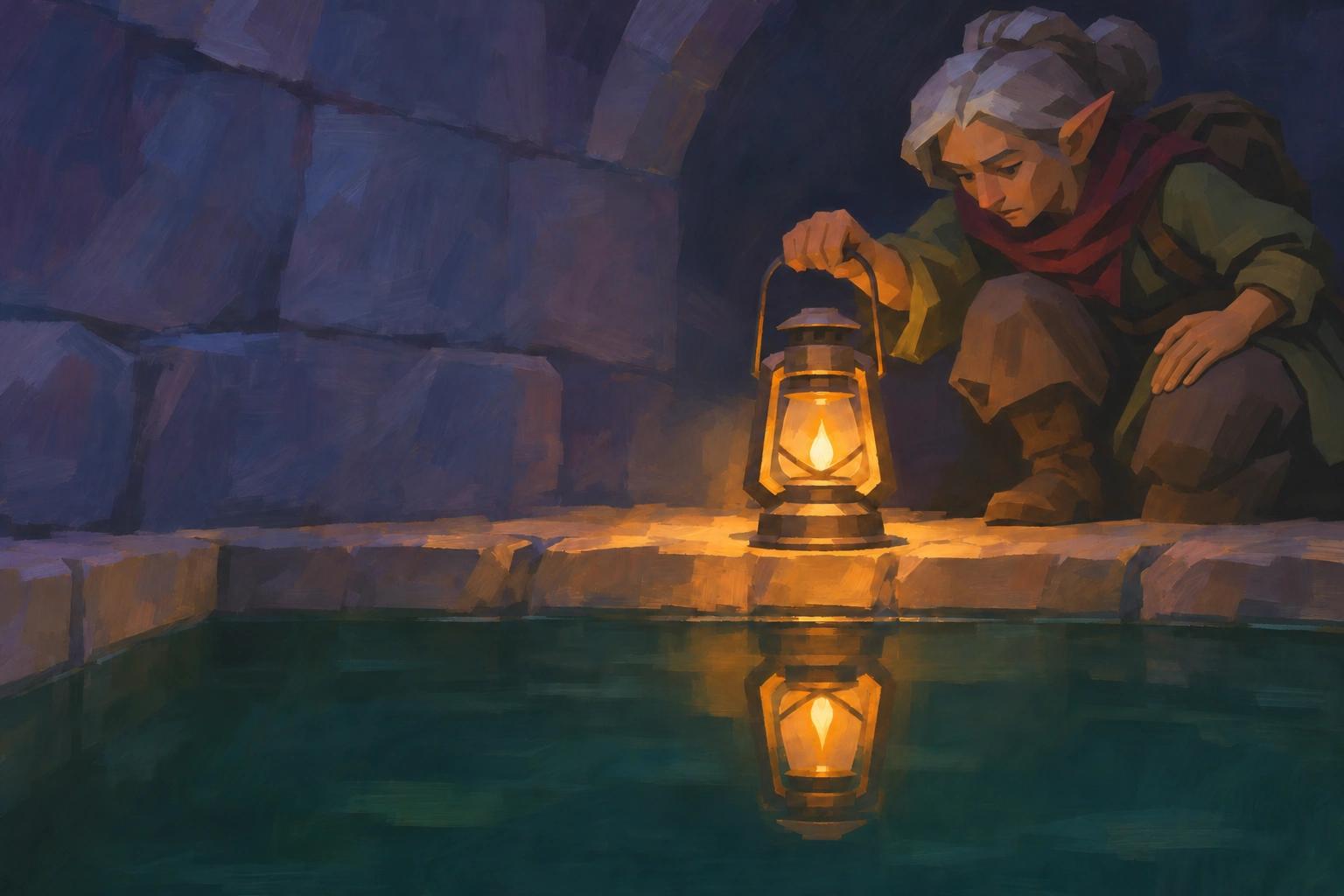
Optional Module
The characters stand at the top of a stair that goes down into nothing, and somebody asks who has the torch. Then nobody asks again for three hours. This module keeps that question alive without turning it into homework. It uses only what the SRD 5.2.1 already says about candles, torches, lamps and lanterns: how far they shine and how long they burn. It counts that time in steps of ten minutes, and it gives you one d20 table for the moments when the light gets small.
This chapter is written for you, the Game Master (GM). It has four parts: the procedure, a table of light sources with their SRD numbers, the d20 table What the Dark Makes Bigger, and advice for running all of it. Nothing else in this book needs it. No subclass, feat, spell, item or background gains anything from it, and none loses anything without it. Use it for one dungeon, for every trip underground, or only on the night the characters lose their packs in the river.
Light as a Procedure
The procedure has no track and no currency. Light never buys a bonus, and nothing about it goes on a separate sheet. The characters simply carry the light sources the SRD describes, those sources burn for as long as the SRD says, and the rules for Bright Light, Dim Light and Darkness decide what the characters can see. All you add is a steady count, the way you already count Rations on a long road.
Use these four steps whenever the characters explore a place without daylight: a cave, a crypt, a cellar, a forest at night with no moon.
1. Count Exploration Rounds. While the characters explore, time passes in exploration rounds of 10 minutes each. Six exploration rounds make 1 hour. Searching a room, crossing a long hall with care, picking a lock and arguing about the map each take about one round. A fight, however long it feels, fits inside the round in which it happens: 100 combat rounds of 6 seconds are 10 minutes, and few fights last a tenth of that.
2. Name the Lights. When exploration begins, the players say which light sources are lit and who carries them. A light someone carries is in that character's hand unless the source is fixed to something else, such as a Lamp set on a table or a Torch wedged in a bracket. Ask once and then assume nothing changes until a player says so.
3. Mark the Burn. At the end of each exploration round, every lit source has burned for 10 minutes. A Candle or a Torch lasts 6 exploration rounds. A flask of Oil in a Lamp, a Hooded Lantern or a Bullseye Lantern lasts 36. A tally on a scrap of paper is enough: one mark per round, and a circle around the mark at which a source goes out.
4. Read the Edge. When you describe a place, describe it from the light outward. Say what lies in Bright Light, what lies in Dim Light, and where the Darkness begins. The rules then follow on their own: the characters see normally in Bright Light, they have Disadvantage on Wisdom (Perception) checks that rely on sight in Dim Light, and they have the Blinded condition while trying to see something in Darkness.
That is the whole procedure. The steps take seconds once the table knows them, and most rounds pass with a single sentence from you: "Another round; the torch has two left."
What the Light Decides
The SRD sorts every space into one of three categories of light, and each category sets how well a creature sees into it.
Bright Light. Bright Light lets most creatures see normally. Inside the bright radius of a light source, the characters read inscriptions, spot tripwires and notice the color of a stain without any penalty from the light.
Dim Light. An area with Dim Light is Lightly Obscured. A creature has Disadvantage on Wisdom (Perception) checks to see something in a Lightly Obscured space. Every light source in this chapter has a ring of Dim Light around its bright radius, and that ring is where most things are half seen.
Darkness. An area of Darkness is Heavily Obscured. A creature has the Blinded condition while trying to see something in a Heavily Obscured space: it can't see and automatically fails any ability check that requires sight, attack rolls against it have Advantage, and its attack rolls have Disadvantage. These effects apply to what the creature is trying to see, so a character standing in the light who shoots at a target in Darkness has Disadvantage on the attack roll, and the target has Advantage against a character it can see in the light.
Passive Perception. A creature with Disadvantage on Wisdom (Perception) checks has a Passive Perception 5 lower than usual. When you decide whether the characters notice something they don't look for, check where it lies. A trap in Dim Light is noticed at Passive Perception minus 5; a trap in Darkness isn't seen at all, though it might still be heard or felt.
Hiding. A creature can take the Hide action while it is Heavily Obscured, so the Darkness beyond the characters' light is a hiding place for anything that waits there, and a lit character stands out to anything watching from it.
Darkvision
The SRD is exact about this sense: a creature with Darkvision can see in Dim Light within a specified range as if it were Bright Light and in Darkness within that range as if it were Dim Light. It discerns colors in that Darkness only as shades of gray.
Read that rule closely, because this module rests on it. Darkvision doesn't make Darkness bright. A character with Darkvision who walks through an unlit cave sees it as Dim Light, which means the cave is Lightly Obscured for that character. The character has Disadvantage on Wisdom (Perception) checks that rely on sight, and a Passive Perception 5 lower for anything it would have to see. Beyond the range of its Darkvision, Darkness is still Darkness. And it sees no color: the red of a warning mark, the green of a poisoned blade and the blue of fresh paint all look the same.
Every character with Darkvision therefore still sees better with a Lamp than without one, and the procedure works for them exactly as it does for anyone else.
Lighting, Carrying and Covering
Lighting. Using a Tinderbox to light a Candle, a Lamp, a Lantern or a Torch takes a Bonus Action. Lighting any other fire with it takes 1 minute. A character can also light one source from another that is already burning; rule that this takes a Bonus Action too.
Carrying. A character who carries a light in one hand has the other free for a weapon, a shield or a spellcasting focus, but not all three. This is the oldest decision in exploration, and the procedure keeps it on the table by asking in step 2 who carries what. A light set down stays where it is, which is useful at a door the group wants to watch.
Covering. A Hooded Lantern has a hood the carrier can lower, reducing its light to Dim Light in a 5-foot radius, and raise again. Any light can be covered with something opaque, which blocks it. Covering a source doesn't put it out, so it keeps burning; mark the rounds as usual. Putting a source out and lighting it again later is always possible for Oil, which burns in a Lamp or Lantern until it has burned for 6 hours in total. A Candle or a Torch that is put out can be lit again, and you count its remaining rounds from where it stopped.
Wind and Water. A Lamp or a lantern shields its flame; a Candle or a Torch does not. When strong wind or falling water strikes an open flame, rule that it goes out. This module sets no number or roll for it: say it when it happens, and let the Tinderbox do the rest.
Light from Spells
Many groups have a spell that makes light, and the procedure treats it like any other source. Spells don't burn fuel, but most of them end, so count their duration in exploration rounds as well.
- Light makes a touched object shed Bright Light in a 20-foot radius and Dim Light for an additional 20 feet for 1 hour, which is 6 exploration rounds. Covering the object with something opaque blocks the light.
- Produce Flame sheds the same light from the caster's hand for 10 minutes, which is one exploration round.
- Dancing Lights sheds Dim Light in a 10-foot radius from each light, but it lasts only up to 1 minute with Concentration. It belongs to a fight, not to a passage.
- Continual Flame casts Bright Light in a 20-foot radius and Dim Light for an additional 20 feet until dispelled. A group that owns one has solved the count for one light, a fair reward for 50 GP of ruby dust.
- Daylight fills a 60-foot-radius Sphere with Bright Light and sheds Dim Light for an additional 60 feet for 1 hour.
- Darkness fills a 15-foot-radius Sphere that Darkvision can't see through and nonmagical light can't illuminate. None of the sources in the next section helps against it.
What Fits in an Exploration Round
Use this list when a player asks how long something takes. It is a guide for your rulings, not a set of fixed costs.
Time in Exploration Rounds
| Activity | Rounds |
|---|---|
| Search a room or a stretch of passage with care | 1 |
| Cross a large hall or cavern while watching for danger | 1 |
| Pick a lock, force a door or set up a rope | 1 |
| Copy an inscription or draw a map of the last few rooms | 1 |
| A fight and its aftermath, including looting and binding wounds | 1 |
| A Short Rest | 6 |
| A Long Rest | 48 |
The last two rows matter most. A Short Rest burns a whole Torch or Candle. A Long Rest underground with one light burning burns a flask and a third of Oil, or eight Torches. A group that sleeps in Darkness to save its light has made a choice worth noticing, and a group that keeps a light burning all night has told everything nearby where it sleeps.
Light Sources
The table below gives every common light source in the SRD 5.2.1 with its cost, its light and how long it burns. The names in the first column are the names in the SRD equipment list; the text of this chapter uses the shorter forms, such as Hooded Lantern.
Light Sources
| Item | Cost | Bright Light | Dim Light | Burns | Exploration Rounds |
|---|---|---|---|---|---|
| Candle | 1 CP | 5-foot radius | Additional 5 feet | 1 hour | 6 |
| Torch | 1 CP | 20-foot radius | Additional 20 feet | 1 hour | 6 |
| Lamp | 5 SP | 15-foot radius | Additional 30 feet | 6 hours per flask of Oil | 36 |
| Lantern, Hooded | 5 GP | 30-foot radius | Additional 30 feet | 6 hours per flask of Oil | 36 |
| Lantern, Hooded (hood lowered) | — | None | 5-foot radius | 6 hours per flask of Oil | 36 |
| Lantern, Bullseye | 10 GP | 60-foot Cone | Additional 60 feet | 6 hours per flask of Oil | 36 |
| Oil | 1 SP | — | — | Fuel for a Lamp or lantern | — |
| Tinderbox | 5 SP | — | — | Lights a source as a Bonus Action | — |
Reading the Table
Candle. A light to read by or to leave in a window, not to explore with. Its bright radius covers only the person holding it.
Torch. The best light for its price and the worst for its life. A group that relies on Torches carries many, and every Short Rest costs one.
Lamp. The patient light. Its bright radius is smaller than a Torch's, but its Dim Light reaches farther and a flask of Oil lasts six times as long. Every lamp in the class chapters of this book also lights like a Lamp.
Hooded Lantern. Twice the bright radius of a Lamp, the same fuel, and a hood. With the hood lowered, it keeps a footing lit and is hard to see from the far end of a hall.
Bullseye Lantern. A beam, not a pool. It reaches three times as far as a Torch, but only in a Cone, and leaves the group's flanks in Darkness: right for a long gallery, wrong for a crossroads.
Light for a Day
Use this table when the characters shop before a trip. It shows what one day of exploring costs with each kind of light, assuming 8 hours underground with one source burning the whole time.
Light for 8 Hours
| Light | Needed | Cost | Weight |
|---|---|---|---|
| Candles | 8 Candles | 8 CP | — |
| Torches | 8 Torches | 8 CP | 8 lb. |
| Lamp | 1 Lamp, 2 flasks of Oil | 7 SP | 3 lb. |
| Hooded Lantern | 1 Hooded Lantern, 2 flasks of Oil | 5 GP, 2 SP | 4 lb. |
| Bullseye Lantern | 1 Bullseye Lantern, 2 flasks of Oil | 10 GP, 2 SP | 4 lb. |
None of these costs will break a group, and that is the point. The procedure isn't about poverty. It is about the moment when the second flask is in a pack on the far side of a collapsed tunnel. Then the count matters, and everyone already knows how many rounds are left.
What the Dark Makes Bigger
The smaller the light, the bigger the dark. Every adventurer knows this: at the edge of a Candle's light, a coat on a hook is a giant, and a dripping pipe is something breathing. This table turns that old fear into play. Each entry gives what the characters think they see or hear when the light is small, and what the light shows when somebody brings it close.
When to Roll. Roll a d20 on this table when the light shrinks: when a light source goes out or is covered, when the brightest light the group has is only Dim Light, or when a character moves beyond the group's light alone. Roll at most once per exploration round, and never when nothing has changed.
Bringing the Light. Describe the first column and stop. The characters can react however they like: wait, retreat, attack, call out. The moment a character brings a light source close enough that the thing lies in Bright Light, describe the second column. No check is needed. Darkvision doesn't settle an entry, because it shows the shape in shades of gray, and a gray shape is exactly what the dark makes bigger. Only light settles it.
Time. Most entries cost nothing but nerve. If the characters spend a long time over one, such as a careful approach, a debate or a detour, that costs an exploration round like anything else.
What the Dark Makes Bigger
| d20 | In the Dark | Under the Lamp |
|---|---|---|
| 1 | Footsteps follow the group and stop when it stops. | Water drips from the ceiling in time with the group's own boots, and the echo holds each drop a moment longer. |
| 2 | The floor ahead ends in black, a pit with no bottom. | A stain of old soot across the flagstones, three paces wide and perfectly flat. |
| 3 | Two points of light hang at eye height and never blink. | Brass nail heads in a door, polished by every hand that ever knocked on it. |
| 4 | Something huge breathes in the next chamber, slow and wet. | A draft moves through a cracked pipe. Somewhere above, there is a way to the open air. |
| 5 | A shape taller than the doorway stands in a side passage. | A coat of mail on a rack with a helmet on top. The shadow did the rest. |
| 6 | Someone whispers a character's name from far down the passage. | The passage is empty. A long gallery returned the group's own talk. Ask the players who said the name first. |
| 7 | The walls crawl, every surface alive and moving. | A few dozen beetles, harmless, leaving a cleared trail that marks the shortest way across the next room. |
| 8 | A figure lies face down across the path. | A bedroll and a pack left by earlier explorers, with a Candle stub and a torn map inside. |
| 9 | The far wall of the cave seems a mile away, and voices die in it. | The cave is 40 feet across. The silence comes from thick moss on every wall. |
| 10 | Something cold touches the back of a character's neck. | A root hanging from the ceiling. Roots mean soil, and soil means the surface is close. |
| 11 | A closed door stands where the group came in. | The same open archway, with a hanging cloth that swung shut in a draft. Nobody needs to explain it. |
| 12 | Rot and old blood, thick enough to taste. | A larder behind a loose stone: spoiled meat, broken jars, and one sealed jar of honey that is still good. |
| 13 | Rows of figures stand in the hall ahead, waiting. | Statues, empty chairs or a tailor's forms, whichever you like. One of them faces the wrong way. |
| 14 | A short laugh rings out and stops. | A loose stone settling in rubble. A character who takes the Search action finds a bird's nest in a crack above it. |
| 15 | A roar fills the passage ahead, like a river in flood. | A thin stream runs down a long stone chute, and the echo does the roaring. The water is clean. |
| 16 | A second light moves far down the passage. | The group's own light, reflected in a still pool or a sheet of polished stone. Wave, and it waves back. |
| 17 | The walls close in, and the ceiling sinks lower with every step. | The passage is as wide as ever. A character who measures it with a Pole loses nothing but a little pride. |
| 18 | A long pale shape turns under the black surface of a pool. | A drowned rope, turning slowly in a current, tied to something at the bottom that is worth pulling up. |
| 19 | Every sound stops at once, even the dripping. | Nothing changed. The whole group held its breath together. Each player says what their character was listening for. |
| 20 | A shape waits at the edge of the light, very still. | The dark made nothing bigger this time. The shape is real and as large as it looked; let the light reach it before it moves. |
Using the Table
Nineteen of the twenty entries are harmless, and that is on purpose. The table works because the players don't know which roll is the twentieth. After a few harmless shapes, the players start to bring the light forward before anyone draws a sword, and that is the habit this module wants to build: when something looms, the answer is the lamp.
Say the first column in the same voice you use for real danger. Don't wink. If a player wants to attack the coat of mail, let the attack happen; a sword through an empty helmet is a fine story. Several entries leave something useful behind, such as a trail, a map or a jar of honey, to reward the characters for bringing the light. Nothing on the table has a rules value of its own.
Variant: The Players' Fears. Instead of reading the first column, describe only a sound or a shape and ask the player whose character is nearest to say what the character fears it is. Then bring the light and read the second column. The fear and the truth rarely match, and the gap between them is often the best moment of the night.
Variant: Your Own Twenty. If the place has a monster you already plan to use, let it be the twentieth entry, and let the table's harmless results lead up to it. The characters then meet the real thing at the edge of their light, which is where it belongs.
At the Table
The procedure is fast and the table is short. What makes this module work is how you use them: when you ask about light, when you don't, and what you let the count mean.
Who Holds the Light
The question in step 2 is a question about the group, not about equipment. The character who carries the light walks in front, or in the middle, and has one hand busy. The character who walks behind it sees what it shows. A party that hands the Lamp to its weakest fighter says something about itself, and so does a party in which the strongest fighter insists on carrying it.
Let the players argue about it once, then let it settle; changing the carrier outside a fight costs nothing but a sentence. Give the light a body at the table if you can, such as a small lamp or a die standing on end in front of whoever carries it. Players remember an object far better than a line on a sheet.
Groups with Darkvision
Many groups include characters with Darkvision, and some consist only of them. The procedure still works, because Darkvision turns Darkness into Dim Light, not into Bright Light. Remind the players of that once, plainly, when they first decide to explore without a light: they will move through gray twilight, they will notice less, and they will see no colors. Then play it fairly. Describe unlit places in shapes and shades. Apply Disadvantage to Wisdom (Perception) checks that rely on sight. Lower their Passive Perception by 5 for anything they would need to see.
Most such groups light a Lamp sooner or later, and not because you forced them to: the first time they need to read a warning or tell a poisoned blade from a clean one. When that moment comes, say nothing about it.
When to Stop Counting
The count is a tool for tension, so put it down when there is none. In a cellar the characters will leave in ten minutes, don't count. When they have more Oil than they could ever use, mention the count only at rests. Pick it up again the moment it can change a decision: when the second flask is lost, or when the group has light for only one of two paths.
If you run your game with the Bugbear Lamp tracker, its lamp clock can keep the count for you. It is a convenience and never a requirement; a pencil does the same job.
Example of Play
Three characters climb down into an old mine: a fighter with a Torch, a wizard with a Lamp and a rogue with a Hooded Lantern, its hood lowered. You count the first exploration round as they cross the entrance gallery. The fighter's Torch lights the walls in Bright Light 20 feet around her; the wizard's Lamp adds Dim Light out to 45 feet; the rogue, a little ahead, walks in her own 5-foot ring of Dim Light.
In the third round the group stops at a branching. The rogue's player wants to scout the left branch alone. She takes her Hooded Lantern into the passage, beyond the group's light, and you roll on What the Dark Makes Bigger: a 13. You tell her that rows of figures stand in the hall ahead, waiting. The rogue has Darkvision, so her player asks whether she can see them clearly. You answer that she can't: to her Darkvision they are gray shapes in Dim Light. She raises the hood. In Bright Light 30 feet around her, the figures are pit props stacked upright against a wall, and one of them leans the wrong way. She leaves it alone.
In the sixth round the fighter's Torch goes out. She lights a new one from the wizard's Lamp as a Bonus Action. That is her second Torch of four, and the group has been underground for an hour. Nobody says anything, but the wizard's player writes "2 left" on his sheet.
With the Other Modules
This module needs neither of the other two, and they don't need it. If you also use Lamplit Rest, the two meet only at rests: the light that burns through a Long Rest underground is counted here, and the watch that keeps it is played there. The lamp the players pass around at a Lamplit Rest can be the same object that stands in front of the carrier during exploration. If you also use First Flame, nothing changes; the preludes play by the ordinary SRD rules for light.
When the session ends, the count ends with it. The characters climb back into daylight with whatever is left in their packs, and nobody remembers the number of rounds. They remember the shape at the edge of the Candle's light and the moment somebody stepped forward with the Lamp. That is the whole module in one line: hold up the lamp, and the bugbear is only a beetle.