
The Footlights
The travelling company plays a hay barn on a wet night. Rain drums on the roof, the benches are full of farmers who paid in eggs and cider, and halfway through the second act the lead forgets his line. He stands there with his mouth open. Somebody coughs. At the back a boy laughs at the wrong moment, and a mutter starts along the benches the way a draft finds its way through a barn wall.
The bard in the wings never steps out. She hums the first bar of the next song, low enough that only the stage can hear it. The fiddler catches the tune and plays it out loud. The lead hears it, remembers where he is, and walks into his next speech as if he had planned the pause all along. The farmers settle back. Nobody on the benches knows the show nearly died tonight, and nobody will ever thank her for saving it.
Footlights sit at the very edge of the stage, below the actors' feet, so that everyone else can be seen. Nobody buys a ticket to look at them. You can play a Bard who stands in the middle of the stage, and plenty do, but the craft is older than applause. It is knowing what the room needs a breath before the room knows it: the right note, the right word, the push that turns a fumble into a story people retell for years. Your magic is a voice that changes what happens next. Most nights you spend it on someone else's moment, and the show goes on.
Playing a Bard
A Bard turns other players' rolls into the scene's big moments. You do your best work watching the table, not your character sheet: who is about to make the roll that matters, who just failed one, who needs a nudge before trying at all. Bardic Inspiration is the heartbeat of the class, and the best habit is to spend it early. From level 5 it comes back on a Short Rest, so a die you saved for later is usually a die you wasted. Outside a fight you are often the one who talks first, and the one who notices when a conversation is going wrong before anyone else does. Let other players take the lead in scenes that belong to their characters, and step in when the scene stalls.
Charisma comes first. Dexterity comes next if you want a better AC and Initiative, or Constitution if you lean on spells that need Concentration. Put Expertise into the skills nobody else in the party has. When you prepare spells, aim for one control spell, one healing spell and one problem-solver at each spell level; Magical Secrets at level 10 fills whatever gap the party still has. Among this book's backgrounds, the Fire-Eater suits a showy Bard, the Chandler a careful listener and the Camp Cook a Bard who holds a group together. The SRD's Criminal and Sage work as well as they always have.
The three colleges in this chapter pull in different directions. Choose the College of Acclaim if you like cheering a friend's success into the next one, the College of the Prompter if you like arranging help before anyone asks for it, and the College of the Finale if you want one enormous moment per rest and can live with being empty afterwards. Spell and Song suits an Acclaim Bard, Room Reader suits a Prompter, and Practiced Heckler or Steady Performer keeps a Finale Bard on stage through the last act.
An Acclaim Bard wants allies who make many attack rolls, so a Fighter, a Monk or a Ranger is the natural partner. A Prompter wants a frontliner who gets hit often, and in return that frontliner spends less time on the floor. A Finale Bard wants a party that can finish a fight within a few rounds; a Rogue or a Paladin closes what your last act opens. Whatever your college, keep someone between you and the teeth. A Bard who spends everything on friends rarely keeps much for armor. In return, tell the others what your help can do before the fight starts, so they know when to ask for it.
Bard Subclasses
Every Bard college teaches the same voice to do a different job. Choose the one that matches how you like to help: out loud after a success, quietly before trouble, or all at once at the end. Each college also changes what you do outside a fight.
Bard Subclasses at a Glance
| Subclass | Carried | Choose It If You Like |
|---|---|---|
| College of Acclaim | held high | cheering one friend's success into another friend's |
| College of the Prompter | hooded | arranging help before anyone knows they need it |
| College of the Finale | stoked | one enormous scene per rest, then going quiet |
College of Acclaim
Turn One Triumph into the Next
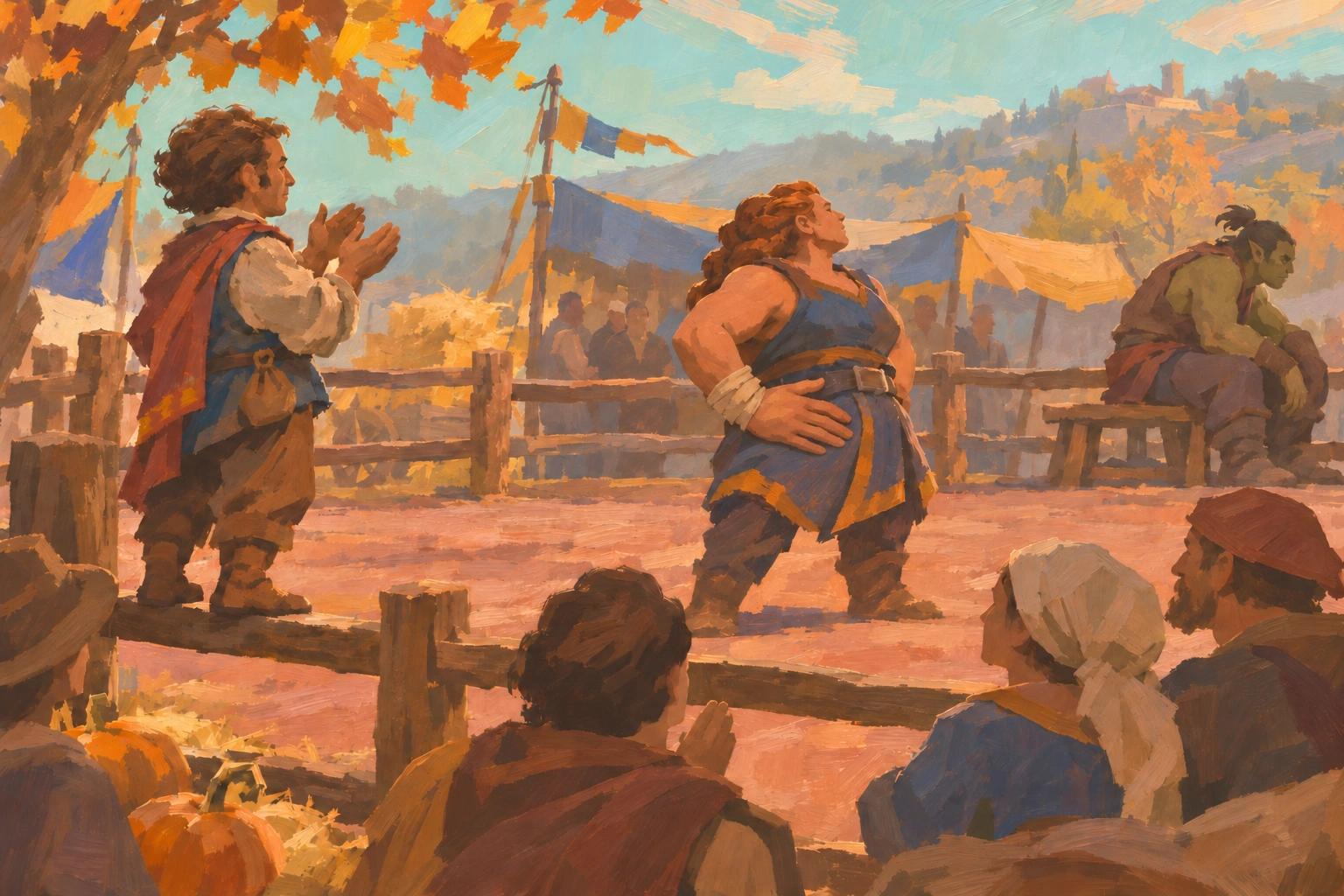
Bards of the College of Acclaim learned their craft in noisy places: wrestling rings and the square where the harvest race ends. They know that a crowd doesn't only watch a victory; it builds the next one. When a friend lands a blow, an Acclaim Bard is already shouting, and the next friend goes in on that shout and doesn't miss. In a fight they turn one good roll into two. At a feast they make a companion's deeds the talk of the room. What pulls at them is the roar of a crowd, as long as it is roaring someone else's name.
Shines on: the second hit, made easy by your applause.
Leaves in the dark: your own name; the crowd only shouts theirs.
Level 3: Encore
When a creature you can see within 60 feet of yourself succeeds on a D20 Test, you can take a Reaction and expend one use of your Bardic Inspiration without rolling the die. Choose one other creature you can see within 60 feet of yourself that can hear you; you can't choose yourself or the creature that succeeded. Before the end of its next turn, the chosen creature has Advantage on its next D20 Test made against the same creature as the successful roll or made to overcome the same obstacle. If it doesn't make such a roll by then, the Advantage is lost. A creature can benefit from only one Encore at a time.
For example, if the Fighter hits an ogre, the Rogue's next attack roll against it has Advantage.
Level 3: Sing Their Praises
You gain proficiency in the Persuasion skill. If you already have this proficiency, you gain proficiency in another skill of your choice.
In addition, you can spend at least 10 minutes telling an audience about the deeds of one willing ally. For the next hour, that ally has Advantage on Charisma checks made to influence any creature that heard the whole telling. Only one ally can benefit from this feature at a time; telling a new story ends the previous benefit.
Level 6: Crowd Favorite
When you use Encore, you can choose two creatures instead of one to gain its Advantage. Each of them must meet the feature's requirements. You still take your Reaction for each use of Encore. For example, when the Fighter hits the ogre, both the Rogue and the Ranger have Advantage on their next attack roll against it.
In addition, Encore doesn't expend a use of your Bardic Inspiration when the success that triggers it is a Critical Hit.
Level 14: Standing Ovation
When a creature succeeds on a D20 Test that had Advantage from your Encore, you can use Encore in response (no action required) without expending a use of your Bardic Inspiration. Once you use Encore this way, you can't do so again until the start of your next turn. You can still use Encore with your Reaction in the same round.
College of the Prompter
Save the Show from Behind the Curtain
Every stage has one light the audience never sees: a shaded candle in the prompter's box, just bright enough to read the script by. Bards of the College of the Prompter learned their craft in that box. They don't need the center of the stage; they need everyone on it to remember their lines. In a negotiation or a fight, a Prompter gives a quiet cue before an ally needs it, and the help arrives exactly on time. Prompters are the reason a desperate plan can look rehearsed. What pulls at them is the line nobody else remembers, and the quiet hope that one day someone will notice who saved the scene.
Shines on: the moment before a friend falters.
Leaves in the dark: the Prompter, every time.
Level 3: Cue
As a Bonus Action, you can expend one use of your Bardic Inspiration to cue one creature other than yourself that you can see within 60 feet of yourself. The cue lasts for 1 hour. The first time within that hour the creature is hit by an attack roll or fails a saving throw, it rolls your Bardic Inspiration die and gains one of the following benefits of its choice (no action required). The cue then ends. A creature can have only one of your cues at a time.
Step. The creature moves up to half its Speed without provoking Opportunity Attacks.
Guard. The creature gains a bonus to AC equal to half the number rolled (round up) until the start of its next turn. The bonus doesn't apply against the attack that triggered the cue.
Steady. The creature gains Temporary Hit Points equal to the number rolled plus your Charisma modifier.
Level 3: Prompter's Box
You gain proficiency in the Insight skill. If you already have this proficiency, you gain proficiency in another skill of your choice.
In addition, you can recall, word for word, anything you heard or read within the last 24 hours, such as a password, a contract clause or a muttered threat.
Level 6: Quiet Word
When a creature you can see within 60 feet of yourself that can hear you fails an ability check, you can take a Reaction and expend one use of your Bardic Inspiration to make the same check yourself, using your own modifier and proficiencies. The creature can use your total instead of its own. You can't use this feature on an ability check made against you or on an Initiative roll.
Level 14: Perfect Prompt
When a creature you can see within 60 feet of yourself fails a D20 Test, you can take a Reaction to make the roll succeed instead. A failed attack roll becomes a hit, but never a Critical Hit.
Once you use this feature, you can't use it again until you finish a Long Rest unless you expend a level 5+ spell slot (no action required) to restore your use of it. You can restore your use this way only once per Long Rest.
College of the Finale
Spend Everything on the Last Act
Bards of the College of the Finale believe a show is remembered by how it ends. They play the long middle of a fight carefully, then pour everything they have into a few dazzling rounds where every note is louder than the last. Afterward they are hoarse and briefly useless, and they call that a fair trade. At the table, a Finale Bard is the player who asks whether this is the big fight, and means it. What pulls at them is the moment itself, and the hard discipline of choosing it. A Finale Bard who picks the wrong fight spends the rest of the day humming quietly at the back.
Shines on: the moment you hold nothing back, and it's enough.
Leaves in the dark: your reserves, which you never kept for later.
Level 3: Grand Finale
As a Bonus Action, you can begin a finale by expending all your remaining uses of Bardic Inspiration; you must expend at least two. The finale lasts for a number of your turns equal to the number of uses you expended minus one, counting the turn you begin it (maximum of 4 turns), and it ends at the end of the last of those turns. It ends early if you have the Incapacitated condition. For example, three uses cover this turn and your next turn.
Once you begin a finale, you can't regain expended uses of Bardic Inspiration by any means, including Font of Inspiration and Superior Inspiration, until you finish a Short or Long Rest. While the finale lasts, you gain the following benefits.
Crescendo. Once on each of your turns, when you hit a creature with an attack roll or a creature fails a saving throw against a spell you cast, you can roll your Bardic Inspiration die and add the number rolled to one damage roll of that attack or spell.
Chorus. Once per round, when another creature you can see within 60 feet of yourself fails a D20 Test, you can roll your Bardic Inspiration die and add the number rolled to the d20, potentially turning the failure into a success (no action required).
Neither benefit expends a use of Bardic Inspiration.
Level 3: Showmanship
You gain proficiency in two of the following skills of your choice: Acrobatics, Athletics, Intimidation or Performance. For each of these skills you already have, you gain proficiency in another skill of your choice instead.
Level 6: Stage Presence
While your finale lasts, you have Immunity to the Charmed and Frightened conditions, and you have Advantage on Constitution saving throws that you make to maintain Concentration. If you have either condition when you begin a finale, that condition ends on you.
Level 14: Curtain Call
When your finale ends and you don't have the Incapacitated condition, you can end it with a closing blast of sound. Each creature of your choice within 30 feet of yourself that can hear you makes a Constitution saving throw against your spell save DC. A creature takes Thunder damage on a failed save, or half as much damage on a successful one. To determine the damage, roll a number of your Bardic Inspiration dice equal to the uses you expended to begin that finale. For example, a level 15 Bard who began the finale with five uses deals 5d12 Thunder damage.
Once you use this feature, you can't use it again until you finish a Long Rest.
Bard Options
Everything in this section is optional, and the Game Master (GM) decides what is available in a campaign. The Bard has no option family of its own. Instead, this section offers four variant features that each trade one Bard feature for another, four General feats and an Epic Boon built on Bardic Inspiration, three magic items for Bards and a lamp anyone can use, then the personal tables and the list of new Bard spells.
Bard Variant Features
Each variant replaces the named feature at the same level. Ask your GM before you take one. A variant is a different shape for the same job, not a better version of it, so choose one because it fits your character. No Bard college in this book needs a feature that a variant replaces.
Bard Variant Features
| Level | Variant | Replaces | You Trade |
|---|---|---|---|
| 2 | Borrowed Knack | Jack of All Trades | a small bonus to everything for full proficiency in one thing |
| 7 | Steady Voice | Countercharm | protection against fear and charm for protection of allies' spells |
| 9 | Wide Repertoire | Expertise | depth in two skills for breadth in skills, tools and languages |
| 18 | Two-Part Harmony | Superior Inspiration | refills in a fight for a second die when you inspire |
Level 2: Borrowed Knack
Bard Variant Feature (replaces Jack of All Trades)
When you spend at least 10 minutes watching or practicing alongside a creature that has proficiency in a skill or with a tool, you gain proficiency in that skill or with that tool. The creature must either be willing to show you or carry out the work where you can watch it the whole time. The proficiency lasts until you finish a Long Rest. You can have only one proficiency from this feature at a time; gaining a new one ends the previous one.
For example, after 10 minutes at a carpenter's bench, you have proficiency with Carpenter's Tools until your next Long Rest.
Level 7: Steady Voice
Bard Variant Feature (replaces Countercharm)
When a creature other than you that you can see within 30 feet of yourself fails a Constitution saving throw to maintain Concentration, you can take a Reaction to cause the save to be rerolled, and the new roll has Advantage. The creature must use the new roll. Steady Voice doesn't use your Bardic Inspiration, so it works even when you have no uses left.
For example, when the Cleric maintaining Spirit Guardians is hit and fails the save, your voice gives the Cleric a second chance, with Advantage, to keep the spell.
Level 9: Wide Repertoire
Bard Variant Feature (replaces Expertise)
You gain proficiency in one skill and with one tool of your choice, and you learn two languages of your choice. This variant replaces only the Expertise you gain at Bard level 9; the Expertise you gained at level 2 is unchanged. Expertise from any other source, such as another class, is also unaffected.
For example, a Bard who travels the mountain roads might gain proficiency in Survival and with Cartographer's Tools and learn Dwarvish and Giant.
Level 18: Two-Part Harmony
Bard Variant Feature (replaces Superior Inspiration)
When you take the Bonus Action of your Bardic Inspiration feature to give a creature a Bardic Inspiration die, you can give a Bardic Inspiration die to a second creature without expending another use. The second creature must be within 30 feet of the first and able to see or hear you.
You can use this benefit a number of times equal to your Charisma modifier (minimum of once), and you regain all expended uses when you finish a Long Rest. For example, a Bard with a Charisma of 20 can inspire two friends with one Bonus Action five times between Long Rests.
Bard Feats
General feats require level 4+. Boon of the Muse is an Epic Boon, a choice for the level 19 Epic Boon feature. Every feat here builds on Bardic Inspiration, so it works for any character who has that feature, including a character with Bard levels from multiclassing. The Playing a Bard section suggests which feat suits which college.
Practiced Heckler
General Feat (Prerequisite: Level 4+, Bardic Inspiration Feature)
You gain the following benefits.
Ability Score Increase. Increase your Dexterity or Charisma score by 1, to a maximum of 20.
Heckle. As a Bonus Action, you can expend one use of your Bardic Inspiration to heckle one creature you can see within 60 feet of yourself that can hear you. The target must succeed on a Wisdom saving throw against your spell save DC or have Disadvantage on attack rolls against creatures other than you until the start of your next turn. For example, a heckled ogre that swings at the Fighter has Disadvantage on that attack roll, but its attacks against you are unaffected.
Room Reader
General Feat (Prerequisite: Level 4+, Bardic Inspiration Feature)
You gain the following benefits.
Ability Score Increase. Increase your Wisdom or Charisma score by 1, to a maximum of 20.
Read the Mood. You gain proficiency in the Insight skill. If you already have this proficiency, you gain proficiency in another skill of your choice.
Winning Words. When a creature adds one of your Bardic Inspiration dice to a Charisma check, it rolls the die twice and uses either roll. For example, an ally who adds your die to a Charisma (Deception) check rolls two dice and keeps the one it prefers.
Spell and Song
General Feat (Prerequisite: Level 4+, Bardic Inspiration Feature)
You gain the following benefits.
Ability Score Increase. Increase your Intelligence or Charisma score by 1, to a maximum of 20.
Sung Spell. When you cast a Bard spell using a spell slot, and the spell restores Hit Points to a creature or targets only willing creatures, you can expend one use of your Bardic Inspiration to give one of those creatures a Bardic Inspiration die as part of the same casting, without taking a Bonus Action. You can use this benefit only once per turn. For example, you can cast Healing Word and inspire the same ally with one Bonus Action.
Steady Performer
General Feat (Prerequisite: Level 4+, Bardic Inspiration Feature)
You gain the following benefits.
Ability Score Increase. Increase your Constitution or Charisma score by 1, to a maximum of 20.
Hold the Note. When you fail a Constitution saving throw to maintain Concentration, you can expend one use of your Bardic Inspiration, roll the die and add the number rolled to the save, potentially turning it into a success (no action required). You can use this benefit only once per roll. It works for any spell you maintain, including spells from another class. For example, when a hit forces a save to keep Hypnotic Pattern, a failed save plus your die can still keep the pattern in place.
Boon of the Muse
Epic Boon Feat (Prerequisite: Level 19+, Bardic Inspiration Feature)
You gain the following benefits.
Ability Score Increase. Increase one ability score of your choice by 1, to a maximum of 30.
Favored Dice. Whenever a creature rolls one of your Bardic Inspiration dice, it rolls the die twice and uses either roll. This includes the dice you roll yourself for features that use your Bardic Inspiration die. For example, an ally holding your d12 rolls 2d12 and keeps the higher roll.
Carrying Voice. The range of your Bardic Inspiration feature increases to 120 feet.
Bard Magic Items
Bards collect instruments, costumes and props the way other adventurers collect weapons. The first three items require attunement by a Bard and work with Bardic Inspiration. The lamp works for anyone, Bard or not, and is as useful at a midday market as on a night stage.
Pitch Pipe of Accord
Wondrous Item, Uncommon (Requires Attunement by a Bard)
This small brass pipe sounds one clean note, the kind a company tunes to before a show. The pipe has 3 charges and regains 1d3 expended charges daily at dawn.
Sounding Note. While holding the pipe, you can take a Bonus Action to blow it and expend 1 charge to give one creature within 60 feet of yourself that can hear you a Bardic Inspiration die without expending a use of your Bardic Inspiration. The die follows the rules of your Bardic Inspiration feature, so a creature can still have only one of your Bardic Inspiration dice at a time. You can use this property only once per turn.
Curtain Cloak
Wondrous Item, Rare (Requires Attunement by a Bard)
This heavy cloak is cut from the faded velvet of a stage curtain and still smells faintly of dust and greasepaint. Performers wear it to leave a stage quickly when a show goes badly.
Quick Exit. When a creature you can see hits you with an attack roll while you wear the cloak, you can take a Reaction and expend one use of your Bardic Inspiration. You take only half the attack's damage, and then you teleport up to 30 feet to an unoccupied space you can see. For example, an ogre's hit for 18 damage deals 9, and you reappear on the far side of the room. You choose the destination after the damage is dealt.
Maestro's Laurel
Wondrous Item, Very Rare (Requires Attunement by a Bard)
This wreath of gilded leaves never wilts, and a crowd falls quiet when its wearer raises a hand. While you wear the laurel, you gain a +1 bonus to spell attack rolls and to the spell save DC of your Bard spells. The bonus doesn't apply to spells from another class or to spells cast from other magic items.
Spells. While wearing the laurel, you can cast Mass Suggestion or Irresistible Dance from it without expending a spell slot, using your spell save DC. The spell is cast at its lowest level, and Irresistible Dance requires Concentration as normal. Once you cast either spell this way, you can't do so again until the next dawn. For example, you can turn a hostile crowd at the gate with Mass Suggestion and still enter the fight beyond it with all your spell slots.
Showman's Lamp
Wondrous Item, Uncommon
This lamp burns Oil like an ordinary Lamp, shedding Bright Light in a 15-foot radius and Dim Light for an additional 30 feet; a flask of Oil keeps it burning for 6 hours. Its brass shade is painted with a row of tiny stage curtains. The lamp has 3 charges and regains 1d3 expended charges daily at dawn.
Painted Scene. While holding the lamp, you can take a Magic action to expend 1 charge to cast Silent Image from it (save DC 13). The image appears within 60 feet of the lamp. You must maintain Concentration on the spell as normal. This property works in daylight and whether or not the lamp is lit, and blowing the lamp out doesn't end the image.
Bard Personal Tables
Roll on each table or choose an entry that fits your character. Every entry is a person, a place, an object or a secret, and each one is a hook your GM can use in the first session. None of them has a rules effect. If two entries pull against each other, keep both; a Bard is allowed a complicated past.
How It Was Lit
| d6 | Beginning |
|---|---|
| 1 | You sang a feverish child through one long night, and in the morning the fever broke. |
| 2 | A travelling company left you behind in a hay barn with a borrowed fiddle and a debt you still owe. |
| 3 | You talked your way off a gallows with a story so good the crowd demanded the ending. |
| 4 | Your grandmother taught you every verse of a ballad nobody else remembers; the last verse reads like a map. |
| 5 | You were the prompter for a show that burned down, and you saved the script instead of your shoes. |
| 6 | A stranger paid you a silver piece to stop singing, then a gold one to start again, then vanished. |
What Feeds the Flame
| d6 | Drive |
|---|---|
| 1 | You owe a song to someone who died before hearing it, and you still haven't found its ending. |
| 2 | Every town you play pays you with one true story; you're collecting them for a reason you won't say. |
| 3 | You want one crowd, somewhere, to know your name before they ever learn your face. |
| 4 | A rival stole your best tune and is still performing it, badly, three towns ahead of you. |
| 5 | You promised a friend you would make them famous one day, and they still believe you. |
| 6 | You're looking for the audience that walked out on you once, to finish the show properly. |
Soot
| d6 | Mark |
|---|---|
| 1 | Your voice cracks on one particular note, and anyone who knew you before that winter hears it. |
| 2 | You hum without noticing; strangers have followed you a mile humming the same tune. |
| 3 | Three innkeepers along the coast road won't let you through the door, and none of them will say why. |
| 4 | A pale scar crosses your palm from a string that snapped while you kept playing. |
| 5 | You count beats under your breath when you're nervous, and liars find it unsettling. |
| 6 | Children in one valley still sing a rude verse you made up about a tax collector. |
Beyond the Edge
| d6 | Out There |
|---|---|
| 1 | Somewhere a performer wears your face and sings your songs, and the reviews are terrible. |
| 2 | A buyer is offering good gold for the only written copy of your grandmother's ballad. |
| 3 | The crowd you couldn't win over has sent a letter asking for a rematch, with stakes. |
| 4 | A song you wrote as a joke has become a marching tune, and the marchers are heading your way. |
| 5 | Someone keeps finishing your unfinished songs and leaving them where only you will find them. |
| 6 | The fiddle you borrowed years ago has an owner, and the owner has finally caught up. |
New Bard Spells
These spells are on the Bard spell list. You'll find them in Spells A–L and Spells M–Z.
New Bard Spells
| Spell Level | Spells |
|---|---|
| Cantrip | Discordant Note, Hear the Echo, Lost Thread |
| Level 1 | Beneath Notice, Dress Rehearsal, Hear the Lie, Ink Spatter, Small Again |
| Level 2 | Dizzy Spell, Flag of Truce, Keyhole Ear, Quiet Council, Vanishing Act |
| Level 3 | Conjure Stagehand, Pang of Conscience, Unfolded Map, Unmasking Glare |
| Level 4 | Exchange of Stations, Lamp in the Window, Word on the Street |
| Level 5 | Compelled Confession, Mirror Hall, Restoring Refrain |
| Level 6 | Living Tableau, Thunderous Applause |
| Level 7 | Exeunt, Nothing Hidden |
| Level 8 | Sleeping Valley |
| Level 9 | Call Them Home, The Show Must Go On |