
The Firefly
The search party has eleven torches and no idea where the boy went. He wandered off from the reed cutters an hour before dusk, and now the marsh is black water and whispering stems in every direction. Each time someone lifts a torch higher, the night beyond it gets deeper. At the edge of the circle, the ground looks exactly as solid as the patch that just swallowed the miller's leg to the knee.
The druid at the back of the line does something nobody understands. She pushes her own torch into the mud and stands still. The others shout at her to keep up. She doesn't. She waits until her eyes get used to the night, and then she sees them: fireflies rising out of the reeds, not everywhere, only in a few places, and only where the roots grow thick enough to stand on.
She walks from one to the next. The water reaches her ankles and never higher. Half an hour later she finds the boy asleep on a hummock with his cheek on his arm, as if he had simply decided the marsh was a bed. She doesn't wake him at once. She sits beside him and listens to the frogs, and when he stirs, she tells him to step only where the small green sparks rise, and he does, all the way home.
A firefly shows you one safe step, then the next, and only if you stand still long enough to see it. You can call down storms, and some nights you will. But the oldest part of the craft is reading a place until it tells you where to stand. The others bring what they need. You find yours already living there.
Playing a Druid
A Druid changes the scene itself. Ground, plants, animals and a little weather are your tools, and you solve the problems the others walk past: the river nobody can ford, the hedge that hides the road, the dog that knows where the thief went. Wild Shape is a resource as much as a body. You spend it on scouting, swimming and slipping under doors, and every circle in this book turns it into its own best trick, so count your uses the way a Fighter counts Second Wind.
Wisdom comes first. Constitution comes next if you mean to hold Concentration, and Dexterity keeps your AC respectable in Light armor. Primal Order sets your posture at level 1: Warden for armor and martial weapons at the front, Magician for an extra cantrip and lore, and this book adds the Tracker for a Druid on the trail and the Herbalist for one who tends the camp. Among your spells, area control such as Entangle, Spike Growth and Plant Growth wins fights, while healing and summons keep them won. Prepare one spell for the road every day.
The SRD's Sage still suits a Druid who studies the old ways. Among this book's backgrounds, the Herder fits a Druid raised among animals, the Charcoal Burner one who knows the deep woods and their silence, and the Beekeeper a patient observer. Choose the Circle of the Orchard if you like supplying friends before they need it, the Circle of the Fen if you like leaving enemies stuck while you vanish into the mist, and the Circle of the Molt if you like shedding trouble and changing to fit any place, at a cost everyone can see. Shared Vigor suits an Orchard Druid, Unseen Prowler a Fen Druid and Expanded Forms a Molt Druid who wants a shape for every job.
Orchard fruit does the most for the party's climbers and swimmers. The Fen loves archers and casters with area spells, who can stand back while enemies wade. The Molt is the scout who never stays caught, so let it go first. A Druid also covers the gaps nobody planned for: the Cleric's healing runs short, the Rogue's lock won't open, the Wizard needs eyes around the corner. Keep one spell slot and one use of Wild Shape for the surprise, because a Druid who spent everything in the first fight has nothing left for the river. In return, ask the frontliners to keep enemies off you while you hold Concentration, and tell the party before a fight which ground you plan to change, so nobody charges into it.
Druid Subclasses
There are three ways to follow a firefly through the reeds. Choose by temperament, not by spell list; each one spends Wild Shape on something other than a beast's body.
Druid Subclasses at a Glance
| Subclass | Carried | Choose It If You Like |
|---|---|---|
| Circle of the Orchard | held high | handing friends exactly what the next hour will ask of them |
| Circle of the Fen | hooded | taking the ground from under the enemy and waiting in the mist for your moment |
| Circle of the Molt | stoked | slipping every trap and paying for each escape where the whole table can see |
Circle of the Orchard
Grow What Your Friends Need Next
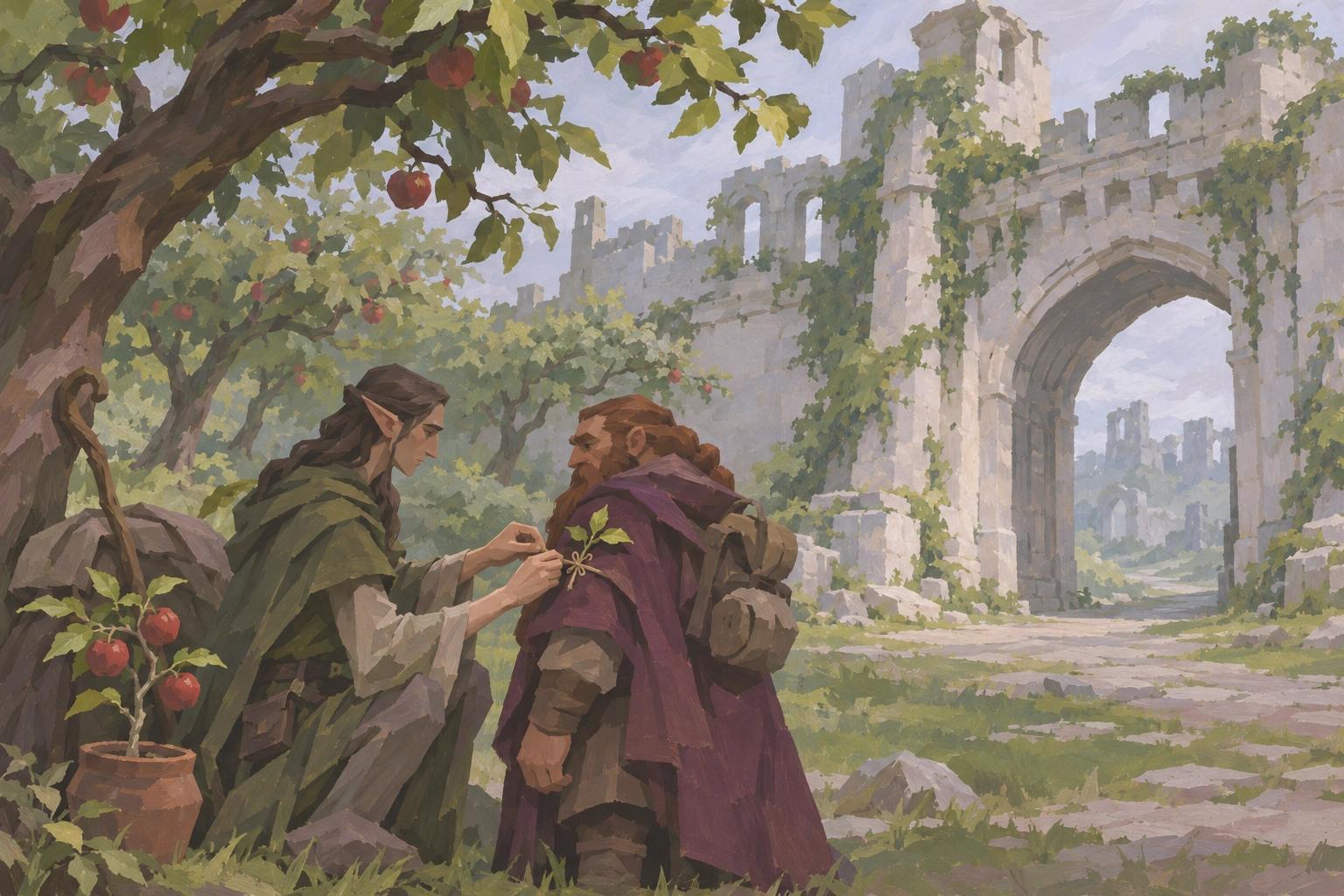
Every old farm has a tree that somebody planted for a grandchild they would never meet. Druids of the Circle of the Orchard think that way about everything. They tend fruit that ripens in a moment, and they hand it out before the climb, the swim or the fight, so that help is already in a friend's pocket when it's needed. After a rest, they tie living sprigs to their companions' sleeves, and the sprigs keep working long after the Druid has stopped thinking about them. What pulls at them is the next season: they always want to know what the group will need tomorrow, and they are rarely ready for what arrives today.
Shines on: the cliff everyone climbs because you packed the right fruit.
Leaves in the dark: the surprise ambush, which never waits for anything to ripen.
Level 3: Windfall
As a Magic action, you can expend a use of Wild Shape to grow a number of magical fruits equal to your Wisdom modifier (minimum of one) in your hand or on a plant within 5 feet of you. Choose each fruit's kind from the options below. The fruits wither when you finish a Long Rest.
A creature can take a Bonus Action to eat one of these fruits or to feed one to a willing creature within 5 feet of itself.
Hearty. The eater gains Temporary Hit Points equal to your Druid level plus your Wisdom modifier. No more than three fruits from one use can be Hearty.
Climbing. The eater gains a Climb Speed equal to its Speed for 1 hour.
Diving. For 1 hour, the eater gains a Swim Speed equal to its Speed and can breathe water.
For example, a Hearty fruit grants 6 Temporary Hit Points at level 3 with a Wisdom modifier of +3.
Level 3: Orchard Keeper
You always have the Goodberry and Plant Growth spells prepared. They don't count against the number of spells you can prepare, and you can cast Plant Growth once you have level 3 spell slots.
Level 6: Scion Gift
When you finish a Short or Long Rest, you can expend a use of Wild Shape to set a living scion, a sprig bound to clothing or skin, on a number of willing creatures equal to your Wisdom modifier (minimum of one). Each of them must have finished the rest within 30 feet of you, and you can choose yourself. Choose one of the following benefits for each scion. A scion lasts until its bearer finishes a Long Rest, and a creature can bear only one scion at a time.
Bark. The bearer's AC can't be less than 14.
Root. The bearer has Advantage on saving throws it makes to avoid the Prone condition or being pushed or pulled.
Wayfinder. The bearer has Advantage on Wisdom (Survival) checks and can't become lost except by magical means.
For example, after a Short Rest with a Wisdom modifier of +3, you can give the Wizard Bark and the Rogue Wayfinder and keep Root for yourself.
Level 10: Rootstock
Creatures bearing your scions have Resistance to Poison damage. In addition, once per turn, when a creature bearing one of your scions regains Hit Points from a spell you cast, it regains additional Hit Points equal to your Wisdom modifier (minimum of 1). For example, your Healing Word restores 2d4 plus twice your Wisdom modifier to a scion bearer.
Level 14: Ever-Bearing
When you use Windfall, one of the fruits can be Golden. A creature that eats a Golden fruit regains Hit Points equal to 2d8 plus your Druid level and ends one of the following conditions on itself: Blinded, Deafened, Frightened or Poisoned. Each use of Windfall can make only one Golden fruit.
You can also use Windfall without expending a use of Wild Shape. Once you do so, you can't do so again until you finish a Long Rest.
Circle of the Fen
Wait in the Mist, Let Them Sink
Every marsh has a place where the path you took this morning is gone by evening. Druids of the Circle of the Fen live in that place. They don't stop enemies with walls or thorns; they take the ground out from under them. A Fen Druid turns a road into clinging mud under a low mist, waits while the enemy wades and stumbles, and then steps out of the reeds exactly where nobody is looking. What pulls at them is patience itself: the certainty that a fight goes better at their pace, and the itch when their allies won't wait for it.
Shines on: a fight that slows to your pace instead of theirs.
Leaves in the dark: the allies who wanted to charge in behind the enemy.
Level 3: Mire
As a Magic action, you can expend a use of Wild Shape to turn the ground in a 15-foot-radius Sphere centered on a point you can see within 60 feet of yourself into clinging mire under a low mist. The mire lasts for 1 minute or until you use this feature again. For the duration, the area is Difficult Terrain for creatures other than you and the creatures you choose, and the mist makes the area Lightly Obscured.
When the mire appears, each creature of your choice in the area makes a Strength saving throw against your spell save DC. On a failed save, the creature sinks in, and you choose one: it has the Prone condition, or it loses half its movement (half its remaining distance if it is taking its turn, otherwise half its Speed on its next turn). No creature repeats this save while the mire lasts.
Level 3: One with the Reeds
While you are within your Mire, you can take the Hide action as a Bonus Action, and the mist counts as Heavily Obscured for you when you hide. You still make the Dexterity (Stealth) check as normal, and a creature that can see through the mist, such as one with Blindsight, can still find you. For example, after the mire stalls a charge, you can hide in the mist as a Bonus Action and then attack from it with Advantage while you remain unseen.
Level 6: Patient Mire
When a creature you can see within 60 feet of yourself moves on the ground, you can take a Reaction to use Mire, expending a use of Wild Shape as normal and centering the area on a point within 5 feet of that creature. The saving throws happen at once, and if the triggering creature fails, Mire's effect applies to it before it moves any farther. For example, a charging ogre that fails sinks in halfway to you.
Level 10: Born of the Fen
You gain a Swim Speed equal to your Speed, and you can breathe water. You also have Resistance to Poison damage, and you have Advantage on ability checks and saving throws you make to avoid or end the Grappled or Restrained condition. For example, a crocodile that grabs you in the river has to hold a Druid who swims as well as it does and slips its grip more easily than most.
Level 14: Deep Bog
As a Magic action, you can turn the ground in a 30-foot-radius Sphere centered on a point you can see within 120 feet into deep bog for 1 minute, as long as you maintain Concentration on it. The area is Lightly Obscured and Difficult Terrain for creatures other than you and those you choose.
Each creature of your choice that is in the area when the bog appears, enters it or starts its turn there must succeed on a Strength saving throw against your spell save DC or have the Restrained condition. A creature makes this save only once per turn. A Restrained creature repeats the save at the end of each of its turns, ending the condition on itself on a success. Once you use this feature, you can't use it again until you finish a Long Rest unless you expend a level 5+ spell slot (no action required) to restore your use of it.
Circle of the Molt
Shed What Holds You, Become What Fits
Snakes leave their old skins on warm stones, cicadas leave theirs on bark, and Druids of the Circle of the Molt leave theirs wherever something tried to hold them. When a net drops or a hand closes, the Molt Druid tears free, slips away and comes out the other side changed: gills for the river, grip for the cliff, a body that bends through the gap under the gate. Each new skin is soft, and the whole table can see it. What pulls at them is the next shape the road will ask for, and the uneasy count of how many times they have already started over today.
Shines on: the trap that closes on an empty skin.
Leaves in the dark: your guard, softer each time you start over.
Level 3: Shed Skin
As a Bonus Action, you can expend a use of Wild Shape to end one of these conditions on yourself: Blinded, Deafened, Grappled, Poisoned or Restrained. You can then move up to half your Speed without provoking Opportunity Attacks, and you gain one adaptation below until you finish a Short or Long Rest or use this feature again.
Gills. You gain a Swim Speed equal to your Speed and can breathe water.
Grip. You gain a Climb Speed equal to your Speed and can climb across ceilings with your hands free.
Supple. You can move through a space as narrow as 6 inches and have Advantage on checks to escape a grapple.
Keen. You gain Tremorsense with a range of 10 feet.
Each use lowers your AC by 1 (by 2 from Druid level 6) until you finish a Short or Long Rest. The reduction doesn't stack and applies in Wild Shape and under effects that set a minimum AC.
Level 6: Quick Molt
When you gain the Blinded, Deafened, Grappled, Poisoned or Restrained condition, you can take a Reaction to use Shed Skin, expending a use of Wild Shape and lowering your AC as normal. When you use Shed Skin this way, you don't move. For example, when a net lands on you during the enemy's turn, you are out of it before your own turn begins.
Level 10: Shedding Touch
When you use Shed Skin, you can also touch one willing creature within 5 feet of you, before or after you move. That creature ends one of Shed Skin's conditions on itself, and it gains the adaptation you chose until it finishes a Short or Long Rest. The AC reduction doesn't apply to that creature. For example, you can tear yourself and a grappled friend out of the same tentacles and give both of you gills for the flooded tunnel.
Level 14: Perfect Molt
Shed Skin can also end the Paralyzed or Petrified condition on you. At the start of your turn, if you have either condition, you can use Shed Skin (no action required), expending a use of Wild Shape and lowering your AC as normal. In addition, Shed Skin gains the following adaptation option.
Wings. You gain a Fly Speed equal to your Speed.
Druid Options
Everything in this section is optional, and the GM decides what is available in a campaign. The Druid has two option families: Primal Order options for level 1 and Elemental Fury options for level 7. Three variant features follow, then four General feats and an Epic Boon built on Wild Shape, three magic items for Druids and a lamp anyone can use, the personal tables and the list of new Druid spells. No Druid circle in this book needs any of these options, though some pairings feel natural: a Tracker in the Circle of the Fen, a Herbalist in the Circle of the Orchard.
Primal Order Options
At level 1, the Primal Order feature offers Magician and Warden. You can choose one of the following options instead. Like those two, each one sets how your Druid spends the hours between spells: the Tracker belongs on the trail, the Herbalist beside the cooking pot after a hard fight. Your choice is permanent unless your GM lets you change it.
Primal Order Options
| Option | You Gain | Instead Of |
|---|---|---|
| Tracker | Survival, easy going over rough ground and a quiet step on the road | a cantrip and lore, or Martial weapons and Medium armor |
| Herbalist | extra healing for friends who spend Hit Point Dice on a Short Rest | a cantrip and lore, or Martial weapons and Medium armor |
Tracker
Primal Order Option
You gain proficiency in the Survival skill; if you already have this proficiency, you gain proficiency in another skill of your choice. In addition, nonmagical Difficult Terrain costs you no extra movement, and traveling at a Normal pace doesn't impose Disadvantage on your Dexterity (Stealth) checks. For example, you can wade a muddy ford at full Speed and still slip past a roadside camp without slowing the group to a Slow pace.
Herbalist
Primal Order Option
When you finish a Short Rest, choose a number of creatures up to your Wisdom modifier (minimum of one) that spent at least one Hit Point Die during the rest within 30 feet of you; you can choose yourself. Each of them regains additional Hit Points equal to your Wisdom modifier (minimum of 1). For example, with a Wisdom modifier of +3, three friends who spent dice each regain 3 more Hit Points.
Elemental Fury Options
At level 7, the Elemental Fury feature offers Potent Spellcasting and Primal Strike. You can choose one of the following options instead. Each option names what it gains at level 15, when Improved Elemental Fury makes your choice more powerful. Neither one calls on an element: Bramble Guard answers a blow with thorns, and Green Renewal lets your spells mend a friend.
Elemental Fury Options
| Option | Level 7 | Level 15 |
|---|---|---|
| Bramble Guard | 1d8 Piercing to a creature that hits you in melee | 2d8 |
| Green Renewal | 1d8 healing when you cast a Druid spell with a slot | 2d8 |
Bramble Guard
Elemental Fury Option
Thorns rise along your skin, bark or hide. Once per turn, when a creature within 5 feet of you hits you with a melee attack roll, it takes 1d8 Piercing damage (no action required). This works while you are in a form from Wild Shape. For example, two bites from the same wolf on one turn trigger the thorns only once.
Improved Elemental Fury. At Druid level 15, the damage increases to 2d8.
Green Renewal
Elemental Fury Option
Once on each of your turns when you cast a Druid spell using a spell slot, you can choose one creature you can see within 30 feet of yourself. That creature regains Hit Points equal to 1d8. The spell doesn't need to affect that creature.
Improved Elemental Fury. At Druid level 15, the healing increases to 2d8. For example, casting Spike Growth also restores 1d8 Hit Points to the Fighter beside it.
Druid Variant Features
Each variant replaces the named feature at the same level. Ask your GM before you take one. A variant is a different shape for the same job, not a better version of it, so choose one because it fits your character. No Druid circle in this book needs a feature that a variant replaces.
Druid Variant Features
| Level | Variant | Replaces | You Trade |
|---|---|---|---|
| 2 | Wild Messenger | Wild Companion | a familiar at your side for a courier that flies far away |
| 5 | Green Reserves | Wild Resurgence | trading slots and shapes at any time for one level 2 slot on a Short Rest |
| 18 | Enduring Shape | Beast Spells | casting spells as a beast for tougher, longer beast forms |
Level 2: Wild Messenger
Druid Variant Feature (replaces Wild Companion)
As a Magic action, you can expend a use of Wild Shape to cast Animal Messenger without a spell slot or Material components. You don't need to have the spell prepared. When you cast it this way, its duration is 48 hours instead of 24 hours.
The beast still carries only a message of up to twenty-five words. For example, a crow can carry your warning to a village two days' flight away, and you don't have to spend 10 minutes on a ritual while the riders close in.
Level 5: Green Reserves
Druid Variant Feature (replaces Wild Resurgence)
When you finish a Short Rest, you can expend one use of Wild Shape to regain one expended spell slot of level 2 or lower. Once you use this feature, you can't use it again until you finish a Long Rest. Unlike Wild Resurgence, this feature never turns spell slots into uses of Wild Shape, and it doesn't work outside a Short Rest.
For example, after a morning fight you can spend the Wild Shape use you regain on the rest to have your level 2 slot back for Moonbeam in the afternoon. A party that rarely takes Short Rests gets little from this variant; choose it if yours stops twice a day.
Level 18: Enduring Shape
Druid Variant Feature (replaces Beast Spells)
When you assume a form with Wild Shape, you gain Temporary Hit Points equal to twice your Druid level instead of your Druid level. You can also stay in that form for a number of hours equal to your Druid level instead of half of it. You still can't cast spells while you are in a form from Wild Shape. This feature doesn't combine with other features that double these Temporary Hit Points.
For example, at level 18 you gain 36 Temporary Hit Points each time you shift and can scout as a hawk from dawn to dusk.
Druid Feats
General feats require level 4+. Boon of Many Shapes is an Epic Boon, a choice for the level 19 Epic Boon feature. Every feat here builds on Wild Shape or Wild Companion, so it works for any character who has that feature, including a character with Druid levels from multiclassing. The Playing a Druid section suggests which feat suits which circle.
Druid Feats at a Glance
| Feat | You Gain | Suits |
|---|---|---|
| Expanded Forms | two more Beast forms that you can swap | a scout or a Circle of the Molt Druid |
| Faithful Familiar | a familiar that stays and grows tougher | a Druid who travels with one companion |
| Shared Vigor | Wild Shape's Temporary Hit Points for a friend | a Circle of the Orchard Druid |
| Unseen Prowler | stealth and whispered news in beast form | a Circle of the Fen Druid |
| Boon of Many Shapes | larger, tougher beast forms | any Druid at level 19 |
Expanded Forms
General Feat (Prerequisite: Level 4+, Wild Shape Feature)
You gain the following benefits.
Ability Score Increase. Increase your Wisdom or Constitution score by 1, to a maximum of 20.
More Shapes. You know two additional Beast forms for Wild Shape. They follow that feature's limits on Challenge Rating and Fly Speed. Whenever you finish a Long Rest, you can replace one of these forms with another eligible form. For example, a level 4 Druid can add a giant badger for digging and a mule for carrying to the forms already known. These forms count as known forms for any feature that refers to them.
Faithful Familiar
General Feat (Prerequisite: Level 4+, Wild Companion Feature)
You gain the following benefits.
Ability Score Increase. Increase your Intelligence or Wisdom score by 1, to a maximum of 20.
Lasting Bond. The familiar you summon with Wild Companion doesn't disappear when you finish a Long Rest. It lasts until it drops to 0 Hit Points, you dismiss it, or you summon another familiar. You still can have only one familiar at a time.
Sturdy Companion. Your familiar's Hit Point maximum increases by your Druid level. For example, at level 6 your owl has 7 Hit Points instead of 1, enough to survive a stray arrow while it scouts ahead.
Shared Vigor
General Feat (Prerequisite: Level 4+, Wild Shape Feature)
You gain the following benefits.
Ability Score Increase. Increase your Wisdom or Constitution score by 1, to a maximum of 20.
Lend Your Hide. When you assume a form with Wild Shape, you can give the Temporary Hit Points that Wild Shape grants to one creature you can see within 30 feet of yourself instead of gaining them yourself. Temporary Hit Points from other sources, such as an item, still go to you. For example, at level 8 you can shift with a Bonus Action and hand the battered Fighter 8 Temporary Hit Points, then return to your normal form on a later turn. Temporary Hit Points don't stack, so the Fighter keeps the higher number.
Unseen Prowler
General Feat (Prerequisite: Level 4+, Wild Shape Feature)
You gain the following benefits.
Ability Score Increase. Increase your Dexterity or Wisdom score by 1, to a maximum of 20.
Soft Paws. While you are in a form from Wild Shape, you have Advantage on Dexterity (Stealth) checks.
Whispered Report. You know the Message cantrip; Wisdom is your spellcasting ability for it. While you are in a form from Wild Shape, you can cast it without components, even though you can't otherwise cast spells in that form. For example, a cat in the guardhouse can tell the Rogue outside which way the guards are looking. If you already know Message, you learn another Druid cantrip of your choice instead.
Boon of Many Shapes
Epic Boon Feat (Prerequisite: Level 19+, Wild Shape Feature)
You gain the following benefits.
Ability Score Increase. Increase one ability score of your choice by 1, to a maximum of 30.
Greater Shapes. The maximum Challenge Rating of the forms you can assume with Wild Shape increases by 1.
Hardy Shapes. When you assume a form with Wild Shape, you gain Temporary Hit Points equal to twice your Druid level instead of your Druid level. This doesn't combine with other features that double these Temporary Hit Points. For example, a level 19 Druid gains 38 Temporary Hit Points with each shift and can take the shape of a CR 2 Beast such as a giant elk.
Druid Magic Items
Druids rarely carry gold, but they keep what the wild gives them: shed antlers, a crooked branch, a cloak that smells of every season. The first three items require attunement by a Druid and build on Wild Shape or Druid spells. The lamp works for anyone, Druid or not, and is as useful at noon as at dusk.
Druid Magic Items
| Item | Rarity | What It Does |
|---|---|---|
| Antler Torc | uncommon | two more Beast forms and a little extra toughness when you shift |
| Bramble Crook | rare | a daily summons of woodland beings and a free path through thorns |
| Mantle of Seasons | very rare | one more use of Wild Shape and a daily trip through trees or on the wind |
| Firefly Lamp | uncommon | a lamp that outlines hidden enemies once a day |
Antler Torc
Wondrous Item, Uncommon (Requires Attunement by a Druid)
This neck ring is carved from a single shed antler, and its tines are worn smooth by many hands.
Remembered Forms. While you wear the torc, you know two additional Beast forms for Wild Shape. They follow that feature's normal limits, and you choose them when you attune to the torc. In addition, when you assume a form with Wild Shape, you gain additional Temporary Hit Points equal to your Wisdom modifier (minimum of 1). For example, a level 4 Druid with Wisdom +3 gains 7 Temporary Hit Points with each shift instead of 4. If you lose attunement, you forget both forms, and you can choose new ones when you attune again.
Bramble Crook
Staff, Rare (Requires Attunement by a Druid)
This shepherd's crook has grown, not been carved, and fresh thorns sprout along its shaft every spring. You can use the crook as a Druidic Focus.
Woodland Call. While holding the crook, you can cast Conjure Woodland Beings from it without expending a spell slot, using your spell save DC. The spell is cast at its lowest level and requires Concentration as normal. Once you cast it this way, you can't do so again until the next dawn.
Briar Walker. While holding the crook, you ignore Difficult Terrain made of plants, such as brambles, undergrowth or the thorns of Spike Growth, though you still take any damage the terrain deals. For example, you can walk through a hedge maze in a straight line and leave your pursuers tangled behind you. The crook doesn't protect anyone else, so your friends still wade.
Mantle of Seasons
Wondrous Item, Very Rare (Requires Attunement by a Druid)
This long cloak is woven from leaves that change color with the year: green in spring, gold in autumn and white with frost in winter, whatever the weather outside.
Turning Season. While you wear the mantle, the number of uses of Wild Shape you have increases by one.
Spells. While wearing the mantle, you can cast Transport via Plants or Wind Walk from it without expending a spell slot. The spell is cast at its lowest level. Once you cast either spell this way, you can't do so again until the next dawn. For example, you can step through an oak into a forest a hundred miles away with the whole party and still have every spell slot for the day ahead. With Wind Walk, you can carry up to ten friends across a mountain range as drifting cloud. The extra use of Wild Shape is regained like your other uses: one on a Short Rest and all of them on a Long Rest.
Firefly Lamp
Wondrous Item, Uncommon
This lamp burns Oil like an ordinary Lamp, shedding Bright Light in a 15-foot radius and Dim Light for an additional 30 feet; a flask of Oil keeps it burning for 6 hours. Its green glass is speckled with tiny painted insects.
Opened Glass. While holding the lamp, you can take a Magic action to open its glass and cast Faerie Fire from it (save DC 13). You must maintain Concentration on the spell as normal. Once you use this property, it can't be used again until the next dawn. It works whether or not the lamp is lit, and in daylight the outline still reveals Invisible creatures and gives attackers Advantage as normal. For example, a guard can open the glass in a sunny courtyard and catch the Invisible thief creeping toward the gate.
Druid Personal Tables
Roll on each table or choose an entry that fits your character. Every entry is a person, a place, an object or a secret, and each one is a hook your GM can use in the first session. None of them has a rules effect.
How It Was Lit
| d6 | Beginning |
|---|---|
| 1 | You were lost in a forest for three days as a child and came home knowing which berries were lying. |
| 2 | A dying hedge-witch pressed a seed into your hand and told you not to plant it yet. |
| 3 | You raised an orphaned fox kit, and long after it left, it kept bringing you things it wanted you to see. |
| 4 | The marsh took your family's farm one spring, and you walked out into it to ask why. |
| 5 | You ate something strange on a dare and woke up the next morning understanding the birds. |
| 6 | A storm felled the oldest tree in your valley, and you heard it speak as it fell. |
What Feeds the Flame
| d6 | Drive |
|---|---|
| 1 | You still carry the seed you were told not to plant, looking for the ground it wants. |
| 2 | A blight is spreading somewhere upriver, and the animals keep telling you to hurry. |
| 3 | You want to see every kind of tree in the world before you settle under one. |
| 4 | Someone is clearing old woods for profit, and you know which grove they mean to cut next. |
| 5 | You owe the fox that once fed you one favor, and it hasn't asked for it yet. |
| 6 | You learn one new animal's shape for every town that treated you kindly on the road. |
Soot
| d6 | Mark |
|---|---|
| 1 | Moss grows in the seams of your boots no matter how often you scrub them clean. |
| 2 | Dogs never bark at you, and their owners find that more suspicious than barking. |
| 3 | You still flinch at the sound of an axe biting into wood, even far away. |
| 4 | Your hair keeps a few green leaves in it through every season, even deep winter. |
| 5 | One village sends for you whenever its well goes bad, and they pay you in honey. |
| 6 | You smell of rain even indoors, and cats follow you from room to room. |
Beyond the Edge
| d6 | Out There |
|---|---|
| 1 | The seed has sprouted in its pouch, and its shoot keeps bending toward somewhere far north. |
| 2 | A hunter has been following your animal tracks, convinced you're a beast worth a bounty. |
| 3 | The oldest tree's last words were a warning, and the thing it warned about has arrived. |
| 4 | Something in the marsh learned your name the day you walked in, and it has started calling. |
| 5 | A merchant sells potions brewed from the grove you protected, and business is booming. |
| 6 | The birds you understand have stopped singing near one particular road, and they won't say why. |
New Druid Spells
These spells are on the Druid spell list. You'll find them in Spells A–L and Spells M–Z.
New Druid Spells
| Spell Level | Spells |
|---|---|
| Cantrip | Clinging Mud, Hear the Echo, True Measure |
| Level 1 | Nettle Rash, Planted Feet, Shelter from the Storm, Splint and Salve, Unseen Tripwire |
| Level 2 | Baited Lure, Bridge the Gap, Dizzy Spell, Slip Free, Thorn Sentry |
| Level 3 | Hornet Swarm, Quickset Hedge, Seed of Return, Stonefall |
| Level 4 | Mouse-Sized, Sympathetic Wounds, Thundering Herd |
| Level 5 | Leave No Trail, Restoring Refrain, Sudden Sinkhole |
| Level 6 | Creeping Frost, Expose Weakness |
| Level 7 | Old Growth, Rebuilding Word |
| Level 8 | Back from the Brink, Sleeping Valley |
| Level 9 | Every Leaf an Eye |