
The Dark Lantern
Rain ticks on the skylight of a locked office above a warehouse, well after midnight. Below, a guard climbs the stairs one slow step at a time and stops on the landing to cough. There are four ledgers on the desk and no time to read them all.
The woman at the desk knows which one she wants. She learned it three days ago, buying a clerk his beer and listening to him complain about the late shift. She opens the ledger to the right month without looking, then thumbs the shutter of her lantern open the width of one finger. The beam falls on a single line: a name, a sum, and a date that doesn't match the receipt in her pocket. She reads it twice. She doesn't take the page. A missing page is a story, and a copied line is a secret, and secrets keep.
The boots reach the top step. She closes the shutter, and the office is exactly as it was, down to the drip of rain on the sill. When the door handle turns, the only thing in the room that moves is the guard.
A dark lantern is built to hide its own light. It throws one narrow cone onto one thing, for as long as it takes to see it, and then the shutter closes. Nobody in the room ever sees the hand that holds it. That is the point. You show the party exactly what it needs to see, at exactly the moment it needs to see it, and you are somewhere else when anyone thinks to ask who looked.
Playing a Rogue
You are the specialist. Expertise and Reliable Talent make you the best in the party at a handful of skills, and Sneak Attack makes one hit each turn count for more than anyone else's. You don't need to be in front, and you don't need to be seen. You need to be in the right place, once per turn, with the right weapon.
Sneak Attack wants Advantage or an ally standing next to your target, and a Finesse or Ranged weapon in your hand. Spend every turn making one of those true, and use Cunning Action to get into position and out again. From level 5, Cunning Strike lets you trade Sneak Attack dice for effects, and this chapter adds six more. Spending dice is often worth more than the damage: a runner who can't run or a guard who can't shout is a fight that ends early.
Dexterity is everything: your attacks, your Armor Class, your Stealth and your Initiative. After that, take Wisdom if your group finds trouble by watching and listening, or Intelligence if it finds trouble by searching rooms and reading papers. The Criminal background suits any rogue, and so do this book's Lamplighter and Glassblower. A Thief-Taker who talks to witnesses does well as a Midwife, and a Gambler who bluffs does well as a Wrecker. Quick Knife fits the Thief-Taker, Quiet Hands fits the Saboteur, and Rooftop Shot or Scrapper's Footwork fits the Gambler.
Outside combat, you open what is locked and find what is hidden. Tell your Game Master (GM) which locks, traps and conversations you want to own, and choose your Expertise to match. Go ahead of the group when it matters and come back with one useful fact, not a full report: which guard drinks, which hinge squeaks, which window nobody watches. Then let the others decide what to do with it. When the party reaches a door, it should already be open, and you should already know what is behind it.
You make the fighters better by attacking what they hold, and they make you better by holding it. A barbarian or a paladin standing next to your target gives you Sneak Attack every turn without Steady Aim, and a cleric or a druid who can lock down a crowd gives you a target worth hitting. Choose your subclass by temperament: the Thief-Taker if you like catching someone for the people they wronged, the Saboteur if you like breaking a plan before it starts, the Gambler if you can't resist doubling the bet.
Rogue Subclasses
There are three ways to carry a dark lantern, and the difference is what you choose to show. Pick by temperament rather than by weapon: each subclass works with a rapier, a shortbow or a pair of daggers, and with any build in Playing a Rogue.
Rogue Subclasses at a Glance
| Subclass | Carried | Choose It If You Like |
|---|---|---|
| Thief-Taker | held high | finding the culprit, holding on, and calling your friends in |
| Saboteur | hooded | breaking the enemy's plan the night before it starts |
| Gambler | stoked | doubling the bet on every hit and grinning either way |
Thief-Taker
Catch the Culprit and Hold On
Every market has someone who knows who did it, and every town has someone paid to go and get them. Thief-Takers are that someone. They learned the trade from both sides of the law, and they know two things for certain: witnesses remember more than they think, and a culprit who can't run starts to talk. At the table, a Thief-Taker asks the question nobody else thought of, then grabs the right person by the collar and holds on while the rest of the party arrives. What pulls at them is the one who got away years ago, and the worry that the next one will too. They are patient with witnesses and short with everyone else.
Shines on: the suspect who stops struggling and starts talking.
Leaves in the dark: the quick exit through the back window.
Level 3: Collar
As a Bonus Action, you can use the Grapple option of your Unarmed Strike against a creature within 5 feet of you. For this grapple, the DC for the saving throw and any escape attempts equals 8 plus your Dexterity modifier and Proficiency Bonus. All other rules of the Grapple option apply, including the free hand it needs and the size limit.
You have Advantage on attack rolls against a creature you have Grappled. You can hold the creature with one hand and attack with a Light or Finesse weapon in the other.
For example, at level 3 you can grab a fleeing cutpurse as a Bonus Action, then attack it with your rapier with Advantage and add your Sneak Attack damage on a hit.
Level 3: Ask Around
You gain proficiency in the Insight and Intimidation skills. For each of these proficiencies you already have, you gain proficiency in another skill of your choice. You have Advantage on Wisdom (Insight) and Charisma (Intimidation) checks you make against a creature you have Grappled or that has the Restrained condition.
In addition, you can spend 1 hour in a settlement asking questions about a creature you can describe. At the end of the hour, you learn where in the settlement the creature was last seen within the past 24 hours, if anyone you could ask saw it there. The GM decides who saw it and how much they remember. You can't ask about the same creature in the same settlement again until 24 hours have passed.
Level 9: Hue and Cry
When you deal Sneak Attack damage to a creature, you can forgo one of the Sneak Attack dice before you roll them to raise the cry. Until the start of your next turn, the next attack roll that each other creature makes against the target has Advantage, and the target's Speed is reduced by 10 feet. You can raise the cry only once per turn.
Level 13: Hold Fast
Your grip doesn't give. While you have a creature Grappled, moving it costs you no extra movement, and it has Disadvantage on ability checks it makes to escape your grapple. In addition, you can grapple a creature that is up to two sizes larger than you with the Grapple option of your Unarmed Strike, including with Collar.
Level 17: Brought to Book
When you deal Sneak Attack damage to a creature you have Grappled, you can force it to make a Constitution saving throw (DC 8 plus your Dexterity modifier and Proficiency Bonus). On a failed save, it has the Incapacitated condition until the end of its next turn.
You can use this feature a number of times equal to your Dexterity modifier (minimum of once), and you regain all expended uses when you finish a Long Rest.
Saboteur
Break What They Rely On
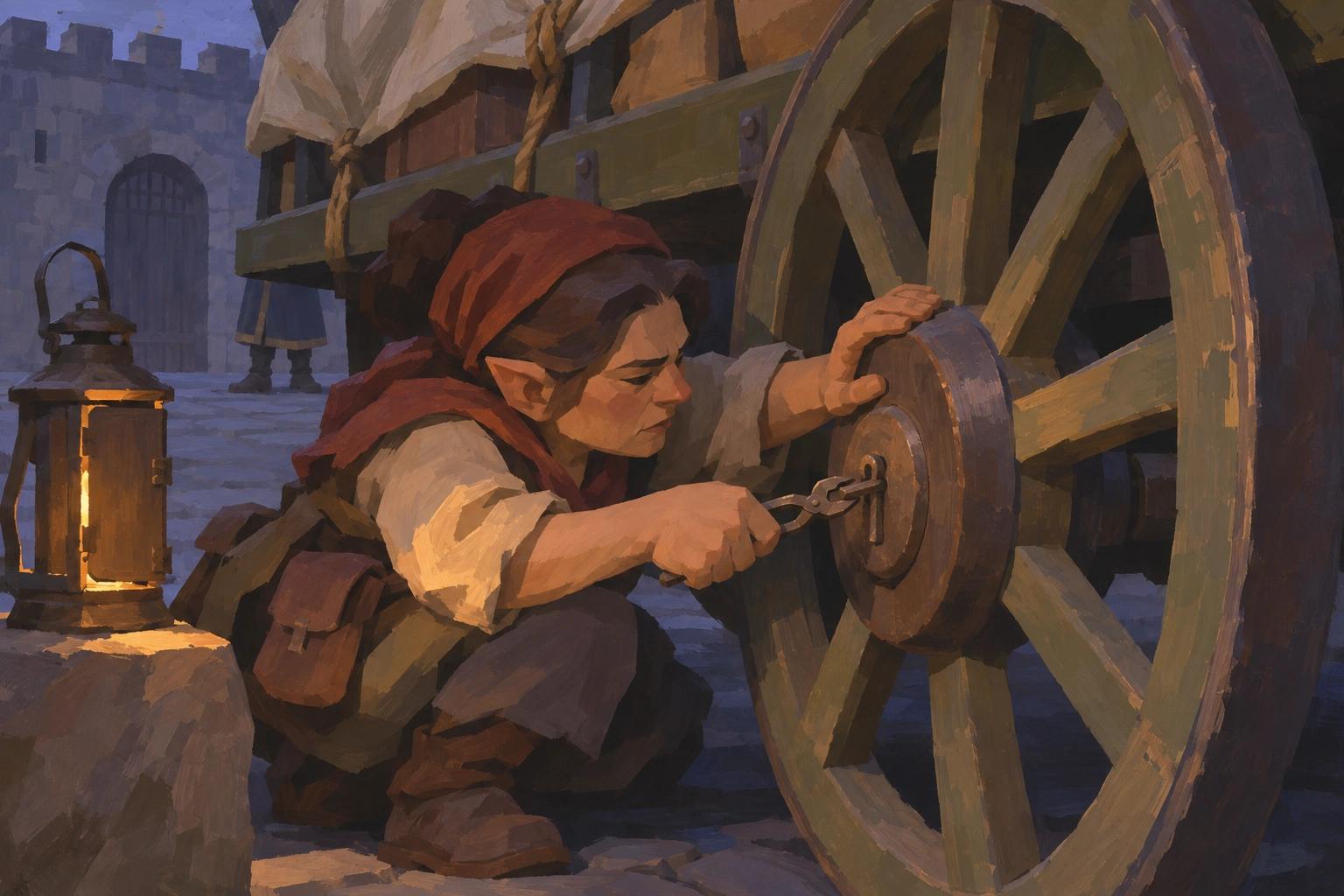
Every plan rests on something small: a bolt in a crossbow, a pin in a hinge, a strap across a breastplate. Saboteurs find that small thing and loosen it, quietly, a long time before anyone needs it. At the table, a Saboteur spends the night before the battle under the enemy's wagons, and the next day the drawbridge won't rise and the captain's buckle gives way at the worst moment. Nobody is sure it wasn't bad luck. What pulls at them is the perfect failure, the one that leaves no trace, and the fear that someday they will loosen the wrong bolt. Nobody has ever seen them put a tool back where they found it.
Shines on: an enemy's buckle giving way at the worst moment.
Leaves in the dark: the credit, which goes to bad luck.
Level 3: Quiet Wrecking
You gain proficiency with Tinker's Tools. As a Bonus Action, you can silently sabotage an unattended object within 5 feet of you that is no larger than a door, with one effect below. A creature that examines the object spots it with a successful Wisdom (Perception) check against a DC equal to 8 plus your Dexterity modifier and Proficiency Bonus, and can undo it with a Utilize action.
Jam. A door, lock, lid or hatch sticks shut. Opening it takes an action and a successful Strength (Athletics) check against the same DC.
Cut. A rope, strap or harness parts the next time it bears weight.
Foul. The next attack roll made with a fouled weapon misses, and a fouled trap or machine fails the next time it is used.
Level 3: Weak Point
When you deal Sneak Attack damage to a creature that wears armor, holds a Shield or wields a weapon, you can forgo one of the Sneak Attack dice before you roll them. The creature must succeed on a Dexterity saving throw (DC 8 plus your Dexterity modifier and Proficiency Bonus) or suffer one effect of your choice below. You can use Weak Point only once per turn.
Loosened Strap. If it wears armor or holds a Shield, its Armor Class is reduced by 1 (by 2 from Rogue level 9) until it takes a Utilize action to fix its gear or 1 minute passes. This reduction doesn't stack.
Fouled Weapon. The creature has Disadvantage on its next attack roll with a weapon before the end of its next turn.
Level 9: Delayed Failure
When you use Quiet Wrecking, you can delay the sabotage until a time you choose within 24 hours, or until a trigger you describe in 25 words or fewer occurs.
In addition, by working for 1 minute with Tinker's Tools, you can sabotage a structure or vehicle that fits in a 20-foot Cube, such as a wagon. It fails as you describe the next time it bears weight or is used, under the normal rules for falling and objects.
Level 13: Spike the Works
Seized Joint. Weak Point gains this effect: if the creature is a Construct or wears Heavy armor, its Speed is halved until the end of its next turn.
In addition, as a Utilize action, you can touch an unattended magic item, or one worn or carried by a creature that fails a Dexterity saving throw against your Weak Point DC, and suppress its properties for 1 minute. You can't do so again until you finish a Short or Long Rest.
Level 17: Total Breakdown
When you use Weak Point, you can cause two of its effects instead of one, and the creature has Disadvantage on the saving throw. Once you use this benefit, you can't use it again until you finish a Short or Long Rest. In addition, Delayed Failure can sabotage a structure or vehicle that fits in a 40-foot Cube if you work on it for 10 minutes.
Gambler
Bet Everything on the Next Blow
Some rogues count the odds. Gamblers count them too, and then they bet anyway. They learned their trade at back tables and dice pits, where a straight face is worth more than a sharp knife, and they fight the same way they play: every hit is a stake, and every stake can double or vanish. At the table, a Gambler is the one everyone watches when the die comes out, because the result might end the fight or leave the monster laughing. What pulls at them is the next roll, always, and the night they will finally walk away a winner. They are cheerful losers and unbearable winners.
Shines on: the whole table leaning in before the die stops.
Leaves in the dark: steady numbers, and anyone who likes to plan ahead.
Level 3: Let It Ride
Immediately after you roll Sneak Attack damage, you can let it ride: roll 1d6 and apply the result from the Let It Ride table. Any dice you removed for Cunning Strike aren't rolled and don't count. You can let it ride only once per turn, and you can't reroll this d6.
Let It Ride
| d6 | Sneak Attack Damage |
|---|---|
| 1–2 | equals the number of Sneak Attack dice you rolled |
| 3–4 | unchanged |
| 5–6 | doubled |
On a Critical Hit, count the extra Sneak Attack dice the Critical Hit gives you as dice you rolled; on a 1 or 2, the damage equals that total number of dice. For example, at level 3 you roll 2d6 for Sneak Attack and get 8. On a 1 or 2 you deal 2, on a 3 or 4 you deal 8, and on a 5 or 6 you deal 16, plus your weapon's damage in every case.
Level 3: Straight Face
You gain proficiency with one Gaming Set of your choice and in the Deception skill. If you already have proficiency in Deception, you gain proficiency in another skill of your choice instead. You have Advantage on ability checks you make with a Gaming Set.
In addition, any Wisdom (Insight) check a creature makes to read your intentions or emotions has Disadvantage. This doesn't affect magic that reads your thoughts or detects lies. For example, a guard who tries to tell whether you are nervous about the forged pass rolls with Disadvantage, and your own Charisma (Deception) check, if the GM calls for one, is made as normal.
Level 9: Pocket the Winnings
When you roll a 5 or 6 for Let It Ride, you can move up to half your Speed without provoking Opportunity Attacks (no action required). In addition, if you didn't use Cunning Strike on that hit, you can apply one Cunning Strike effect that costs 1d6 to the target without removing a Sneak Attack die; the target makes any saving throw the effect calls for. You can use this feature only once per turn.
Level 13: Cut Your Losses
When you use Uncanny Dodge, you can let it ride instead of halving the damage: roll 1d6. On a 1 or 2, you take the attack's full damage. On a 3 or 4, you take half the damage, as normal. On a 5 or 6, you take no damage from the attack. You can't reroll this d6.
Level 17: Double Down
Before you make an attack roll, you can double down (no action required). If the attack hits and deals Sneak Attack damage, you must let it ride with these results instead: on a 1 through 4, the Sneak Attack damage equals the number of Sneak Attack dice you rolled; on a 5 or 6, it is tripled. If the attack misses or deals no Sneak Attack damage, this feature isn't expended. Once you use it, you can't use it again until you finish a Long Rest.
Rogue Options
Everything in this section is optional, and the Game Master (GM) decides which of these options are available in a campaign. The section offers six new Cunning Strike effects for rogues of level 5 and higher, three variant features that each replace a Rogue feature with a different one of the same level, four feats and an Epic Boon for characters who have the Sneak Attack feature, three magic items made for quiet work and a lamp anyone can use, then the personal tables.
Cunning Strike Options
When you use Cunning Strike, you can choose one of the following effects instead of one from that feature. Each effect's cost in Sneak Attack dice is in its header; you remove those dice before you roll damage. An effect with the Level 14+ prerequisite also requires the Devious Strikes feature. If an effect calls for a saving throw, the DC equals 8 plus your Dexterity modifier and Proficiency Bonus.
Cunning Strike Effects
| Level | Effect | Cost | What It Does |
|---|---|---|---|
| 5 | Poison | 1d6 | the target has the Poisoned condition for up to 1 minute |
| 5 | Trip | 1d6 | a Large or smaller target has the Prone condition |
| 5 | Withdraw | 1d6 | you move half your Speed without provoking Opportunity Attacks |
| 5 | Cut Purse | 1d6 | you take a small object the target carries |
| 5 | Hobble | 1d6 | the target's Speed is halved, and it can't Dash |
| 5 | Open Guard | 1d6 | another creature's next attack against the target has Advantage |
| 5 | Rattled Nerves | 1d6 | the target can't take Reactions |
| 14 | Daze | 2d6 | the target can do only one thing on its next turn |
| 14 | Knock Out | 6d6 | the target has the Unconscious condition |
| 14 | Obscure | 3d6 | the target has the Blinded condition |
| 14 | Melt Away | 2d6 | you slip 10 feet away and hide behind less cover |
| 14 | Pin to the Wall | 3d6 | the target has the Restrained condition |
For example, a level 11 rogue with 6d6 Sneak Attack can use Improved Cunning Strike to spend 1d6 on Hobble and 1d6 on Open Guard: the target can't run, the fighter's next swing has Advantage, and the rogue still rolls 4d6. The table also shows the effects of the Cunning Strike and Devious Strikes features for comparison.
Cut Purse
Cunning Strike Effect (Cost: 1d6; Prerequisite: Level 5+ Rogue)
The target must succeed on a Dexterity saving throw, or you take one object it is wearing or carrying that weighs no more than 1 pound and isn't being held, worn as armor or clothing, or attuned, such as a pouch or a key. If you have a free hand, the object is now in it; otherwise, it falls in your space.
Hobble
Cunning Strike Effect (Cost: 1d6; Prerequisite: Level 5+ Rogue)
You cut at the leg the target runs on. The target must succeed on a Constitution saving throw or have its Speed halved until the start of your next turn. During that time, it also can't take the Dash action. For example, a messenger with a Speed of 30 feet moves only 15 feet, with no Dash to make up the difference.
Open Guard
Cunning Strike Effect (Cost: 1d6; Prerequisite: Level 5+ Rogue)
You feint low and cut high, and the target's guard swings the wrong way. The next attack roll that a creature other than you makes against the target before the start of your next turn has Advantage. The target doesn't make a saving throw against this effect. Otherwise, the effect ends with no benefit.
Rattled Nerves
Cunning Strike Effect (Cost: 1d6; Prerequisite: Level 5+ Rogue)
Your blade passes close enough to make the target flinch for a while. The target must succeed on a Wisdom saving throw or be unable to take Reactions until the start of its next turn. For example, a guard who fails the save can't make an Opportunity Attack against you or your allies as you all walk past it.
Melt Away
Cunning Strike Effect (Cost: 2d6; Prerequisite: Level 14+ Rogue)
After the attack, you can move up to 10 feet without provoking Opportunity Attacks. If you end this movement behind Half Cover or in a Lightly Obscured area, you can take the Hide action (no action required). For this Hide action, Half Cover or a Lightly Obscured area is enough, and you don't need to be out of any enemy's line of sight; the DC 15 Dexterity (Stealth) check still applies.
Pin to the Wall
Cunning Strike Effect (Cost: 3d6; Prerequisite: Level 14+ Rogue)
You drive the blade through a sleeve, a cloak or a strap and into whatever stands behind it. The target must succeed on a Dexterity saving throw or have the Restrained condition until the end of its next turn. For example, a caster pinned to the doorframe can still cast a spell, but it can't walk away from the fight.
Rogue Variant Features
Each variant feature replaces the named Rogue feature at the same level; you gain the variant instead of that feature. Ask your GM before you take one. You can take more than one variant feature, as long as each replaces a different feature. No Rogue subclass in this book needs a feature that a variant replaces.
Rogue Variant Features
| Level | Variant | Replaces | You Trade |
|---|---|---|---|
| 1 | Trade Patter | Thieves' Cant | a secret language for an honest trade and a different kind of contact |
| 3 | Low Feint | Steady Aim | Advantage at any range for Advantage in melee that leaves you half your Speed |
| 7 | Duck Out | Evasion | less damage from area effects for a quick step out of them |
Level 1: Trade Patter
Rogue Variant Feature (replaces Thieves' Cant)
You know one language of your choice, and you gain proficiency with one type of Artisan's Tools of your choice. When you talk with a creature that has proficiency with the same type of tools, you have Advantage on Charisma (Persuasion) checks you make to learn rumors or gossip from it. You don't know Thieves' Cant unless you learn it another way.
For example, a rogue with Smith's Tools can stand at a forge, talk about tempering for a few minutes and come away knowing who bought a dozen new locks last week.
Level 3: Low Feint
Rogue Variant Feature (replaces Steady Aim)
As a Bonus Action, you choose one creature within 5 feet of you. You have Advantage on your next melee attack roll against that creature this turn. You can use this feature only if you haven't moved during this turn, and after you use it, your Speed is halved until the end of the current turn.
Low Feint doesn't help a ranged attack, and it never reduces your Speed to 0. For example, you can feint at the guard beside you, stab it with Advantage for Sneak Attack, and still use the rest of your halved Speed to step behind a pillar.
Level 7: Duck Out
Rogue Variant Feature (replaces Evasion)
When you succeed on a Dexterity saving throw against an effect that targets an area, you can move up to half your Speed without provoking Opportunity Attacks immediately after the effect resolves (no action required). You still take any damage the successful save allows, usually half. You can't use this feature if you have the Incapacitated condition.
For example, when you succeed on the save against a Fireball, you take half its damage and then step clear before the next spell lands.
Rogue Feats
General feats require level 4+. Boon of Sharp Edges is an Epic Boon, a choice for the level 19 Epic Boon feature. Every feat here builds on Sneak Attack, so it works for any character who has that feature, including a character with Rogue levels from multiclassing. The Playing a Rogue section suggests which feat suits which subclass.
Quick Knife
General Feat (Prerequisite: Level 4+, Sneak Attack Feature)
You gain the following benefits.
Ability Score Increase. Increase your Dexterity or Intelligence score by 1, to a maximum of 20.
Parting Cut. You have Advantage on Opportunity Attacks you make with a Finesse weapon. When you deal Sneak Attack damage with an Opportunity Attack, the target's Speed becomes 0 until the end of the current turn. For example, an ogre that walks away from you takes your Sneak Attack and stops where it stands, still within reach of the friend you were covering.
Quiet Hands
General Feat (Prerequisite: Level 4+, Sneak Attack Feature)
You gain the following benefits.
Ability Score Increase. Increase your Dexterity or Intelligence score by 1, to a maximum of 20.
Second Try. When you fail an ability check made with Thieves' Tools by 5 or less, the failure doesn't trigger a trap or jam the lock, and you can try again. Each new attempt takes the usual time.
Sure Work. When picking a lock or disarming a trap takes longer than an action, it takes you half as long. For example, a vault lock the GM says needs 10 minutes of work takes you 5.
Rooftop Shot
General Feat (Prerequisite: Level 4+, Sneak Attack Feature)
You gain the following benefits.
Ability Score Increase. Increase your Dexterity or Wisdom score by 1, to a maximum of 20.
Patient Aim. Attacking at long range doesn't impose Disadvantage on your ranged attack rolls during a turn in which you used Steady Aim.
Far Rooftops. The normal range of your ranged weapons increases by 30 feet. This benefit works even if you don't have Steady Aim, for example because you took the Low Feint variant. With it, your Shortbow has a range of 110/320 feet and your Light Crossbow a range of 110/320 feet.
Scrapper's Footwork
General Feat (Prerequisite: Level 4+, Sneak Attack Feature)
You gain the following benefits.
Ability Score Increase. Increase your Strength or Dexterity score by 1, to a maximum of 20.
Step Away. When you deal Sneak Attack damage with a melee attack, you can move up to 10 feet without provoking an Opportunity Attack from the target (no action required). Other creatures can still make Opportunity Attacks against you as normal. This movement doesn't cost any Sneak Attack dice, so you can still use Cunning Strike on the same hit. For example, you can stab the brute and step back out of its reach before it swings.
Boon of Sharp Edges
Epic Boon Feat (Prerequisite: Level 19+, Sneak Attack Feature)
You gain the following benefits.
Ability Score Increase. Increase one ability score of your choice by 1, to a maximum of 30.
Keen Edge. When you roll Sneak Attack damage, you can reroll any die that shows a 1 or 2, and you must use the new roll. You can reroll each die only once. If another feature lets you change the Sneak Attack total after the roll, apply this reroll first. For example, ten Sneak Attack dice that show three 1s and one 2 let you reroll those four dice.
Rogue Magic Items
The knife and the cloak require attunement by a Rogue and work with Sneak Attack and Stealth; the picks work for anyone with the right hands. The lamp works for any character and is as useful at a midday market as in a cellar at night.
Whisper Picks
Wondrous Item, Uncommon
This roll of blued-steel picks counts as Thieves' Tools. The picks make no sound when used, and you have Advantage on ability checks you make with them.
Silent Opening. While holding the picks, you can take a Magic action to touch a lock with them and cast Knock from them. The spell makes no sound. Once used, this property can't be used again until the next dawn. For example, you can open a barred cell door while the guards at the table outside keep playing cards.
Knife of Quiet Endings
Weapon (Dagger), Rare (Requires Attunement by a Rogue)
This plain dagger has a grip wrapped in grey felt. You gain a +1 bonus to attack rolls and damage rolls made with this magic weapon.
Clean Strike. Once on each of your turns when you deal Sneak Attack damage with this knife, you can reroll any of the Sneak Attack dice that show a 1, and you must use the new rolls.
Soft Fall. A creature that drops to 0 Hit Points from damage dealt with this knife makes no sound as it falls, and anything it was holding lands without a sound. This doesn't prevent any other noise in the area, such as a shout from a creature that saw the attack. For example, you can drop the sentry on the wall walk, and the guards in the tower below hear nothing unless one of them was watching.
Cloak of the Empty Corner
Wondrous Item, Very Rare (Requires Attunement by a Rogue)
This grey cloak seems to be the same color as whatever wall stands behind it. While wearing it, you have Advantage on Dexterity (Stealth) checks. The cloak has 3 charges and regains 1d3 expended charges daily at dawn.
Not There. While wearing the cloak, you can take a Bonus Action to expend 1 charge, teleport up to 30 feet to an unoccupied space you can see and give yourself the Invisible condition. The condition lasts until the end of your next turn or until you make an attack roll, deal damage or cast a spell. For example, when the guards close in, you can step into the corner behind them and attack on your next turn with Advantage from being unseen.
Lamp of Turned Backs
Wondrous Item, Uncommon
This lamp burns Oil like an ordinary Lamp, shedding Bright Light in a 15-foot radius and Dim Light for an additional 30 feet; a flask of Oil keeps it burning for 6 hours.
Look Elsewhere. While the lamp is within 5 feet of you, you can take a Magic action to turn its wick down and name up to three creatures you can see, which can include you. For 10 minutes, all other creatures have Disadvantage on Wisdom (Perception) checks to notice the named creatures while those creatures are within 30 feet of the lamp. This property works in daylight and whether or not the lamp is lit. Once used, it can't be used again until the next dawn. For example, at noon you can set the lamp on a counting-house table and walk past the clerks to the back office with two friends.
Rogue Personal Tables
Roll on these tables or choose an entry that fits your character. None of them has a rules effect. Each entry is a person, a place, an object or a secret, and a hook your GM can use in the first session, so tell the GM which ones you picked. Keeping one secret from the other players is very much in character.
How It Was Lit
| d6 | Beginning |
|---|---|
| 1 | You picked your first lock to free a friend from a cellar, and you were good at it immediately. |
| 2 | An old card sharp paid you to fetch drinks and taught you to watch hands instead of faces. |
| 3 | You were caught stealing bread by a woman who hired you instead of calling the watch. |
| 4 | You took the blame for a sibling's theft and learned the trade properly while serving the sentence. |
| 5 | A locksmith's apprentice, you opened the master's strongbox once just to prove you could. |
| 6 | You followed a pickpocket for a whole afternoon and ended the day as her partner. |
What Feeds the Flame
| d6 | Drive |
|---|---|
| 1 | You owe a debt to someone dangerous and pay a little every month, never quite enough. |
| 2 | You live for the moment a door that should not open opens under your fingers. |
| 3 | You keep a list of people who cheated your family, and of what you mean to take back from each. |
| 4 | You feed a younger crew of street children with whatever you bring home. |
| 5 | You still dream about the job that went wrong years ago, and the partner who has not forgiven you. |
| 6 | You love knowing something that nobody else in the room knows. |
Soot
| d6 | Mark |
|---|---|
| 1 | You test every chair before you sit on it, and friends have stopped asking why. |
| 2 | Your left little finger is crooked from the day a strongbox lid came down on it. |
| 3 | Shopkeepers in one town still follow you around their stalls with narrowed eyes. |
| 4 | You weigh every purse you see by the way it swings, and you are usually right. |
| 5 | You carry three sets of picks, and you have never been seen using the third. |
| 6 | You answer questions with questions, and you hate it when others do the same to you. |
Beyond the Edge
| d6 | Out There |
|---|---|
| 1 | A fence who owes you a favor sent a key with no note, wrapped in a stained handkerchief. |
| 2 | Someone is pulling jobs in your style, and the watch is looking for you. |
| 3 | An old partner you left in a cell has been released early, and she knows your new name. |
| 4 | A merchant you robbed years ago wants to hire you, and is offering far too much. |
| 5 | A locked box you stole long ago is still unopened under your bed, and it is getting warm. |
| 6 | The person who taught you everything is dying and has asked to see you one more time. |