
Optional Module
Every character has a first time: the first Rage, the first spell that answered, the first oath said out loud. Most campaigns skip it and start in a tavern with everyone already competent. This module plays it instead. A prelude is a short scene for one or two players that shows the moment a character became their class, and it ends where the campaign begins, at level 1. Nothing else in this book needs this module. Use it when you want the first session to start with a story the table has already seen.
Running a Prelude
Each class has one prelude in the next section. A prelude runs 20 to 40 minutes, uses only the rules of the SRD 5.2.1, and has three scenes: a quiet start, the moment the class arrives, and the morning after. You run it before the first session, at the start of it while the others build their characters, or in a separate half hour on another evening. You speak as the Game Master (GM) throughout; there is no text to read aloud, so tell the scene in your own words.
Before You Start
The player builds a complete level 1 character first: species, background, class, ability scores and starting equipment. A prelude is not a level 0 game. The character already has every level 1 feature on the sheet; the prelude is the night those features show up for the first time. A Barbarian has both uses of Rage before the wolves come, and a Bard has every spell slot before the guests arrive.
Ask the player two questions before the first scene: who else was there, and what the character was doing an hour before. Use both answers. If the player names a grandmother, she is the one who comes back at dawn. Check the prelude's content with the player, too. Every prelude has a threat, and some players would rather not play through a hurt animal or a robbed stranger. Change the threat; keep the moment.
Solo or Duo
A solo prelude has one player and you. It is the easiest version to schedule and the most personal, because every decision belongs to one person. Give that player room. Let quiet beats stay quiet, and don't fill the scene with talking NPCs.
A duo prelude adds a second player, who plays either their own level 1 character, standing in the scene for a reason the two players agree on, or the supporting role the prelude names, such as the young herder at the fold. The second player gets their own decisions, but the prelude still belongs to the first character. Each prelude states how to scale its fight for two characters; use the encounter rules of the SRD 5.2.1 if you need to adjust further, and stay within the Low or Moderate budget for level 1. If you run two preludes back to back for the same pair, swap the roles.
Running the Scenes
Each scene ends with a decision, not a dice roll. Ask for checks when the outcome is uncertain, use the DCs of the SRD (10 for an easy task, 15 for a medium one, 20 for a hard one), and move on as soon as the decision is made. Ten minutes per scene is a good pace. If the player finds a better answer than the prelude expects, take it; the outline is a path, not a fence.
Slow down for the class's first time. When the Barbarian's player says "I rage," stop and ask what it looks like, what it sounds like, who sees it. The rules happen exactly as written, and the description is the reason you're playing the prelude at all. The same goes for a first cantrip or a first Bardic Inspiration: one sentence from the player about how it feels is worth more than a paragraph from you.
A prelude is not the place for a character to die. The SRD lets an attacker that would reduce a creature to 0 Hit Points with a melee attack knock it out instead, leaving it at 1 Hit Point with the Unconscious condition, and the foes in a prelude always choose that. If other damage drops a character to 0 Hit Points, run Death Saving Throws as normal, and let the foes leave rather than finish the job: the wolves take a sheep and go, the thieves grab a purse and run. Failure changes the ending, not the sheet. The character still reaches level 1, still keeps the keepsake and still gets the hook; the story told about that night is simply harder.
The Keepsake and the Hook
Every prelude ends with two things. The first is a keepsake: a small object from that night, such as a wolf's tooth or a snapped string. A keepsake has no rules value. It isn't a Spellcasting Focus, it is worth nothing to anyone else, and it doesn't replace any starting equipment. Write it on the sheet anyway. Players hold on to these longer than to any magic item.
The second is a hook from the class's How It Was Lit table in its personal tables. Each prelude suggests the entry that fits its story; the player may choose another entry or roll instead. The hook counts as the character's How It Was Lit result. Note it for yourself, too: it is a person, a place or a debt you can bring back in the first sessions.
After the prelude, the character finishes a Long Rest before the campaign starts. Whatever was spent that night (Hit Points, uses of Rage, spell slots) is back for the first session.
The Flashback
Some characters are already on the road at level 4 or level 9 when a player wants to know where it all started. Every prelude has a flashback for them: a ten-minute version told during a Short or Long Rest or on a quiet stretch of travel. The flashback is one scene, without combat and without dice unless the player asks for one. The player narrates; you ask the questions the prelude gives and add one detail from the scene.
A flashback changes nothing on the sheet. The character spends no resources and gains no Experience Points, but the keepsake turns up in the bottom of the pack, and if the character never rolled on How It Was Lit, the flashback's hook becomes that entry now. Offer one flashback per character at most; a past told twice starts to contradict itself.
The Night All Lights Went On at Once
The group version runs one night for the whole table: every player character finds their class in the same place, in the same few hours, and meets the others there. It takes one session of two to three hours and replaces the usual first meeting in an inn. Each character's prelude becomes a single beat inside it, and the night ends with the group at level 1, standing together, with a reason to stay together.
Use it for a new group of three to six players. Every player builds a level 1 character as described in Before You Start, then reads the prelude of their class, so they know which beat is theirs.
Choose the Night
Choose one night from the table or invent one. It needs a place where many people are gathered, a threat that grows over a few hours, and a reason nobody can simply leave.
The Night
| d6 | Night |
|---|---|
| 1 | A river crossing in flood: the ferry is stuck, the inn is full, and the water is still rising. |
| 2 | A harvest fair on its last evening, when the fair's strongbox goes missing and the gates are shut. |
| 3 | A mountain hut in a blizzard, with too many travelers and too little wood. |
| 4 | A village wedding where half the guests arrived armed, and nobody admits who invited them. |
| 5 | A caravan camp surrounded by something in the hills that has followed it for three days. |
| 6 | A town under quarantine, where the last cart out leaves at dawn with room for six. |
Three Acts
Before. Open with each character alone or in pairs, doing what they did an hour before their first time. Give each one a short scene of two or three minutes, built from the quiet first scene of their prelude and moved into the chosen night: the Barbarian keeps watch at the stable, the Bard is asked to fill in for a musician who never came. Each scene ends with one small sign that the threat is close. Cut between scenes quickly; the players learn who the others are by watching, not by introductions.
The Turn. The threat arrives, and every character's first time happens within the same hour. Take the middle scene of each prelude and shrink it to one decision and one roll. Run the beats in Initiative order if the threat is a fight, or in the order that tells the best story if it isn't. When a character's class arrives, slow down as in Running the Scenes: one question, one answer, then the next player. Beats can overlap. The Bard's first Bardic Inspiration can go to the Fighter about to make a first stand, and that is the best version of this night.
If the Turn includes a fight, build one encounter for the whole group with the encounter rules of the SRD 5.2.1 at the Moderate budget for level 1, and split it into two or three groups of foes at different places, so every character has a front. The foes still knock out rather than kill, as in a solo prelude.
After. Dawn, or the end of the storm, or the cart leaving. Every character takes their keepsake and their hook as in their prelude. Then ask each player one question about another character: what did yours see them do last night that nobody else saw. The answers are the group's first shared memory, and they make the reason to travel together. The group finishes a Long Rest, and the campaign begins.
An Example Night
Four players have built a Barbarian, a Bard, a Cleric and a Rogue, and the GM rolls a 4: the wedding where half the guests came armed. In Before, the Bard is hired at the last minute because the musician never arrived, the Barbarian is sent to watch the horses behind the barn, the Cleric is there to bless the couple and doesn't believe a word of the vows, and the Rogue is under the head table looking for the dowry purse. Each scene ends with a sign: a stranger counting the guests, a horse that won't settle, a blade under a cloak, a purse that is already gone.
The Turn starts when the armed guests stand up at the toast. The GM runs one fight within the Moderate budget for four level 1 characters (300 XP), split three ways: two Bandits at the barn, three at the doors, and one Bandit with a Tough at the head table, 250 XP in all. The Bard holds the crowd with a Charisma (Performance) check and gives a first Bardic Inspiration to the Barbarian, who rages for the first time at the barn door. The Cleric's first spell keeps the bride's father alive. The Rogue's first Sneak Attack lands on the Tough, who is holding the purse.
In After, the Barbarian keeps a horseshoe nail, the Bard a snapped string, the Cleric a torn page of the vows, and the Rogue the empty purse. Each player answers the question about another character. The Rogue's player says: "I saw the Bard keep singing while the doors came in." That is the reason these four are still together in the second session.
Pacing the Night
With six players, Before takes about thirty minutes, the Turn an hour and After twenty minutes. With three, you have time to let each beat breathe, or to run the fight in full. The danger is uneven attention. Track who has had their first time already and who hasn't; the last player to go waits longest, so give that character a part in someone else's beat while they wait. No character's first time should be the one that saves everyone. The night works when each light shows one thing and the group sees all of them at once.
If a player joins later in the campaign, run that character's own prelude as usual, or play the flashback with the group listening. A latecomer doesn't need the night; they need one moment the others have seen.
The Preludes
Each class has one prelude, in the order of the class chapters. The line under each title gives the class, the number of players and the playing time. Every prelude has three scenes, names the SRD 5.2.1 rules and creatures it uses, and ends with its keepsake, a suggested entry from the class's How It Was Lit table and a ten-minute flashback for characters who are already on the road. Read the whole prelude before you run it; the fight is in the middle, and the scenes before it set up how it goes.
Wolves at the Fold
Barbarian prelude · 1 or 2 players · 25–35 minutes
A winter night at a sheep fold half a day from the village. The adult herders have gone down to fetch salt and will be back at dawn; the character stayed with the flock because somebody had to. The fold is a ring of low stone walls with one gap closed by a hurdle, a hut no bigger than a cart, and a fire pit by the gap. A wolf pack has been following the flock for a week. Tonight it comes close. In a duo, the second player plays the young herder who stayed too, either as their own level 1 character or as a child the character must keep out of the fight.
The prelude uses the Wolf stat block of the SRD 5.2.1. The pack's leader is a Wolf with 16 Hit Points instead of 11; the rest of the pack, four Wolves, circle outside and never all attack at once. The character starts with full Hit Points and both uses of Rage.
The Low Wall. It is cold, the wood is damp, and the fire by the gap keeps going out. Keeping it going through the night takes a successful DC 10 Wisdom (Survival) check; on a failure, the fire dies and the ground around the fold falls from Dim Light into Darkness. The wolves have Darkvision and don't care, but the character does. Every so often, ask for a Wisdom (Perception) check against the pack's Dexterity (Stealth) check (+4): on a success, the character sees eyes at the edge of the slope, counts them and knows where the next pass will come from. Let the player decide how to spend the hours. Bringing the lambs into the hut, piling stones in the weakest stretch of wall, waking the young herder, or simply sitting on the wall with the crook across the knees are all good answers. A creature behind the wall has Half Cover against a wolf outside it, and a wolf that climbs it spends 1 extra foot of movement for each foot climbed. End the scene when the sheep start crying all at once.
Over the Wall. The leader comes over the wall where the character isn't, and the flock breaks against the hut. Roll Initiative. The character has a crook (use the Quarterstaff, including its Topple mastery property if the character chose it with Weapon Mastery), any weapon from the starting equipment that the player says is at hand, and bare hands for an Unarmed Strike. The leader fights alone for two rounds. If it is still standing at the start of the third round, one more Wolf comes through the gap, and from then on both gain Advantage from Pack Tactics. Don't prompt the Rage before the first wound. When the character first takes damage, stop and ask the player what happens. If the answer is a Rage, it is the ordinary level 1 Rage of the SRD: a Bonus Action, Resistance to Bludgeoning, Piercing and Slashing damage, the Rage Damage bonus on Strength-based attacks, and Advantage on Strength checks and saving throws. Ask what the young herder sees. In a duo, add a second Wolf at the start instead of the third round. The pack scatters as soon as the leader is Bloodied. If the character goes down first, the wolves take two sheep and leave.
Dawn on the Wall. At sunrise the herders come back up the path with the salt and find the character still sitting on the wall, the crook broken or the knuckles split. Some sheep are missing, the pit is cold, and the leader's tracks go up the slope with blood in them. The herders don't say much. One of them pulls a tooth from the hurdle where the leader bit it and hands it over. Ask the player what the character says first, and what the character doesn't say. Let the young herder tell the story wrong, louder than it was.
Ending. The character is a level 1 Barbarian and finishes a Long Rest before the campaign starts. The keepsake is the wolf's tooth, which has no rules value. The suggested hook is the fifth entry of the Barbarian's How It Was Lit table: a storm, a broken fence, a fever, and when the character woke, the wolves were gone and the hands hurt. If the character went down in the fight, the entry fits even better. The leader escaped with its wound, and you can bring it back older and bigger in the first sessions.
Flashback. Ten minutes, during a Short or Long Rest or a quiet stretch of road, for a Barbarian who left the fold years ago. Ask the player three questions and let the answers be the scene: what the night at the fold smelled like, what the character was holding when the first wolf came over the wall, and who was watching. Then add one detail the player didn't mention, such as the sound the sheep made, or the young herder's face in the hut door. No dice are rolled. Ask last what the character did with the tooth, and whether it is still in the pack. If it is, it is the keepsake, and the fifth How It Was Lit entry becomes the character's beginning if they don't have one yet.
The Empty Stage
Bard prelude · 1 or 2 players · 20–40 minutes
A village wedding on a late summer evening. The tables are set in a barn yard, the beer is open, and the hired musician, who was due at noon, hasn't come. The character is a guest who can play or sing a little, a cousin of the bride or a traveler who stopped for the free supper. By the time the second barrel is tapped, everyone is looking at the character. In a duo, the second player plays another guest, either as their own level 1 character or as the bride's brother, who has a temper and a reason to keep the peace tonight.
The prelude uses the Commoner and Bandit stat blocks of the SRD 5.2.1. The character starts with full Hit Points, every use of Bardic Inspiration and both level 1 spell slots. The prelude assumes the character knows Vicious Mockery or Minor Illusion; if neither is on the sheet, use whichever Bard cantrip the player chose.
A Wedding Without Music. The bride's mother asks the character to fill in, just until the musician arrives. Holding a restless crowd for the first hour takes a successful DC 10 Charisma (Performance) check. Then a drunk guest (a Commoner) starts to heckle: the song is wrong, the voice is worse, and who invited this one anyway. Let the player choose how to answer. The character can take the Influence action to talk him down with a Charisma (Persuasion) or Charisma (Intimidation) check, DC 15, because the heckler is hesitant rather than willing; a joke at his expense is a Charisma (Performance) check against the same DC. On a success, the crowd laughs with the character and the heckler sits down. On a failure, the crowd laughs at the character, and the heckler stays standing for the next scene. Either way, end the scene with the first plate breaking at the head table.
The Dowry Quarrel. The two families have been arguing about the dowry since noon, and now the fathers are on their feet with half the guests behind them. Six Commoners are a breath away from a brawl, and none of them is armed with more than a Club. The prelude wants words and a first cantrip here, not a blade. Minor Illusion can put a sound into the yard, a crash in the barn or the bride starting to cry, that stops everyone for one turn; Vicious Mockery aimed at the loudest uncle can turn the whole yard's anger into laughter. Warn the player once, plainly: a Commoner has 4 Hit Points, and Vicious Mockery can drop one, which ends this fight and starts a worse one. Any Influence action in this scene has Advantage while the families are still laughing or staring. If the brawl starts anyway, play one round with Club attacks and then let the bride walk into the middle of it. End the scene when somebody shouts from the road.
The Ditch by the Road. The hired musician is in the ditch beyond the gate, bruised and robbed, with a broken fiddle in his lap. The two thieves who did it are still in the hedge across the road, waiting to see whether anyone follows, and they have his purse. In a duo, there are three. Before anyone moves, give the player the moment: the character's first Bardic Inspiration, a Bonus Action, to the shaking musician or to the duo partner. Ask what the character says or sings to do it. Then the thieves step out. They are Bandits, they want to leave with the purse, and a successful Influence action with Charisma (Intimidation), DC 15, sends them off without it. Otherwise roll Initiative. The thieves flee as soon as one of them drops to 0 Hit Points or the purse is back in the musician's hands.
Ending. The musician plays the last dance with three strings, and the character plays it with him. The character is a level 1 Bard and finishes a Long Rest before the campaign starts. The keepsake is the musician's snapped fiddle string, which has no rules value. The suggested hook is the second entry of the Bard's How It Was Lit table: a travelling company left the character behind in a hay barn with a borrowed fiddle and a debt still owed. The musician belongs to that company, moves on at dawn, and leaves his spare fiddle and an unpaid wedding fee behind with the character. The debt comes back in the first sessions.
Flashback. Ten minutes, during a Short or Long Rest or a quiet stretch of road, for a Bard who left that barn yard long ago. Ask the player three questions and let the answers be the scene: which song the character started with before anybody asked, what the heckler shouted, and who the character's first Bardic Inspiration went to. Then add one detail the player didn't mention, such as the smell of spilled beer or the bride's mother counting the guests. No dice are rolled. Ask last whether the snapped string is still wound around something in the pack. If it is, it is the keepsake, and the second How It Was Lit entry becomes the character's beginning if they don't have one yet.
Vigil at the Ford
Cleric prelude · 1 or 2 players · 20–40 minutes
An autumn evening at a river ford on the road to market. Rain upstream has turned the water brown and fast, and a carter tried the crossing anyway. His cart lies on its side at the near bank with one wheel smashed, and his leg is pinned under the bed. The other travelers who reached the ford before dark decided to go round by the bridge, half a day upstream. The character stays. The carter's family waits at the inn on the far bank and can see the cart from there, but nobody can cross until the water falls at dawn. In a duo, the second player plays another traveler who stayed, either as their own level 1 character or as the carter's apprentice, a girl of twelve who is braver than she is useful.
The prelude uses the Commoner and Bandit stat blocks of the SRD 5.2.1. The carter is a Commoner with 2 of his 4 Hit Points left. The thieves are two Bandits who have been waiting out the flood in the willows. The character starts with full Hit Points, every spell slot and the spells the player prepared.
The Pinned Leg. The cart bed is too heavy for one person. Raising it long enough to drag the carter clear takes a successful DC 15 Strength (Athletics) check, or DC 10 if someone levers it with a pole or the apprentice pulls; each failure costs the carter 1 Hit Point. Once he is free, a successful DC 10 Wisdom (Medicine) check splints the leg. Then let the player decide what the night needs: a fire from the cart's wet planks, the cart's lamp hung high where the family can see it, a blanket, talk. The carter talks when he is frightened. Let him ask the character what they believe, and let the player answer out loud for the first time. End the scene when the carter falls asleep and the rain stops.
Something in the Willows. Near midnight, the two Bandits come out of the willows for the cart's load: bolts of cloth and a small strongbox. They want the box, not a fight. A successful DC 15 Charisma (Intimidation or Persuasion) check sends one of them back into the trees; otherwise roll Initiative. The character has the overturned cart for Half Cover, the fire and any weapon from the starting equipment. This is the moment for a first cantrip: Sacred Flame against a thief at the wheel, or Guidance on the apprentice who is trying to hold the lamp steady. Don't name the spell for the player. Ask what the character says while casting it, and treat those words as the first prayer the character ever spoke aloud, even if it is only "no." A Bandit flees as soon as it is Bloodied. In a duo, add a third Bandit who goes for the horse. If the character drops to 0 Hit Points, the thieves take the strongbox and leave the carter alone.
The Breath at Dawn. At first light the water falls, and the family starts across. Halfway over, the carter's breathing stops: he drops to 0 Hit Points and starts making Death Saving Throws. Roll them in the open. The character can reach him with anything at hand: Cure Wounds or Healing Word from a level 1 spell slot, a Healer's Kit, or hands on his chest and a Wisdom (Medicine) check. Don't hurry the player. One failed save is fine, and the family's voices across the water are the clock. When the carter opens his eyes, his wife reaches the bank. Ask the player what the character does with their hands afterward, and whether they tell anyone what they said in the dark.
Ending. The character is a level 1 Cleric and finishes a Long Rest at the inn before the campaign starts. The carter can't pay, so he gives the character the cart's lamp, dented in the fall; it has no rules value. The suggested hook is the first entry of the Cleric's How It Was Lit table: the character kept a dying stranger company through the night, and at dawn something answered the prayer they'd made up. If the carter died, the entry still fits, because the answer came, only for someone else. The thieves know the character's face, and you can bring them back in the first sessions.
Flashback. Ten minutes, during a Short or Long Rest or a quiet stretch of road, for a Cleric who sat at the ford years ago. Ask the player three questions and let the answers be the scene: what the carter talked about when he was afraid, what the character said in the dark that they had never said before, and what answered. Then add one detail the player didn't mention, such as the apprentice asleep against the broken wheel, or the lamp still burning when the sun came up. No dice are rolled. Ask last where the dented lamp is now, and whether the character still fills it. If they do, it is the keepsake, and the first How It Was Lit entry becomes the character's beginning if they don't have one yet.
Reeds at Noon
Druid prelude · 1 or 2 players · 20–40 minutes
A hot noon in late summer at the edge of a reed marsh. It is cutting day, and the village's reed cutters have worked the far beds since dawn from flat-bottomed punts. Just after noon, one punt drifts back to the landing empty, its pole gone. It belongs to the oldest cutter in the village, who hasn't lost a pole in fifty years. The character lives at the marsh's edge, or grew up beside it, and knows that the marsh doesn't care how long someone has known it. In the heat haze, open water, reeds taller than a person and tussocks of firm ground all look the same. In a duo, the second player plays the old cutter's grandchild, either as their own level 1 character or as a stubborn twelve-year-old who refuses to stay at the landing.
The prelude uses the Giant Frog stat block of the SRD 5.2.1. The character starts with full Hit Points, all level 1 spell slots, the cantrips the player chose and the Primal Order option the player chose. Because of the Druidic feature, the character always has Speak with Animals prepared and can cast it as a Ritual.
The Landing. The cutters argue on the landing: row out in a line and shout, or wait for the cool of the evening. Ask the player whether the character joins the boats or goes alone. A successful DC 12 Wisdom (Survival) check on the empty punt finds gray clay on its bottom that the marsh has only in the eastern beds. A character who stands still at the water's edge and succeeds on a DC 12 Wisdom (Perception) check notices what the shouting boats never will: the dragonflies settle only on stems that grow from roots thick enough to stand on, and they mark a crooked path toward the east. One of the cutters says out loud that the old man knew every bed better than anyone, and then looks at the character.
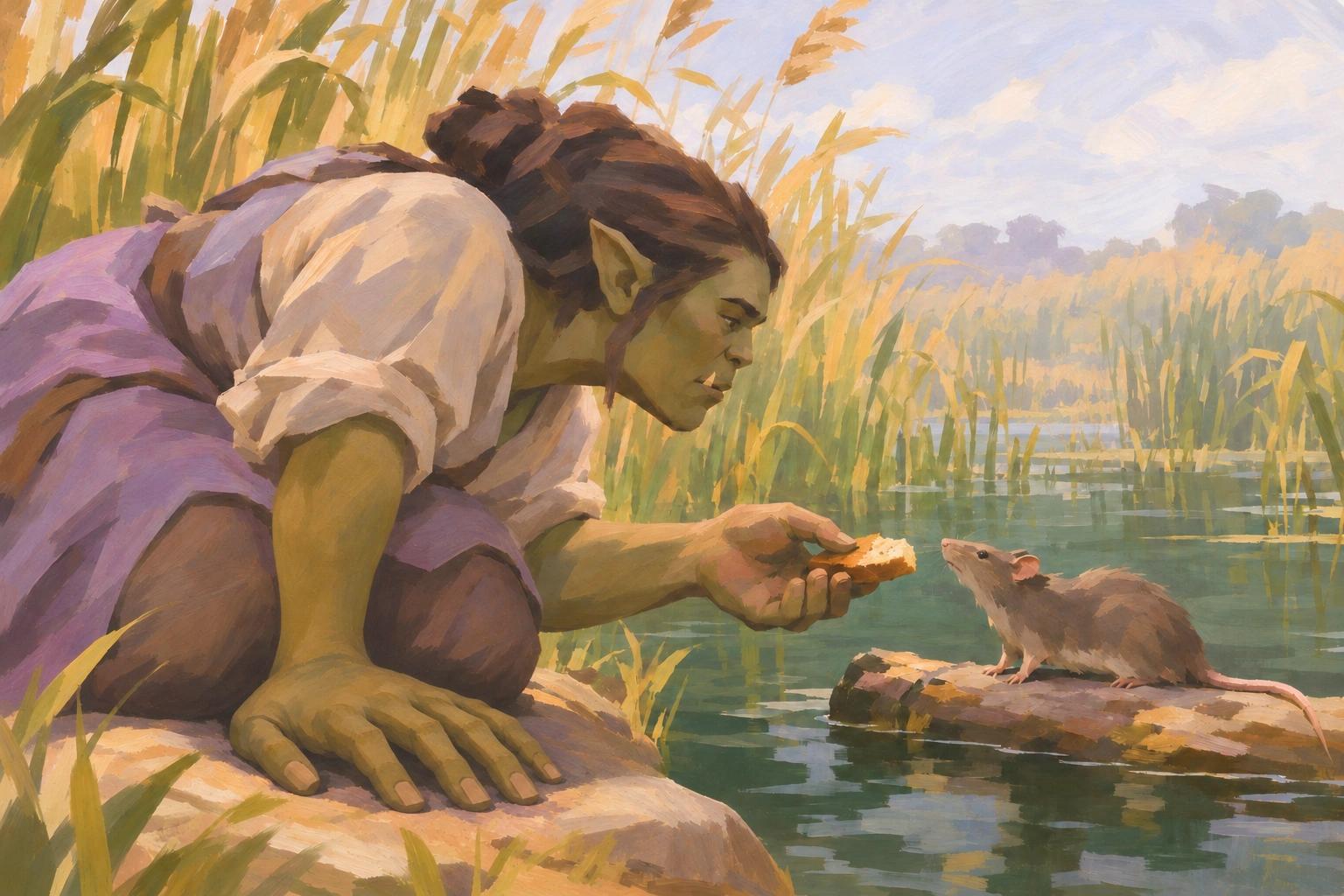
Heron and Water Rat. The reeds close behind the character. Two animals will talk to anyone who asks properly: a heron fishing in the hot shallows and a water rat sunning itself on a floating log. With Speak with Animals, the character can ask them, but they answer in their own terms. The heron knows where the frogs are thickest and cares about nothing else. The water rat saw the old man wade after his pole that morning and wants something in return, such as a promise, a crust of bread or an end to the shouting. Let the player bargain; any honest offer works. Without the spell, a successful DC 12 Wisdom (Survival) check follows the line of trampled reeds instead and takes twice as long. Between the reed beds, the ground looks firm and isn't. A character who crosses it without care makes a DC 10 Wisdom (Survival) check; on a failure, a leg sinks to the knee and the character has the Restrained condition until the character or another creature takes an action to succeed on a DC 10 Strength (Athletics) check. End the scene when the character hears the old man's voice, hoarse and very close.
The Frog in the Shallows. The old cutter is standing waist-deep in gray mud beside a tussock, sunburned and dizzy. He has the Restrained condition, and freeing him takes the same DC 10 Strength (Athletics) check. A few strides away, a hungry Giant Frog lies half-sunk in the warm water, waiting for him to stop moving. Roll Initiative when the frog notices the character. The frog wants a meal, not a fight. It flees into the water as soon as it takes damage from any source, and also if the character succeeds on a DC 12 Wisdom (Animal Handling) or Charisma (Intimidation) check as an action to drive it off. If the frog acts first, it bites the old man and grapples him (escape DC 11), and the scene becomes a race to pull him out of its mouth before it bites again. Let the player decide whether the answer is a cantrip, a shout, a thrown clod of mud or the character standing between the frog and the old man; all of them work if the dice allow. A single point of damage is enough, so there is no need to track its Hit Points. The question is whether the character goes in, not whether the frog dies. In a duo, the grandchild pulls the old man free while the character holds the frog's attention.
Ending. The character brings the old man out along the way the dragonflies and the animals showed, and the boats come back to find them on the landing. The character is a level 1 Druid and finishes a Long Rest before the campaign starts. The keepsake is a plait of green rushes that the old man ties around the character's wrist; it never dries out or frays, and it has no rules value. The suggested hook is the fourth entry of the Druid's How It Was Lit table: the marsh took your family's farm one spring, and you walked out into it to ask why. Today, the marsh answered.
Flashback. Ten minutes, during a Short or Long Rest or a quiet stretch of road, for a Druid who left the marsh years ago. Ask the player three questions and let the answers be the scene: what the character noticed once the shouting boats were behind them, what the water rat asked for, and what the old cutter said when the mud finally let him go. Then add one detail the player didn't mention, such as the frog's eyes just above the warm water, or the smell of cut rushes and hot mud. No dice are rolled. Ask last whether the plait is still around the character's wrist. If it is, it is the keepsake, and the fourth How It Was Lit entry becomes the character's beginning if they don't have one yet.
The Gate at Dusk
Fighter prelude · 1 or 2 players · 25–35 minutes
An autumn evening in a farming village behind a timber palisade. The character is the newest recruit of the village watch, which tonight means the character and one old veteran who has stood at the gate for thirty years. The gate is two heavy leaves of timber with a crossbar, wide enough for a hay cart, and beside it hangs the rope of the alarm bell. Raiders have burned two farms down the valley this month. In a duo, the second player plays a fellow recruit, either as their own level 1 character or as the miller's youngest, who runs faster than she fights.
The prelude uses the Bandit stat block of the SRD 5.2.1 for the raiders. Their leader is a Bandit with 16 Hit Points instead of 11; two more raiders hold the horses on the road and never join the fight. The character starts with full Hit Points, both uses of Second Wind, and the Fighting Style feat and weapon masteries the player chose. The watch's Spear and Shield hang inside the gate for whoever needs them.
The Last Drill. While the light goes, the veteran drills the character in the gateway and corrects every grip: too high, too tight, the feet wrong again. Ask the player what the character keeps getting wrong, and which correction finally lands; that answer is a habit the character keeps for life. Then call for a DC 10 Wisdom (Perception) check. On a success, the character sees riders leave the hedge line while there is still time to swing the gate shut and drop the bar. On a failure, the raiders reach the gate while the bar still leans against the wall, and the leader is already in the gateway when the fight starts. End the scene when the veteran stops talking in the middle of a sentence.
Holding the Gate. Roll Initiative. A crossbow bolt takes the veteran in the first round; he drops to 0 Hit Points inside the gate, stable but out of the fight. If the gate was barred, the raiders spend the first round ramming it, and at the start of the second round the bar splinters and one leaf swings open just wide enough for one creature. A character standing in that gap can be attacked in melee by only one raider at a time; the others shoot their crossbows from the road. The raiders want the grain store behind the gate, not a fight to the death. The leader and two raiders press the attack, and they break off when two of them are down. The bell is the player's decision: pulling the rope takes the Utilize action, and help from the village arrives at the start of the third round after it first rings, but every turn the character spends at the rope leaves the gap open. In a duo, a third raider joins the attack, and the second character can ring the bell, or hold the gap while the first one rings it. Don't prompt Second Wind. When the character is first Bloodied, stop and ask the player what happens. If the answer is a second breath, it is the ordinary level 1 Second Wind of the SRD: a Bonus Action to regain Hit Points equal to 1d10 plus the Fighter level. If the character drops, the raiders take two sacks of grain and a horse and leave the character stable in the gateway.
Dawn at the Gate. At sunrise the gate still stands, split and crooked. The veteran sits on an upturned bucket with his arm strapped up and watches the village fit a new bar. He takes off his dented helmet, turns it over once and hands it to the character without a word about the drill. Ask the player what the character says first, and what the character fixes before sleeping.
Ending. The character is a level 1 Fighter and finishes a Long Rest before the campaign starts. The keepsake is the dented helmet, which has no rules value. The suggested hook is the first entry of the Fighter's How It Was Lit table: the recruit holding the gate rope who didn't let go. By the next market day the village calls the raiders wolves, and the entry fits as written. The raiders' leader got away, and you can bring the leader back in the first sessions, still owed a sack of grain.
Flashback. Ten minutes, during a Short or Long Rest or a quiet stretch of road, for a Fighter who left the village years ago. Ask the player three questions and let the answers be the scene: what the veteran corrected last, what the character was holding when the bar split, and who rang the bell. Then add one detail the player didn't mention, such as the smell of the grain store or the sound the bolt made. If the player's version differs from the one the village tells, both can be true. No dice are rolled. Ask last what became of the helmet. If the character still has it, it is the keepsake, and the first How It Was Lit entry becomes the character's beginning if they don't have one yet.
The Candle Thief
Monk prelude · 1 or 2 players · 25–35 minutes
Early morning at a small shrine high on a mountain, four hundred steps above a village of slate roofs. The character has lived at the shrine for years, carries its water, sweeps its stair and has been taught very little that looks like fighting. On the altar stands the shrine's tall candle, which the keepers have not let go out for as long as anyone remembers. Today someone in the village has been paid to steal it. In a duo, the second player plays the thief's accomplice, a young porter hired to hold a ladder below the shrine wall, either as their own level 1 character or as a nervous local who can still change sides.
The prelude uses the Bandit and Commoner stat blocks of the SRD 5.2.1. The thief is a Bandit who has left its scimitar behind to climb light, so it fights with a dagger (use the scimitar's numbers as Piercing damage). The porter is a Commoner. The character starts as a complete level 1 Monk with full Hit Points; the morning is the first time the training is used for anything but chores.
The Long Stair. At dawn the character carries two full buckets up the four hundred steps, as every morning. Run the climb as three checks, each DC 10: a Strength (Athletics) check on the steep lower flights, a Dexterity (Acrobatics) check where frost has made three steps slick, and a Constitution check on the last stretch, when the arms burn. Ask the player how the character carries the buckets and what they think about on the way. Count the successes; they decide how close to the top the character is when the thief strikes, and nothing else. Halfway up, the character notices a ladder against the shrine wall that wasn't there yesterday, and someone at its foot who looks away. In a duo, this is where the porter enters: let that player decide whether the porter warns anyone, says nothing or runs.
Over the Roofs. A figure comes out of the shrine with the lit candle in one hand and climbs onto the roof of the keepers' house. The chase runs over roofs and walls down toward the village. Give the thief a lead of three obstacles, minus one for each success on the stair. At each obstacle, the character makes one check, DC 12: a Dexterity (Acrobatics) check along a slate ridge, a Strength (Athletics) check to jump a 10-foot gap between two walls (or a Long Jump by the SRD rules, if the character's Strength score allows it with a running start), and a Wisdom (Perception) check to see which way the thief turned in a yard full of drying laundry. Each success closes the lead by one; each failure costs the character nothing but time. A character who fails all three loses the thief in the village, and the porter, if still nearby, points out where it went. When the lead reaches zero, the thief turns at the edge of a roof to fight. Roll Initiative. The character fights with Unarmed Strikes and Martial Arts, including the Grapple and Shove options of an Unarmed Strike. The thief tries to flee rather than win, and it surrenders as soon as it is Bloodied or has the Grappled condition. Whatever happens, the candle falls. Let the character catch it with a free hand; a DC 12 Dexterity (Acrobatics) check catches it with the flame still burning. The roof is the place the character first understands that standing still can be faster than running. Ask the player what the character does with the thief.
Back at the Shrine. The keepers meet the character at the gate. Nobody praises them. The oldest keeper takes the candle, trims it and sets it back on the altar, then breaks off the stub of last night's candle from the holder beside it and hands it over. Ask the player what the character says first, and whether they tell the keepers who paid the thief. In a duo, the porter is still at the gate, and the keepers offer them breakfast. Let that player decide whether they take it.
Ending. The character is a level 1 Monk and finishes a Long Rest before the campaign starts. The keepsake is the candle stub, which has no rules value. The suggested hook is the first entry of the Monk's How It Was Lit table: years of sweeping a mountain stair before anyone showed the character a single strike. Whoever paid the thief is still in the village, and you can bring them back in the first sessions, perhaps with a better offer.
Flashback. Ten minutes, during a Short or Long Rest or a quiet stretch of road, for a Monk who left the shrine years ago. Ask the player three questions and let the answers be the scene: how many steps the stair had and which one was broken, what the character was carrying when the thief came out of the shrine, and what the character did with their hands when the candle fell. Then add one detail the player didn't mention, such as the smell of wet slate or the porter's face at the foot of the ladder. No dice are rolled. Ask last what the character did with the stub, and whether it is still in the pack. If it is, it is the keepsake, and the first How It Was Lit entry becomes the character's beginning if they don't have one yet.
The Rope Bridge
Paladin prelude · 1 or 2 players · 25–35 minutes
An autumn evening on the pass road above a village. A gale is coming over the ridge, and the old bridgewarden who keeps the crossing over the gorge is closing it for the night: she ties the gate shut at her end and hangs the bell that means "don't." The character is helping her, as they do most evenings. Then a carter comes down the far side with five children from the next valley, home from a fair, and the man walking behind them doesn't stop at the gate. In a duo, the second player plays a sibling or a squire who helps at the bridge too, either as their own level 1 character or as the bridgewarden's grandson, who is strong and fourteen and frightened of heights.
The prelude uses the Bandit and Commoner stat blocks of the SRD 5.2.1. The man behind the children is a Bandit who robbed a stall at the fair and walked with them to look honest. The carter and the children are Commoners. The character starts with full Hit Points, every spell slot and a full Lay On Hands pool.
The Swinging Bridge. The children reach the middle of the bridge as the gale hits it. The planks buck, and the bridge starts to swing. Walking out to them is Difficult Terrain and takes a successful DC 10 Strength (Athletics) check; on a failure the character is thrown against the rail and has to try again. Ask the player what the character shouts to the children as they go out. Write the words down. Once the character has both hands on the hand-rope, holding the bridge steady takes a successful DC 15 Strength (Athletics) check each round, or DC 10 if the partner anchors the rope at the post. Three successes before three failures bring the children across. On each failure, the bridge lurches, and one child slips through the side ropes and must be pulled back before anything else happens. The bridgewarden can't walk the planks any more. She stays at the post, rings the bell and shouts the count, and her voice is the only thing the children listen to. In a duo, the partner can lead the carter across, which gives the character Advantage on the next check.
The Man with the Knife. On the near side, the thief decides the night has gone wrong. He cuts through the hand-rope to stop anyone following and runs for the pass road, leaving the last child clinging to the planks. A successful DC 15 Charisma (Intimidation or Persuasion) check talks him down; he drops the knife, sits in the road and asks what will happen to him. Otherwise roll Initiative. The character has any weapon from the starting equipment and its mastery property, and the thief flees as soon as he is Bloodied. While this goes on, the smallest child, pulled back through the ropes last, lies by the gate at 0 Hit Points. Don't point it out. When the player notices, it is the moment for Lay On Hands: a Bonus Action and a hand on a cold chest. Ask what the character feels. In a duo, let the partner hold the cut rope while the character chooses between the thief and the child.
The Promise Repeated. At dawn the wind has dropped. The children sleep in the bridgewarden's hut, and their parents are on the way. The bridgewarden sits the character down by the post and asks what they shouted on the bridge. She makes them say it again, word for word, the words you wrote down. Then she asks whether they meant it. Ask the player what the character answers, and what they decide about the thief, if he is still there. Let the bridgewarden say nothing about oaths. She cuts a length of the frayed hand-rope that held the bridge and hands it over.
Ending. The character is a level 1 Paladin and finishes a Long Rest before the campaign starts. The keepsake is the frayed length of bridge rope, which has no rules value. The suggested hook is the third entry of the Paladin's How It Was Lit table: the character kept a promise nobody expected them to keep, and the words started glowing in their mouth. The words are the ones from the bridge. If the thief escaped, he ran off over the pass with the character's face in his memory, and you can bring him back in the first sessions.
Flashback. Ten minutes, during a Short or Long Rest or a quiet stretch of road, for a Paladin who stood on the bridge years ago. Ask the player three questions and let the answers be the scene: how hard the wind pulled, what the character shouted to the children, and what they did about the man with the knife. Then add one detail the player didn't mention, such as the bell ringing on its post the whole time, or a small hand gripping the character's sleeve. No dice are rolled. Ask last whether the character still carries the frayed rope. If they do, it is the keepsake, and the third How It Was Lit entry becomes the character's beginning if they don't have one yet.
The Flooded Gorge
Ranger prelude · 1 or 2 players · 25–35 minutes
A late summer afternoon on a mountain road that climbs through a gorge, a day's walk below the pass. A carter's wagon has lost a wheel where the road crosses a dry streambed, the carter has gone back down for help, and five travelers are left standing beside it: an old woman with a stick, a tinker, a mother with two children and a nervous young clerk. The character came up the road behind them and is the only one who knows the mountain. It has rained on the peaks above since noon, and now the rain is coming down the gorge too, warm and heavy. The valley on the far side is half a day away. In a duo, the second player plays a younger traveler who walks with the character, either as their own level 1 character or as an apprentice the character has been teaching.
The prelude uses the Wolf stat block of the SRD 5.2.1. The boldest wolf has 14 Hit Points instead of 11; the other two wolves of the pack stay at the edge of sight and never attack. The character starts with full Hit Points, all level 1 spell slots, both free casts of Hunter's Mark from the Favored Enemy feature and the weapon masteries the player chose.
Three Ways Up. The travelers want to wait by the wagon until the rain stops. The character sees what they don't: the trickle in the streambed has turned brown, and it carries twigs and foam. A successful DC 12 Wisdom (Survival) check reads it plainly: water is coming down from the peaks, and soon. Describe three ways out of the streambed: a goat track along a ledge, fast and slick; a side gully, sheltered from the rain but low; and the old road above the washout, slow and open to the weather. Let the player choose and explain the choice to the travelers. The clerk argues for the gully because it is dry, and the old woman says nothing and watches the character. On the goat track, ask for one DC 10 Dexterity (Acrobatics) check from the character for the whole group; on a failure, someone slips and the character must catch them. In the gully, the flood arrives before the group is out, and the character makes a DC 12 Strength (Athletics) check to haul the slowest traveler clear. If the group took the old road, or if any check in this scene fails, the old woman gains 1 Exhaustion level from the wet and the climb by nightfall. End the scene when the water roars past below them and the first wolf howls behind them.
The Overhang. At dusk the wolves shadow the group along the slope, never closer than the next boulder. The travelers can't go on in the dark, so the character has to set a camp, and there will be no fire tonight: every stick on the mountain is soaked. A successful DC 12 Wisdom (Survival) check finds a dry overhang with rock on three sides; on a failure, the camp is under a dripping ledge and the travelers huddle in the middle. Ask the player how the character keeps everyone warm without a fire, such as cloaks shared, children in the middle or wet clothes wrung out and put back on, and who the character trusts to keep the travelers together. In a duo, that is the younger traveler's job, and the second player decides how to keep the children quiet and the clerk from running. Near midnight the boldest wolf comes in alone to test the camp. Roll Initiative. It goes for whoever sits at the open edge of the overhang, and it flees as soon as it is Bloodied. On a success, a creature deeper under the overhang has Half Cover against the wolf while it stays outside; the one at the open edge doesn't. Under the dripping ledge, no one has cover. If the character drops to 0 Hit Points, the wolf drags off the tinker's pack instead of a traveler and doesn't come back.
Into the Valley. The rain stops before dawn. The character leads the group over the pass and down the last slope in the gray light, and by midmorning the valley's first farm is in sight. The travelers thank the character in their own ways: the clerk pays too much, the mother says nothing and holds on, the children want to see the wolf's tracks. The old woman unscrews the carved handle from her walking stick and gives it to the character. Ask the player what the character does when the group reaches the farm: stay for a meal, or turn back up the road before anyone can ask questions.
Ending. The character is a level 1 Ranger and finishes a Long Rest before the campaign starts. The keepsake is the carved walking-stick handle, which has no rules value. The suggested hook is the third entry of the Ranger's How It Was Lit table: you guided a family across the mountains when their guide ran off, and nobody died. The carter who went down for help never came back up, and you can bring that question into the first sessions.
Flashback. Ten minutes, during a Short or Long Rest or a quiet stretch of road, for a Ranger who crossed the pass years ago. Ask the player three questions and let the answers be the scene: which way the character chose and why, what the character shouted when the water came down the gorge, and who stayed awake beside them under the overhang. Then add one detail the player didn't mention, such as the rain drumming on the rock all night, or the old woman's hands on her stick. No dice are rolled. Ask last where the carved handle is now. If it is still in the pack, it is the keepsake, and the third How It Was Lit entry becomes the character's beginning if they don't have one yet.
The Ledger Upstairs
Rogue prelude · 1 or 2 players · 20–30 minutes
A market town at the end of autumn. The baker next door owes the moneylender a debt she never took on: the moneylender wrote it into his ledger last week, in fresh ink on an old page, and on the first day of winter he will take her shop for it. She asks the character to bring her that page. The moneylender keeps his office above his counting room; his nephew sleeps in the back and walks the stairs whenever the tower bell strikes the hour, and a dog sleeps in the yard. In a duo, the second player plays the lookout, either as their own level 1 character or as the baker's daughter, who whistles well and climbs badly.
The prelude uses the Mastiff and Bandit stat blocks of the SRD 5.2.1; the nephew is the Bandit, armed with a cudgel that deals the same damage as the Bandit's Scimitar. The character starts with full Hit Points, Thieves' Tools and a borrowed Hooded Lantern with one flask of Oil.
The Street at Dusk. Let the player decide how the character watches the building: from a doorway, over a mug at the tavern, from the baker's roof. The character can make up to three ability checks, Wisdom (Perception) or Intelligence (Investigation), DC 10 each. Each success reveals one fact, in this order: the third step of the back stair creaks; the dog is fed at dusk and sleeps by the gate afterward; the office lock is newer than its door; the nephew is afraid of his uncle and hates being laughed at. Each failure means the nephew notices someone loitering and remembers the face. End the scene when the shutters close.
By a Narrow Beam. The yard wall is easy to climb. Getting past the dog takes a Dexterity (Stealth) check against its Passive Perception, or a piece of meat and a calm voice. The office lock takes a DC 15 Dexterity check with Thieves' Tools, and the character can try again as often as the night allows. With its hood lowered, the Hooded Lantern sheds only Dim Light in a 5-foot radius, enough to read by and little enough to stay unseen from the street. Finding the forged entry among a hundred pages takes a DC 15 Intelligence (Investigation) check; each attempt takes 10 minutes. Then the tower bell strikes, and the nephew comes up the stairs. The character can take the Hide action: closing the lantern and getting behind the desk or the door puts the character out of sight, and a DC 15 Dexterity (Stealth) check does the rest. In a duo, the lookout's whistle comes one round early. If the nephew finds the character, roll Initiative. He wants to catch a thief and impress his uncle, not to die for a ledger, and he runs for help as soon as he is Bloodied. Don't prompt Sneak Attack; if the player asks whether striking from the dark helps, it is the ordinary level 1 Sneak Attack of the SRD, 1d6 extra damage once per turn with a Finesse or Ranged weapon, given Advantage or an ally beside the target. The window over the yard is the other way out: a DC 10 Dexterity (Acrobatics) check to land well.
The Page in the Oven. At first light the baker reads the page once, folds it and pushes it into the bread oven. Without it, the debt can't be proved. Ask the player whether the character took anything else from the office, and if so, what. Ask what the baker says that the character will remember. When the character turns the lantern over to give it back, the pin of its shutter is broken.
Ending. The character is a level 1 Rogue and finishes a Long Rest before the campaign starts. The keepsake is the broken shutter pin, which has no rules value. The suggested hook is the third entry of the Rogue's How It Was Lit table: the woman who caught the character stealing bread and hired them instead of calling the watch. She is the baker. If the nephew saw the character's face, he looks for it in the first sessions, and his uncle pays him to.
Flashback. Ten minutes, during a Short or Long Rest or a quiet stretch of road, for a Rogue who left that town long ago. Ask the player three questions and let the answers be the scene: what the office smelled like, what the character read on the page before folding it, and where the character hid when the stairs creaked. Then add one detail the player didn't mention, such as the warmth of the oven or the bell's last stroke. Let the player decide whether the baker ever paid the character, and with what. No dice are rolled. Ask last whether the character still carries the pin. If they do, it is the keepsake, and the third How It Was Lit entry becomes the character's beginning if they don't have one yet.
The Jug That Didn't Fall
Sorcerer prelude · 1 or 2 players · 20–40 minutes
The last night of the harvest in a hill village. The whole village dances on the threshing floor at the top of the slope, and the character carries cider round in a heavy clay jug. The character's grandmother is there too. She has known for years what the character is, and she has made them promise, more than once, never to let anyone see it. Last week something killed every hen in the lower yard, and the village has been nervous since. In a duo, the second player plays the character's best friend, either as their own level 1 character or as a neighbor's son who has always been a little afraid of the character.
The prelude uses the Commoner and Giant Weasel stat blocks of the SRD 5.2.1. The villagers are Commoners. The two Giant Weasels that killed the hens live in the sluice chamber under the mill. The character starts as a complete level 1 Sorcerer, with full Hit Points, every spell slot and both uses of Innate Sorcery; the night is when they first show.
The Harvest Dance. Halfway through the dance, the hay cart at the top of the slope breaks its brake and starts to roll toward the dancers. At the same moment, someone bumps the character and the jug slips. Both stop. The cart halts in the stubble, a foot from a child, and the jug hangs in the air at the character's knee. No roll is made and no spell slot is spent; this is the story, not a spell. Ask the player what it feels like, and what the character does with the jug. Then ask who saw it. The grandmother did, from the bench by the barn, and she sets down her cup very slowly. So did one other person. Most of the village only saw a cart that stopped by luck, and they cheer the brake that didn't hold. In a duo, the friend is the one who bumped the character, and saw everything from a hand's width away.
The Whispers. The other person is a frightened neighbor, and within the hour half the village knows. The neighbor says the character killed the hens too. A small crowd gathers in the lane, and somebody has gone to fetch the reeve. The player decides: calm the crowd, or slip away before the reeve arrives. Calming them takes a successful DC 15 Charisma (Persuasion) check, or DC 10 if the character tells the truth about the jug and the cart; a lie uses Charisma (Deception). Slipping away takes a successful DC 10 Dexterity (Stealth) check. Let the grandmother speak once, and let the player decide whether she helps. On a failure the crowd doesn't turn violent; it simply goes quiet and lets the character pass, which is worse. Either way, the character ends up alone by the mill after dark.
The Night at the Mill. The miller's geese start screaming. The two Giant Weasels are out of the sluice chamber, going for the geese penned on the mill race, and the feathers by the sluice gate show who killed the hens. The weasels want food, not a fight; a character who shouts and stands in the gap can drive them off without a blow, but then the village never sees who the culprit was. Otherwise roll Initiative. This time the character can cast on purpose: a Bonus Action for Innate Sorcery, then any cantrip or level 1 spell the character knows. Ask the player what the magic looks like when it comes because the character called it. In a duo, the friend arrives with a lamp and a pitchfork in the second round. A Giant Weasel flees as soon as it is Bloodied. If the character drops to 0 Hit Points, a weasel drags off one goose and the other runs. In the morning, the villagers find the weasels or their tracks, and the feathers by the sluice gate.
Ending. The character is a level 1 Sorcerer and finishes a Long Rest before the campaign starts. The jug broke sometime in the night; the keepsake is its cracked handle, which has no rules value. The suggested hook is the fifth entry of the Sorcerer's How It Was Lit table: the grandmother had it too, she made the character promise to hide it, and the character broke that promise in front of witnesses. Ask whether the grandmother forgives the character before they leave. The reeve has a long memory, and you can bring the village back in the first sessions.
Flashback. Ten minutes, during a Short or Long Rest or a quiet stretch of road, for a Sorcerer who left the village years ago. Ask the player three questions and let the answers be the scene: what the jug looked like hanging in the air, what the grandmother said afterward, and what the magic did the first time the character called it. Then add one detail the player didn't mention, such as the cider dripping upward for a moment, or the child the cart nearly hit, staring. No dice are rolled. Ask last whether the character still has the cracked handle. If they do, it is the keepsake, and the fifth How It Was Lit entry becomes the character's beginning if they don't have one yet.
Terms by Night
Warlock prelude · 1 or 2 players · 20–40 minutes
A mountain pass in the first snow of winter. The character was crossing with a carter's party when the storm closed the road; the party turned back, and the character didn't make it with them. Now it is night, the path is gone under the snow, and the only way down runs over a gorge on a snow-covered log. Somewhere in the drifts, a small violet glow sits where no light should be. In a duo, the second player plays a fellow traveler who was left behind too, either as their own level 1 character or as the carter's half-grown son, who is cold, frightened and much braver than he looks.
The prelude uses the Wolf stat block of the SRD 5.2.1. The character begins without any Warlock features: build them as a complete level 1 Warlock, but Pact Magic and Eldritch Invocations arrive only with the bargain in the second scene. Until then, the character has their Hit Points, their starting equipment and whatever they can think of.
Lost. The cold is the enemy of the first scene. For each hour the character spends in the open, they make a DC 10 Constitution saving throw; on a failed save, they gain 1 Exhaustion level. Let the player decide what the character tries: a Wisdom (Survival) check to find the buried path (DC 15, and there is no path to find), a shelter dug into a drift, a fire from wet pine, or a walk toward the glow. The glow is always a little farther off than it looked. Don't hurry this scene; the player should run out of good ideas before the voice speaks. When they do, or when the character gains their second Exhaustion level, the glow is suddenly close, a small violet flame standing on the snow without burning anything, and it says the character's name.
The Offer. The voice offers to get the character down alive and gives them power enough to do it themselves. It doesn't hide that there is a price, but it names the price vaguely: a service, later, at a time of its choosing. This scene is a negotiation, and the player leads it. Play the voice as patient, amused and very interested in the character, and decide in advance which patron it is, or leave it open for the player to choose later. One good argument, a clever condition or an honest plea wins the player one of two things, their choice: a better term, such as the service being named now or limited to something the character would do anyway, or an honest answer to one question about the voice. If your table likes dice, ask for a DC 15 Charisma (Persuasion or Deception) check instead; on a failure, the voice is charmed by the attempt and still agrees, but the term gets one clause longer. When the character says yes, the Exhaustion levels from the cold are gone, and the character has every Warlock feature of level 1.
The First Use. Down by the gorge, the character finds that they weren't the only one left behind: the second traveler, or the carter's son if the player is alone, sits on the near end of the log, unable to go on. Two Wolves come out of the trees behind them. Roll Initiative. Crossing the log takes a DC 12 Dexterity (Acrobatics) check; on a failure, the crosser doesn't move that turn, and on a failure by 5 or more, they slip and hang from the log until someone helps. The character's task is to get the other one across, not to win the fight. Let the player use any cantrip, spell or invocation they just gained: Eldritch Blast to drive a wolf back, a spell that helps the crosser, or a familiar from Pact of the Chain that carries a rope over. A sensible use grants the crosser Advantage or simply succeeds. The Wolves flee once one of them is Bloodied. When both travelers stand on the far side, the character feels the first tug of what is owed: say only that something, very far away, has made a note.
Ending. The character is a level 1 Warlock and finishes a Long Rest before the campaign starts. The keepsake is a scrap of paper the character finds in a pocket at dawn, with a violet thumbprint on it; it has no rules value. The suggested hook is the first entry of the Warlock's How It Was Lit table: lost in a snowstorm, the character said yes before the voice named its cost. If the player bargained hard, the entry still fits: the voice named one cost, but not all of them. The traveler who crossed with the character saw the flame, and you can bring them back in the first sessions.
Flashback. Ten minutes, during a Short or Long Rest or a quiet stretch of road, for a Warlock whose bargain lies years back. Ask the player three questions and let the answers be the scene: where the character was when the glow appeared, what the voice said first, and which exact words the character said yes with. Then add one detail the player didn't mention, such as the way the snow didn't melt under the flame, or the wolves going quiet all at once. No dice are rolled. Ask last whether the character still has the scrap of paper with the thumbprint, and whether the print has changed. If they have it, it is the keepsake, and the first How It Was Lit entry becomes the character's beginning if they don't have one yet.
The Page That Wouldn't Stay Shut
Wizard prelude · 1 or 2 players · 20–40 minutes
A tall, narrow house at the edge of a village, full of books and drafts. The character is the apprentice of the wizard who lives there, and tonight is the last night of the apprenticeship: one spell is still missing from the character's spellbook. The teacher has left her own book open on the kitchen table and gone up to bed. The page she left open has a mistake in it, and she put it there on purpose. In a duo, the second player plays a fellow apprentice, either as their own level 1 character or as the teacher's grandson, who is nine and wants to help.
The prelude uses the Cat and Animated Flying Sword stat blocks of the SRD 5.2.1; the sword is the kitchen's carving knife and has 5 Hit Points instead of 14. The character starts with full Hit Points, every spell slot, and a spellbook holding five of its six level 1 spells. The sixth, chosen by the player, is the one on the teacher's page.
The Copying. Copying a level 1 spell takes 2 hours and 50 GP of ink, which the teacher has left in a jar. Let the player describe the work: the lamp on the table, the cat on the warm end of the bench, the scratch of the pen. Halfway through, call for a DC 10 Intelligence (Arcana) check. On a success, something in the margin of the teacher's page looks wrong, though the character can't yet say what. On a failure, nothing does. Either way, as the character writes the last line, the wet ink moves, slides off the page and is gone into the house. End the scene when the cutlery drawer opens by itself.
The Loose Spell. The half-copied spell has no stat block. It is a magical effect that moves through the house and plays: spoons dance on the dresser, the stairs grow a step that wasn't there, the cat chases something nobody else can see. Each round, the character can pay attention to it with an ability check, DC 12: Intelligence (Arcana) to read its pattern, Wisdom (Insight) to guess what it wants next, Wisdom (Perception) to see where it is going, or Wisdom (Animal Handling) to follow the cat. A success on the earlier Arcana check gives Advantage on the first of these. Each success calms the spell a little and shows the character one more piece of the mistake; three successes show all of it. Force makes it worse. If the character grabs at it, slams a door on it or casts a spell at it, the carving knife rises from the drawer as an Animated Flying Sword: roll Initiative. The knife fights until it is destroyed, and the spell is still loose afterward. If the cat is in the way, it takes the first slash unless someone gets it clear. In a duo, the second character can try the checks too, but the grandson always tries force first.
The Binding. Once the character knows the mistake, the character sits down, fixes the wrong glyph and reads the page aloud while casting any prepared spell or cantrip of the player's choice. It is the first spell the character casts exactly right, and the loose spell recognizes it, slides back onto the page and lies still. Ask what the spell looked like on its way back, and whether the character feels sorry to see it settle. The cat, if it is unhurt, sleeps on the page for the rest of the night. If the character gathered three failures before three successes, the teacher comes down in her nightgown, finds the spell asleep in the bread bin and points at the glyph without a word.
Ending. The character is a level 1 Wizard and finishes a Long Rest before the campaign starts; the sixth spell is in the spellbook. The keepsake is the teacher's blotted page, which she gives the character at breakfast, and it has no rules value. The suggested hook is the sixth entry of the Wizard's How It Was Lit table: the character failed every examination the teacher set, then passed the one she never said was a test. Tonight was that test.
Flashback. Ten minutes, during a Short or Long Rest or a quiet stretch of road, for a Wizard who left the narrow house years ago. Ask the player three questions and let the answers be the scene: what the wrong glyph was, what the loose spell did that was almost beautiful, and what the teacher said at breakfast. Then add one detail the player didn't mention, such as the smell of the ink or the extra step on the stairs. Let the player decide whether the character ever told the teacher about the knife. No dice are rolled. Ask last where the blotted page is now. If it is still in the spellbook, it is the keepsake, and the sixth How It Was Lit entry becomes the character's beginning if they don't have one yet.